


Selecting bored pile construction technology: Comparison of advantages, disadvantages and application conditions
Selecting the right technology from the outset helps a project better control ground conditions, depth, productivity, site constraints and construction risks. This article helps you quickly distinguish Kelly, CFA, Reverse Circulation, Barrette, Hydraulic Grab and Rotary Drilling so you can select a more suitable solution.
Busy? Listen to the full article.

1. Why should bored pile technology be selected according to project conditions?
Even when both projects use deep foundations, they may require completely different approaches. An urban high-rise may prioritize low vibration and a compact site footprint, while a bridge pier or heavily loaded structure may place greater emphasis on depth, diameter and the ability to penetrate gravel, cobbles or rock.
Technical factors
- Ground conditions: clay, sand, soft soil, gravel/cobbles, weathered rock or hard rock.
- Pile diameter or cross-sectional geometry.
- Design depth and groundwater level.
- Bore stability and spoil/slurry handling requirements.
Construction factors
- Site area and equipment operating clearance.
- Productivity, schedule and equipment mobilization.
- Vibration, noise and impacts on adjacent structures.
- Contractor experience, logistics and whole-cycle construction cost.
Technical note: Kelly and Rotary Drilling are closely related; Kelly is a common configuration within the rotary drilling family. Likewise, a Hydraulic Grab is an excavation tool commonly used for barrette or diaphragm wall construction. Therefore, this article treats them as technology/equipment selection groups, rather than six completely independent construction methods.
2. Kelly Drilling – a flexible solution for varied ground conditions
Kelly Drilling uses a telescopic Kelly bar to transfer torque from the rotary drive to the drilling tool. Tools can be changed to suit the ground, such as a bucket, auger or core barrel, giving the method a high degree of flexibility.
Advantages
- Drilling tools can be changed relatively flexibly to suit the ground profile.
- Suitable for a wide range of pile diameters and depths.
- Can deal with dense soils, gravel/cobbles or rock layers when equipped with suitable tools.
Limitations
- Bore stability must be controlled in loose soils or groundwater.
- Large equipment requires a stable working platform and sufficient operating space.
- Productivity is strongly influenced by geology and spoil-removal cycles.
When to consider: projects requiring high flexibility, variable ground conditions, large-diameter piles or tool changes between soil/rock layers.

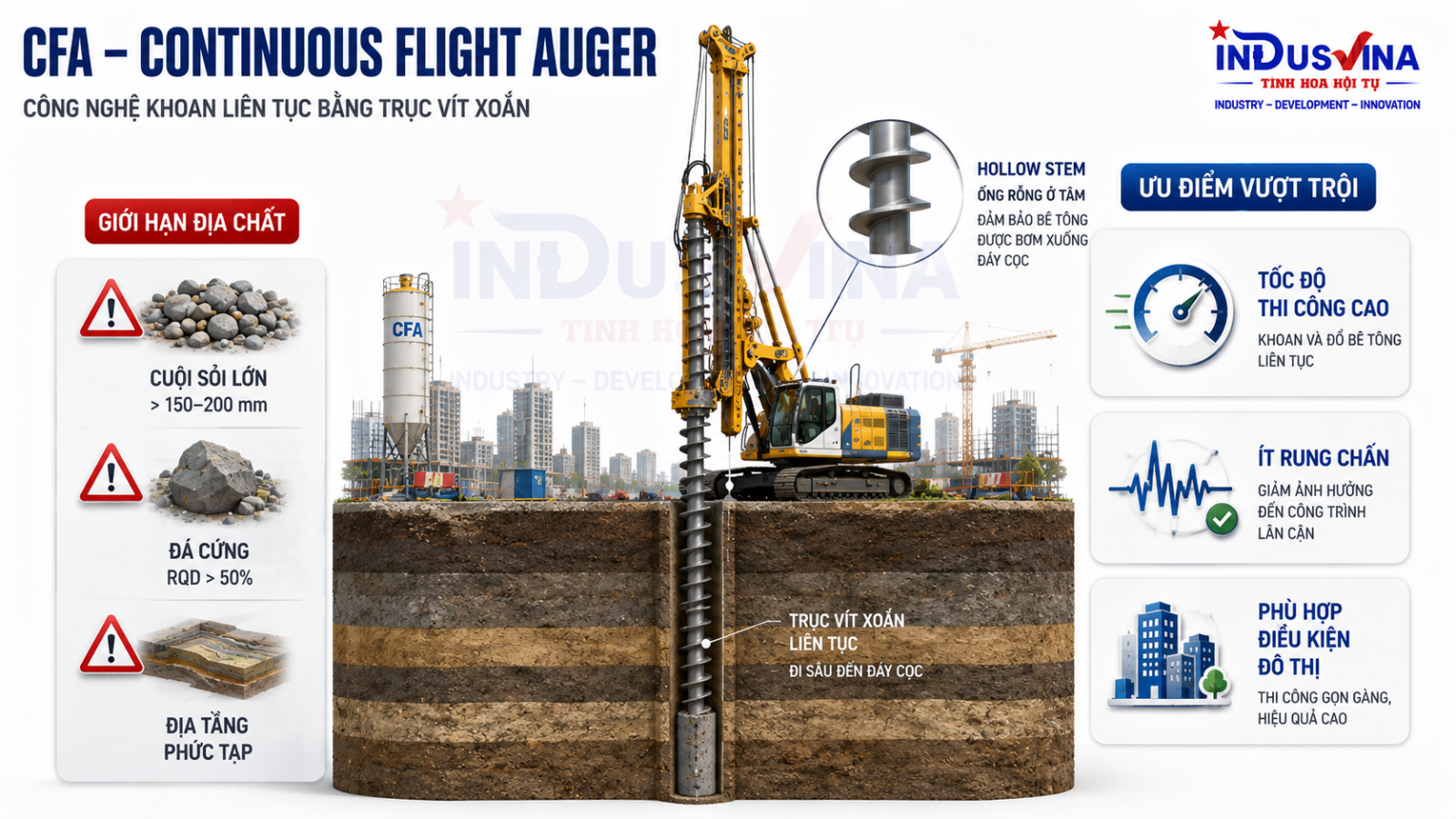
3. CFA – Continuous Flight Auger: prioritizing productivity and low vibration
CFA uses a continuous flight auger. In a typical configuration, the auger is drilled to the required depth and material is pumped through the hollow stem as the auger is withdrawn. The technology is attractive for projects requiring speed and low vibration.
Advantages
- Construction cycles can be fast in suitable ground.
- Low vibration is advantageous in urban areas.
- It does not depend on repeated bucket lifting cycles as Kelly drilling does.
Limitations
- It is not the ideal choice for large cobbles or hard rock.
- Depth and diameter are limited by the rig/auger configuration.
- Auger withdrawal rate and pumping pressure/material delivery must be controlled together.
When to consider: relatively uniform ground, high production requirements, urban environments or areas where vibration must be minimized.
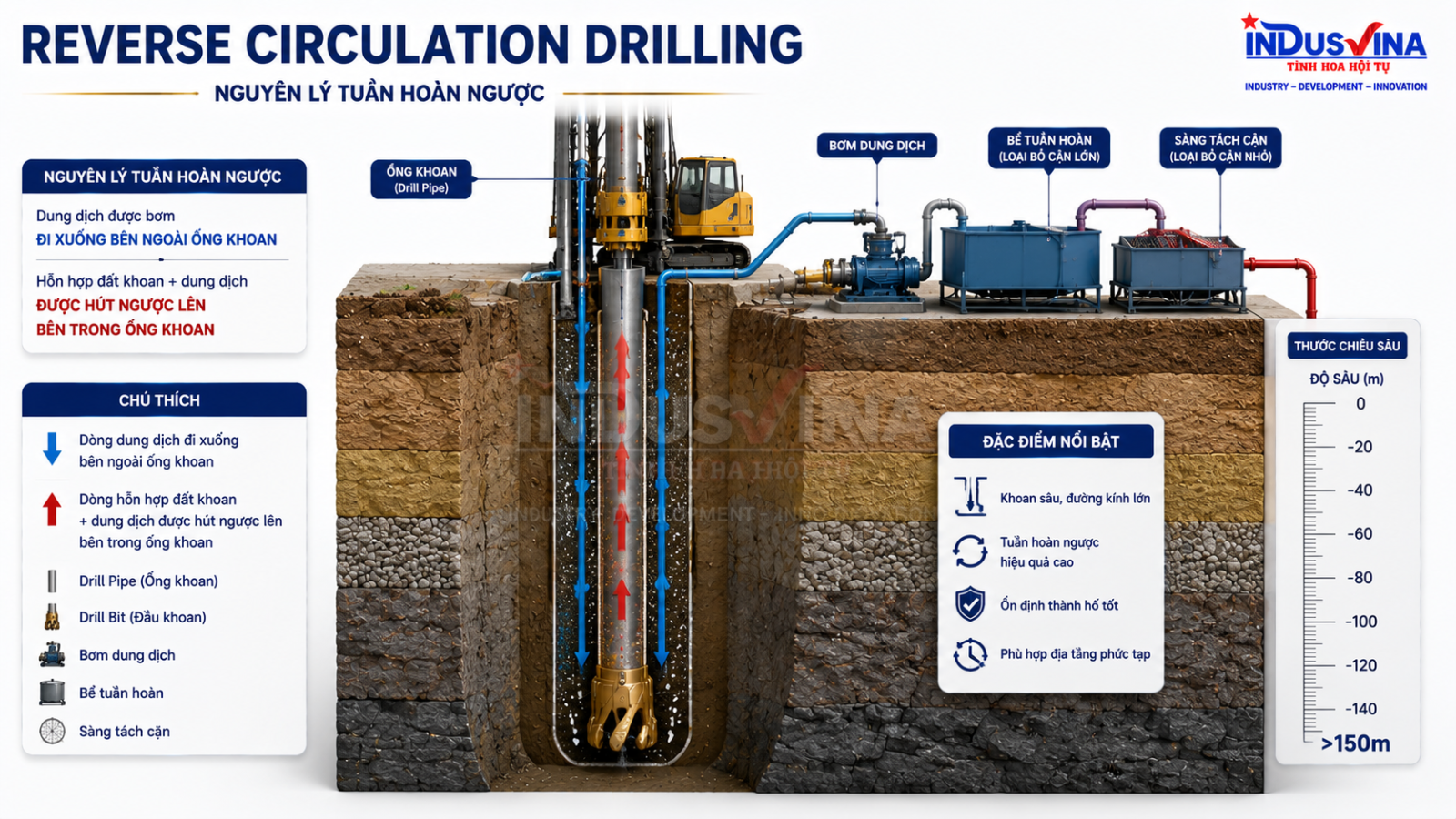
4. Reverse Circulation – an option for deep, large-diameter bores
Reverse Circulation uses a circulating flow to transport cuttings upward through the central drill pipe. Its key characteristic is continuous fluid-based removal of cuttings rather than relying only on lifting a bucket out of the bore.
Advantages
- Offers advantages for deep and large-diameter bores.
- Continuous removal of cuttings can improve efficiency in certain ground conditions.
- Suitable for certain bridge, deep-foundation and special-project applications.
Limitations
- The circulation, pumping and slurry-treatment system is more complex.
- Site space is required for tanks and circulation equipment.
- Actual efficiency depends on equipment, geology and the bore-stabilization method.
When to consider: deep piles, large diameters and projects with sufficient space and a suitable circulation system.
5. Barrette and Hydraulic Grab – when large sections and high loads are required
A barrette is a deep-foundation element with a typically rectangular or elongated cross-section, unlike a conventional circular bored pile. A Hydraulic Grab is one of the excavation tools that can be used to form panels/barrettes in suitable ground.
Advantages
- Large cross-section is advantageous for very high load demands.
- The sectional geometry can be oriented effectively with the main load direction.
- Suitable for high-rise buildings, deep foundations and special underground structures.
Limitations
- Equipment setup, slurry plant operation and panel control are more complex.
- Requires a contractor with specialized experience.
- Cost and logistics may be greater than for conventional circular bored piles.
When to consider: high loads, high-rise structures or foundation-section requirements that are no longer well served by conventional circular piles.

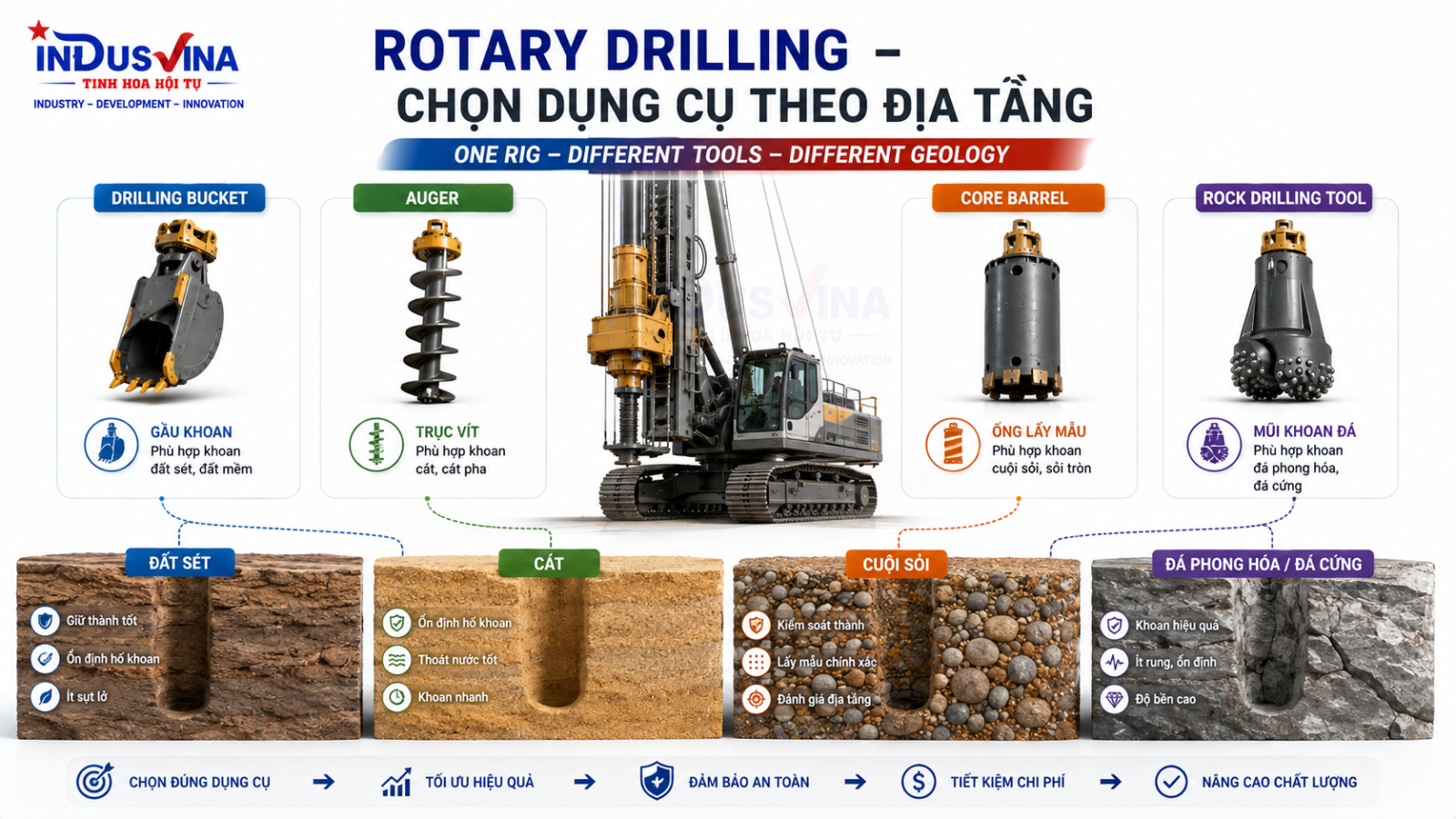
6. Rotary Drilling – matching the drilling tool to the ground
In practice, “Rotary Drilling” is a broad family of rotary drilling techniques. Performance depends heavily on selecting the right drilling tool, torque, crowd force and rig configuration. A rotary rig should therefore not be judged by its name alone; the complete tool package and the ground profile must be considered together.
Clay – cohesive soils
An auger or bucket may be suitable depending on soil condition and spoil-removal requirements.
Sand – loose soils
A drilling bucket and the bore-support system should be considered together.
Gravel and cobbles
Tools require suitable wear resistance, cutting/breaking capability and torque.
Weathered rock – hard rock
A core barrel, rock auger or specialized rock-breaking tool may be selected.
7. Quick comparison of bored pile technology groups
The table below is intended for initial screening. Actual design and construction methodology must still be based on the geotechnical information, loading, specific equipment and project requirements.
| Group | Strengths | Main limitations | Relatively suitable ground | Productivity | Typical applications |
|---|---|---|---|---|---|
| Kelly | Flexible tooling, many diameters | Bucket cycles; rig operating space required | From soft soil to hard layers with suitable tools | ●●●○○ | High-rises, bridges, common deep foundations |
| CFA | Fast, low vibration | Limited with large cobbles/hard rock | Relatively uniform ground, not too hard | ●●●●● | Urban projects, productivity-driven works |
| Reverse Circulation | Deep bores, large diameters | Complex circulation system | Depends on equipment configuration and bore-support method | ●●●●○ | Bridges, deep foundations, special projects |
| Barrette | Large section, high load capacity | Specialized construction | Assess by panel geometry, slurry system and tools | ●●○○○ | Super-tall buildings, special foundations |
| Hydraulic Grab | Efficient panel/barrette excavation in suitable conditions | Difficult in very hard layers unless the method/tool is changed | Soft to medium ground; depends on grab and system | ●●●○○ | Barrette, diaphragm wall |
| Rotary Drilling | Versatile, many tool options | Performance depends on rig/tool configuration | Broad range when tool and torque are matched correctly | ●●●○○ | Many rotary-drilled foundation types |

8. When should each technology be used?
Prioritize Kelly/Rotary with an appropriate tool package.
CFA is worth considering if ground conditions and pile dimensions are suitable.
Reverse Circulation may be an option to evaluate.
Consider barrette construction with suitable panel excavation equipment.
Compare rig envelope, logistics, vibration, noise and spoil/slurry handling.
Do not select by technology name alone; check torque, crowd force and rock tools.

9. Technology selection is only the first step – method and process determine construction quality
This article focuses on technology selection, without going deeply into ITPs, Hold Points, QA/QC checklists or the full construction documentation, in order to avoid duplicating other articles.
Once the appropriate solution group has been identified, continue with these two in-depth INDUSVINA articles:
10. FAQ – Frequently asked questions about bored pile technology
Which bored pile technology is the most common?
There is no single choice for every project. Kelly/rotary bored piling is widely used because of its flexibility; CFA is preferred on some projects requiring high productivity and low vibration; other solutions suit deep, large or heavily loaded foundations.
Are Kelly Drilling and Rotary Drilling completely different technologies?
Not completely. Kelly Drilling is commonly considered a configuration within the rotary bored piling family. In this article the two names are separated to help readers understand the Kelly configuration and the broader tool-selection logic of rotary drilling.
When should CFA be used?
CFA is worth considering when ground conditions are suitable and the project requires high productivity and low vibration. If large cobbles, hard rock or requirements beyond the rig/auger capability are encountered, another solution should be evaluated.
What types of projects suit Reverse Circulation?
This method is often considered for deep, large-diameter bores and projects where a suitable circulation system can be organized.
How does a barrette differ from a circular bored pile?
The clearest difference is cross-sectional geometry. A barrette is usually rectangular or elongated and can suit high loads, high-rise structures and special foundations.
Is a Hydraulic Grab a type of pile?
No. A Hydraulic Grab is an excavation tool commonly used for diaphragm wall or barrette panels. It is therefore important to distinguish the type of foundation element from the equipment used to create the excavation.
Can technology be selected based only on pile depth and diameter?
No. Ground conditions, groundwater, site constraints, adjacent structures, productivity, equipment availability, drilling tools and bore-stabilization measures should all be considered together.
Which technology should be selected when hard rock is present?
The deciding factor is not only the technology name but the capability of the rig and rock-cutting/breaking tools: torque, crowd force, core barrel, rock auger or specialized tooling. The geotechnical profile must be checked against the actual equipment capability.
11. Conclusion
Selecting bored pile technology requires balancing ground conditions – pile geometry – depth – equipment – site constraints – schedule – cost and risk. Kelly, CFA, Reverse Circulation, Barrette, Hydraulic Grab and Rotary Drilling each have their own suitable application range.
Connect with INDUSVINA
INDUSVINA is ready to discuss foundation solutions, construction, MEP, MRO, technical supply and export with customers and partners.
Selecting bored pile construction technology: Comparison of advantages, disadvantages and application conditions.
Selecting the right technology from the outset helps a project better control ground conditions, depth, productivity, site constraints and construction risks.


