


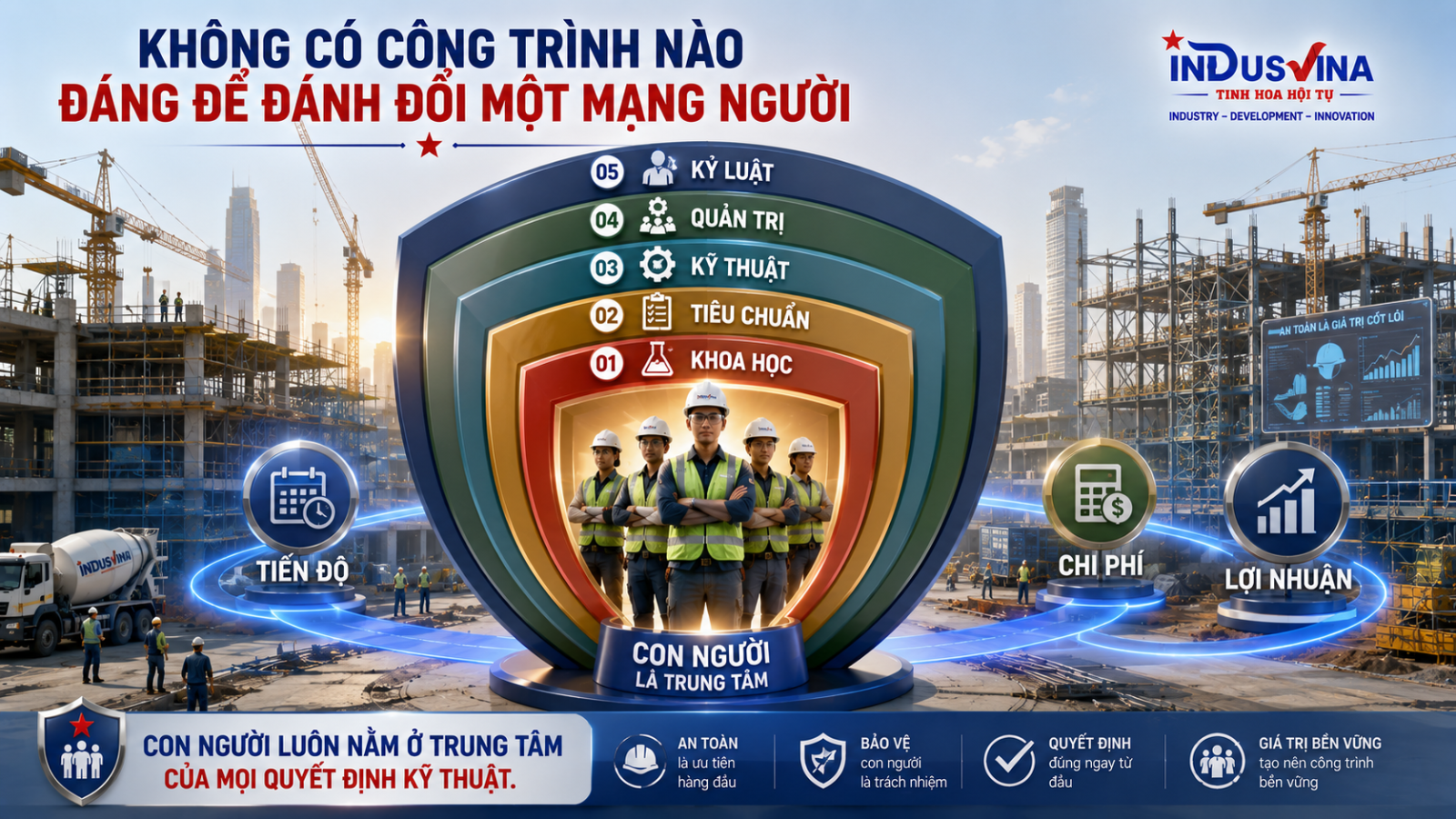
HSE exists because the laws of nature make no exceptions
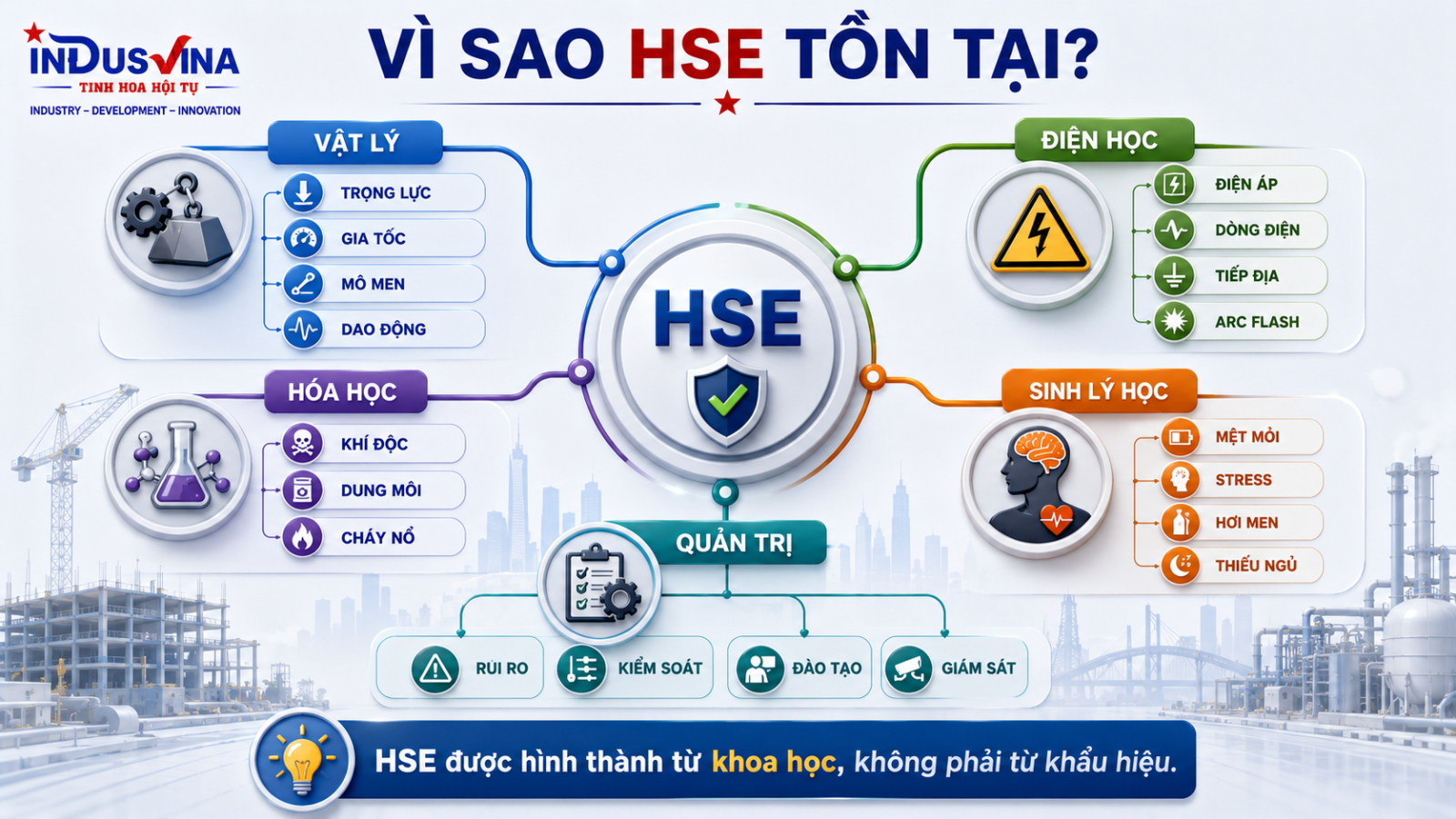
A company engaged in construction, transport infrastructure, MEP, and MRO cannot treat HSE as a secondary part of project documentation. A worksite simultaneously contains gravitational energy, electricity, pressure, heat, rotating motion, lifting loads, chemicals, noise, vibration, dust, toxic gases, and the physiological limits of people. If just one energy source becomes uncontrolled, the consequences can occur within fractions of a second.
Loads and stability
Dead load, live load, wind load, impact load, overturning moment, compression-member buckling, ground bearing capacity, and temporary-structure deformation.
Voltage and current
Touch voltage, step voltage, leakage current, arc flash, grounding, lightning protection, and energy isolation through LOTO.
Physiological limits
Fatigue, sleep deprivation, alcohol impairment, medication that affects reaction time, heat stress, and errors caused by schedule pressure.
Legal and standards framework
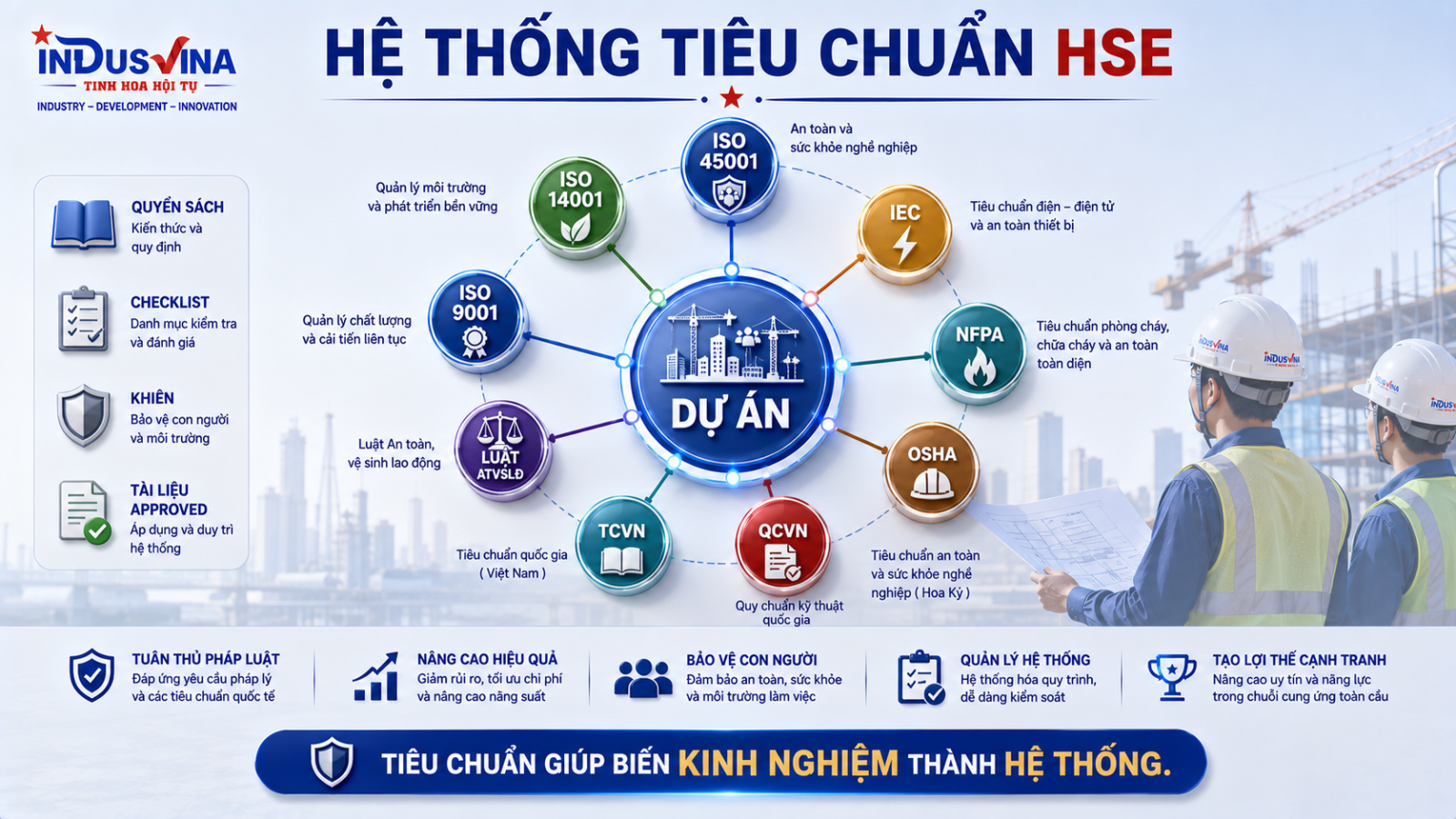
Law establishes minimum obligations; management standards help organize the system; technical regulations impose mandatory requirements; and design standards and manufacturer instructions provide calculation data. An HSE measure is meaningful only when the governing document, acceptance criterion, approver, and supporting evidence are clearly identified.
| Framework | Role | Application |
|---|---|---|
| Law on Occupational Safety and Health | Rights, duties, prevention, training, reporting, and investigation. | Assignment of responsibilities, training records, equipment control, and incident reporting. |
| ISO 45001 | An occupational health and safety management system based on risk thinking. | Planning, operation, evaluation, and continual improvement. |
| ISO 14001 | Management of environmental aspects and compliance obligations. | Dust, noise, wastewater, waste, chemicals, and spills. |
| QCVN/TCVN | Technical requirements for construction, electrical work, lifting equipment, fire safety, and the environment. | Cite the standard number and clause in method statements, ITPs, checklists, and acceptance records. |
| OSHA, NFPA, IEC | International references or additional contractual requirements. | Arc flash, LOTO, confined spaces, clearances, and fire protection. |
When preparing project documents, verify the current edition and mandatory scope. Do not list standards for appearance only; each standard must be linked to a control criterion.
Engineering analysis: never replace calculation with experience
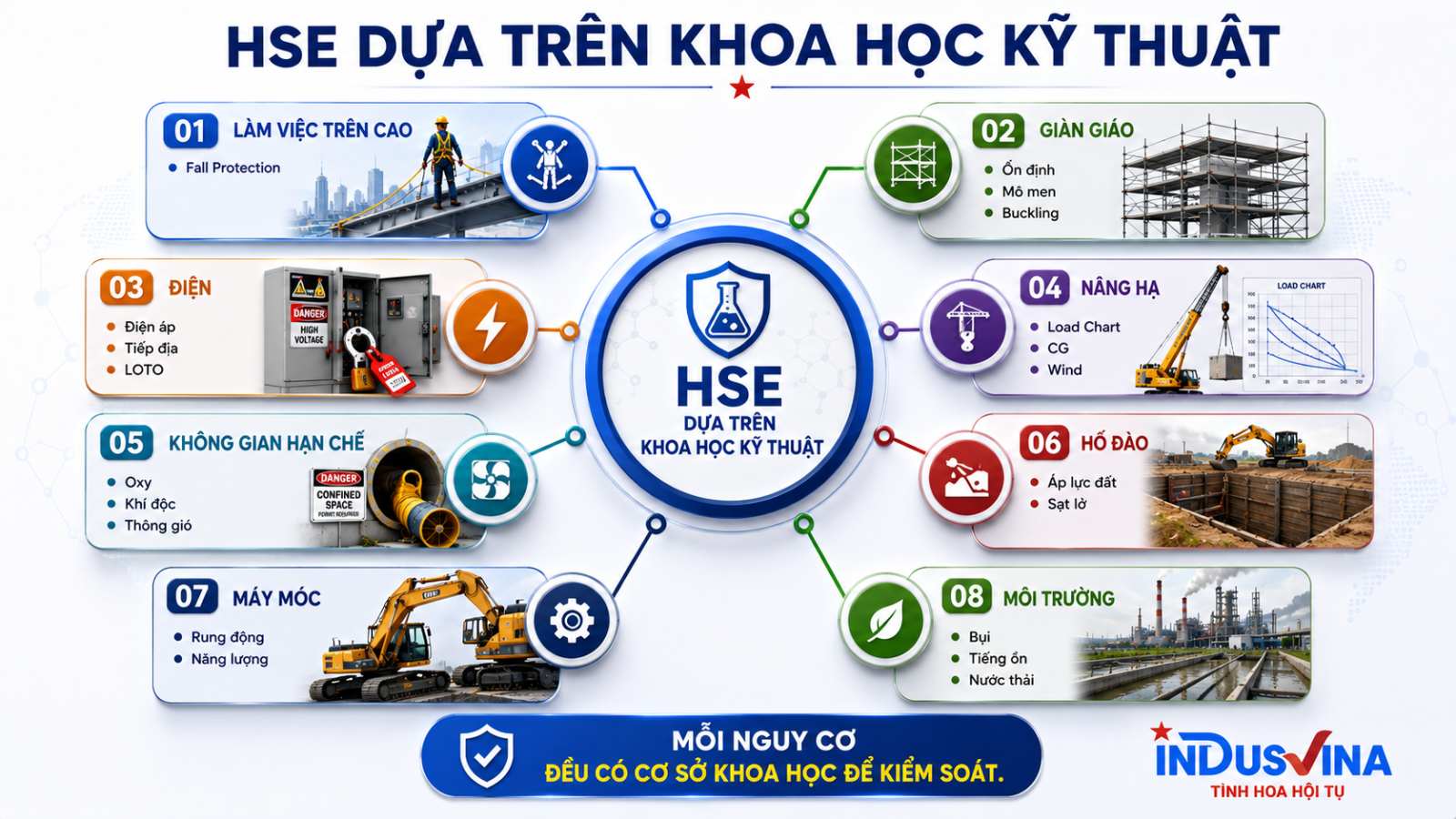
Scaffolding, falsework, and temporary structures
Temporary structures often carry load under unfavorable conditions: concentrated loads, concrete that has not reached strength, waterlogged ground, incomplete connections, and loads that change with the sequence of work. The documents must demonstrate the load path from the working platform through the support system to the foundation and anchor points.
- Loads: self-weight, personnel, materials, equipment, fresh concrete, dynamic loads, and adverse load cases.
- Stability: slenderness, diagonal bracing, connections, differential settlement, and overall instability.
- Supporting ground: bearing capacity, drainage, sole plates, and distance from excavations.
- Changes: do not remove bracing, alter support spacing, or add stored materials without authorization.
Work at height
A fall-arrest system must control the anchor point, free-fall distance, energy-absorber extension, clearance below, and swing-fall impact risk.
Lifting operations
Lifting capacity must be checked against the correct load chart for radius, boom length, counterweight, outriggers, ground conditions, and wind limits. With multi-leg slings, leg tension rises rapidly as the angle to the horizontal decreases.
Excavations
Control earth pressure, groundwater, surcharge loads, vibration, shoring, drainage, access and egress, displacement monitoring, and exclusion zones near the excavation edge.
Electricity, grounding, and arc flash
Protective design must combine suitable RCD/ELCB devices, grounding, equipotential bonding, guarding, safe clearances, and LOTO. High-power switchboards must also be assessed for arc-flash risk.
Confined spaces
Isolate all energy sources, conduct pre-entry and continuous gas testing, provide ventilation, assign an attendant, maintain communication, issue a permit, and prepare rescue equipment. Do not allow an unplanned rescuer to become the next victim.
The cost of safety and the cost of unsafe work
PPE, training, inspection, temporary-structure design, sensors, gas testing, monitoring, and supervision are visible costs in the budget. Accident costs often emerge only after an incident and are spread across many departments, so they are easily underestimated.
Prevention costs
- Surveys, HIRA/JSA, and method design.
- Training, toolbox talks, and rescue drills.
- PPE, guardrails, lifelines, and compliant scaffolding.
- Inspection, gas testing, monitoring, and supervision.
Can be planned and builds long-term capability.
Unsafe-work costs
- Emergency response, medical treatment, compensation, and insurance.
- Work stoppage, investigation, remediation, and remobilization.
- Damage to equipment, structures, and the environment.
- Contract penalties, disputes, and reputational loss.
Can exceed contingency allowances and cause irreversible loss.
For fatality or catastrophic risks, decisions must not be based on return on investment alone. Legal requirements, the ALARP principle, and ethical limits are binding conditions.

Lessons learned from the Can Tho Bridge incident
On September 26, 2007, two approach spans under construction at the Can Tho Bridge collapsed. According to a memorial article published by Thanh Nien, the incident caused 55 fatalities and 80 injuries. VnExpress reported the same figures in its coverage of the tenth-anniversary memorial.
According to the findings of the State Investigation Committee reported by the press in 2008, differential settlement of the upstream T13U temporary-pier foundation cap was identified as the initiating cause; the differential settlement increased internal forces, damaged connections, caused elements of the temporary pier to lose stability, and led to collapse of the structure above.
Facts reported by public sources
- Time of the incident: the morning of September 26, 2007.
- Casualties reported by multiple reputable sources: 55 fatalities and 80 injuries.
- The investigation findings published in 2008 identified differential settlement of the T13U temporary-pier foundation cap as the initiating cause.
- The loss-of-stability process involved increased internal forces, connection damage, and instability of the temporary-pier system.
HSE lessons that may be drawn
- Temporary structures must be designed, independently checked, accepted, and managed as genuine load-bearing systems throughout the period in which they carry load.
- Assumptions about foundations, settlement, loads, and construction sequence must be verified through investigation, calculation, and monitoring.
- Alert thresholds, hold points, and stop-work criteria must be established for abnormal displacement or deformation.
- Management of change must be applied whenever site conditions differ from the design documents or approved method statement.
- Stop Work Authority must be explicit and independent of rank or schedule pressure.
A learning framework, not a basis for assigning blame
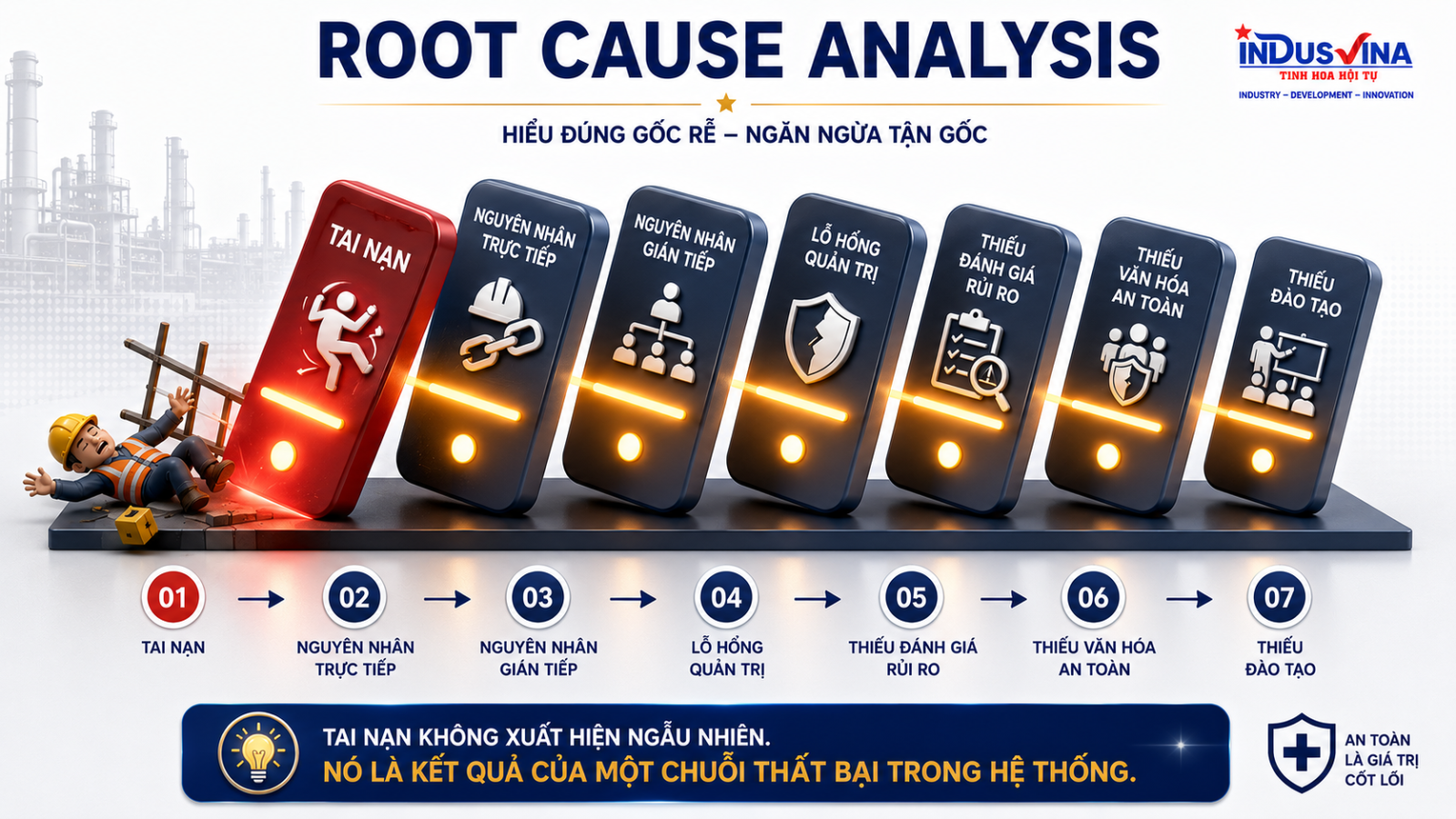
This approach avoids stopping at general comments such as “complacency” or “lack of care.” The purpose of RCA is to turn lessons into actionable requirements: independent calculations, ground verification, settlement and displacement monitoring, load control, change approval, defined hold points, and clear authority to decide whether work may continue.
References for casualty figures and reported findings
- Thanh Nien – “Commemorating 10 years since the Can Tho Bridge approach-span collapse”: reports the incident date, 55 fatalities, and 80 injuries.
- VnExpress – “Nearly 50 engineers commemorate victims of the Can Tho Bridge collapse”: reports 55 deaths and 80 injuries.
- VnExpress – “Investigation findings on the Can Tho Bridge incident announced”: reports the announcement of the State Investigation Committee’s findings.
- Nong Nghiep va Moi Truong – “Findings on the Can Tho Bridge collapse announced”: identifies differential settlement of the T13U temporary-pier foundation cap as the principal initiating cause.
- Tuoi Tre – “Investigation results for the collapse of two Can Tho Bridge approach spans”: describes differential settlement, bracing damage, and instability of the temporary pier.
Sources accessed July 30, 2026. Before publishing or updating the article, INDUSVINA should recheck the accessibility and content of each link.
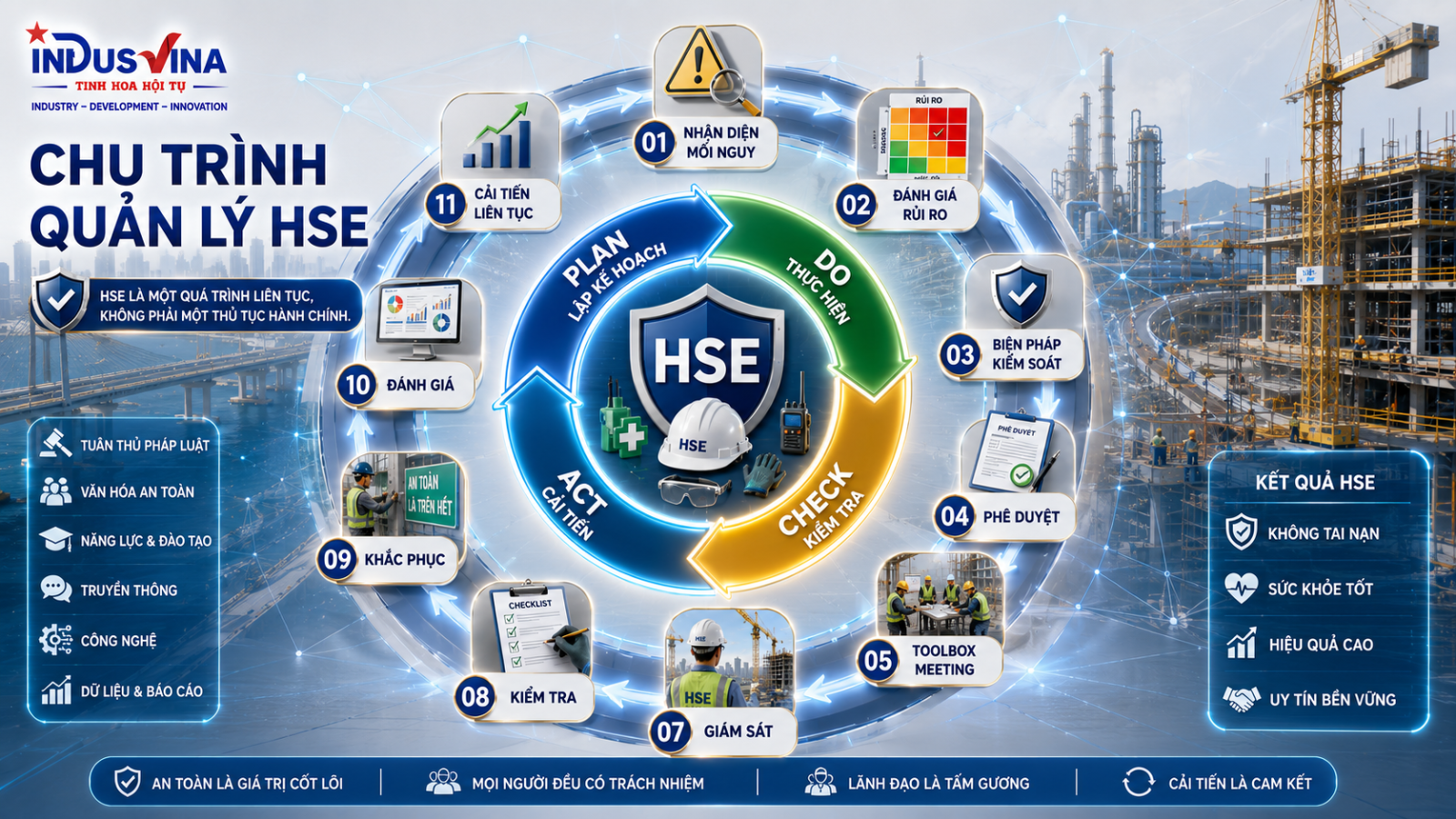
Control cycle and hierarchy of solutions
Before work
- Survey and input data.
- HIRA/JSA, method statement, and rescue plan.
- Verify people, equipment, and materials.
- Permit to Work and Hold Points.
During work
- A toolbox talk specific to the task.
- Monitor loads, wind, and conditions.
- LOTO, exclusion zones, and spotters.
- Stop Work when conditions change.
After work
- Restore energy and the work area safely.
- Close permits and retain evidence.
- Near misses, NCRs, and lessons learned.
- CAPA and effectiveness verification.
Hierarchy of Controls
- Eliminate the hazard.
- Substitute with a less hazardous option.
- Engineering controls: guardrails, interlocks, guarding, local exhaust, bracing, RCDs, and sensors.
- Administrative controls: procedures, permits, training, and supervision.
- PPE: the final layer of protection, not a substitute for safe design.
HSE technology: measurable, alertable, and traceable
BIM/Digital Twin
Simulate sequence, hazardous zones, clashes, and access.
IoT/sensors
Monitor settlement, tilt, vibration, gases, dust, noise, and machine condition.
AI Camera
Detect exclusion-zone intrusion, missing PPE, smoke, or fire; human verification is always required.
e-PTW/QR
Control permits, approvers, validity periods, locations, and change history.
Wearable
Alert for falls, hazardous zones, or heat stress.
Drone
Inspect roofs, bridges, long routes, and difficult-to-access areas.
Gas testing
Measure oxygen, flammable gases, and toxic gases before and during work.
Dashboard
Track leading indicators, near misses, CAPA, and risk trends.
People, health, and operational discipline
A person affected by alcohol, sleep deprivation, medication that slows reaction time, or inadequate health is not facing only a personal risk. In lifting, electrical work, machinery operation, or work at height, one person’s error can transmit consequences to the entire crew.
Pre-shift conditions
- Fit for work and competent.
- No alcohol impairment or cognition-reducing substances.
- No signs of severe fatigue.
- Trained and understands Stop Work Authority.
- Appropriate PPE has been inspected.
Discipline at every level
- No exemptions for managers or familiar crews.
- Do not use schedule pressure to justify unsafe conditions.
- No “temporary workaround” without controls.
- Decision-makers must remain accountable.
- People who report hazards must be protected.
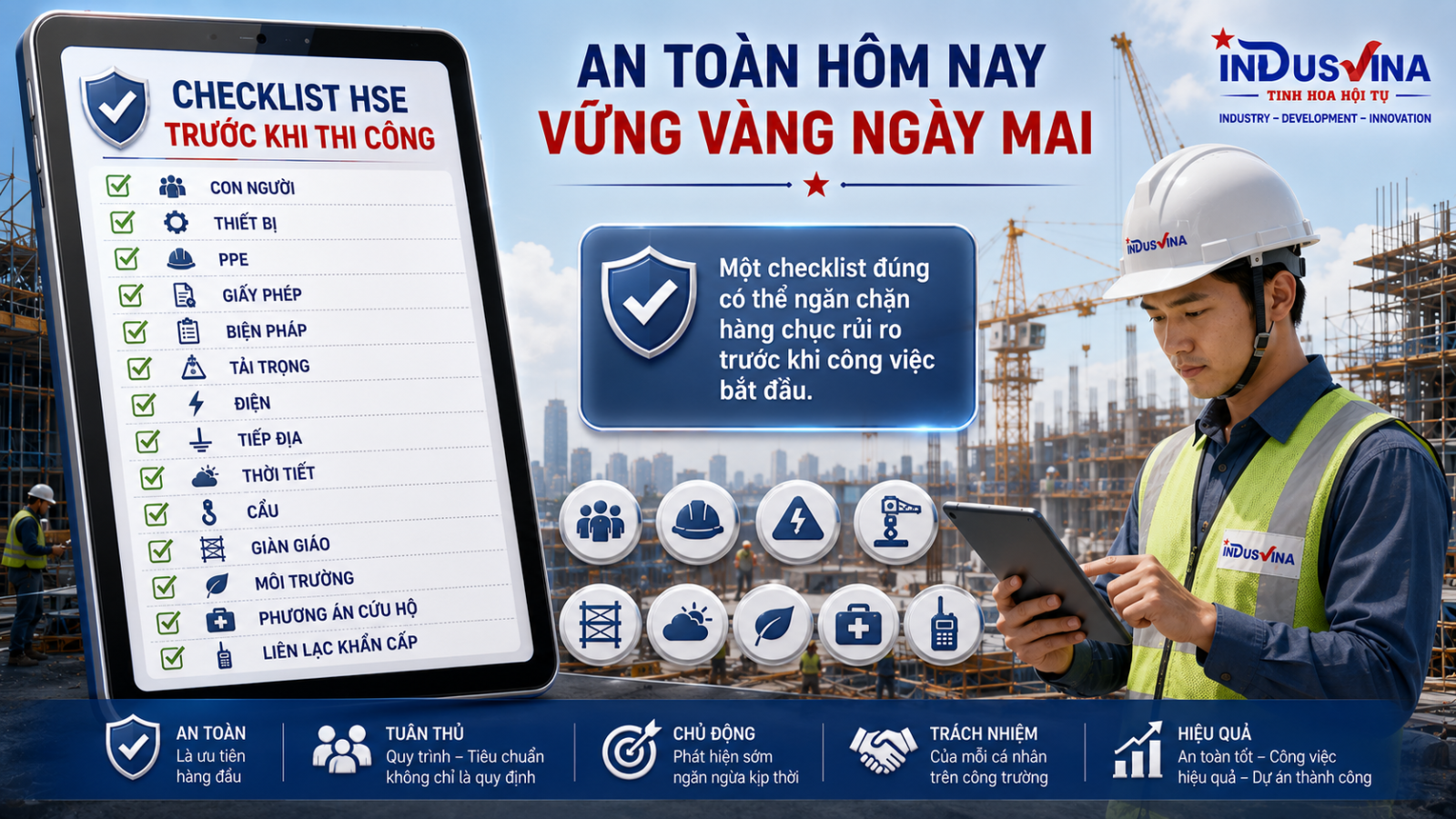
Pre-work HSE checklist
- Scope and responsibility boundaries are clear.
- Drawings, method statements, and calculations are approved.
- HIRA/JSA reflects actual site conditions.
- The permit is valid and applies to the correct location.
- Personnel are medically fit, trained, and certified.
- No person is impaired by alcohol or lack of alertness.
- Equipment has been inspected, maintained, and checked before the shift.
- Loads, radius, ground conditions, and wind limits are confirmed.
- Scaffolding, falsework, bracing, and anchors meet requirements.
- Electrical supply, grounding, and LOTO are suitable.
- Confined spaces have been gas-tested and a rescue plan is ready.
- Excavations have collapse protection, drainage, and safe access.
- Hazardous zones are isolated and attended.
- PPE is the correct type and size and remains in good condition.
- Weather, water, tide, and traffic conditions are acceptable.
- Rescue arrangements and communication are ready.
- Dust, noise, wastewater, and waste are controlled.
- Hold points and Stop Work Authority are agreed.
INDUSVINA’s HSE perspective
Across a career involving projects from Kien Luong–Kien Giang, Vung Tau, and Cape Ca Mau to Khanh Hoa, Da Nang, Buon Ma Thuot, and Hanoi, the value lies not only in completed works but also in everyone being able to return home safely after each working day.
INDUSVINA does not regard the absence of a fatal accident as a reason for complacency. It is a responsibility that must be sustained through inspection, calculation, workforce discipline, control of construction conditions, and Stop Work Authority.

Related articles and services
FAQ – Frequently asked questions
How is HSE different from a safety inspection?
Why is PPE not the first solution?
Must temporary structures be calculated?
Does technology automatically make a worksite safer?
When must work be stopped?
Connect with INDUSVINA
Discuss construction, infrastructure, MEP, MRO, method statements, engineering control, and HSE systems tailored to project requirements.


