


Incoterms® 2020 – Understanding Correctly to Avoid Real Losses in Import–Export
Incoterms® 2020 is not just a few abbreviations such as EXW, FOB, CIF or DDP. It is a rule system that helps businesses clearly define delivery obligations, costs, insurance, customs procedures and the point of risk transfer in international trade.

1. What is Incoterms® 2020?
Incoterms® is a set of international trade rules issued by the ICC and widely used in cross-border sales contracts.
Incoterms helps both parties clearly define:
- Place of delivery.
- Point of risk transfer.
- Transport, loading/unloading and insurance costs.
- Responsibility for export and import customs clearance.
- The role of seller and buyer in the logistics chain.
2. Why can misunderstanding Incoterms cause real financial losses?
A company may sign a contract marked CIF and assume that the seller is responsible for everything until the destination port. But under CIF, although the seller pays freight and buys insurance, risk usually transfers once the goods are loaded on board at the port of shipment.
If cargo is damaged or lost during ocean transport, who bears the loss depends on the risk transfer point, the insurance terms and how the contract is written.
3. Classification of the 11 Incoterms® 2020 rules
Rules for any mode of transport
EXW, FCA, CPT, CIP, DAP, DPU, DDP
Applicable to road, sea, air, rail or multimodal transport.
Rules for sea and inland waterway transport only
FAS, FOB, CFR, CIF
Suitable when goods are delivered directly on board or alongside the vessel at the port.
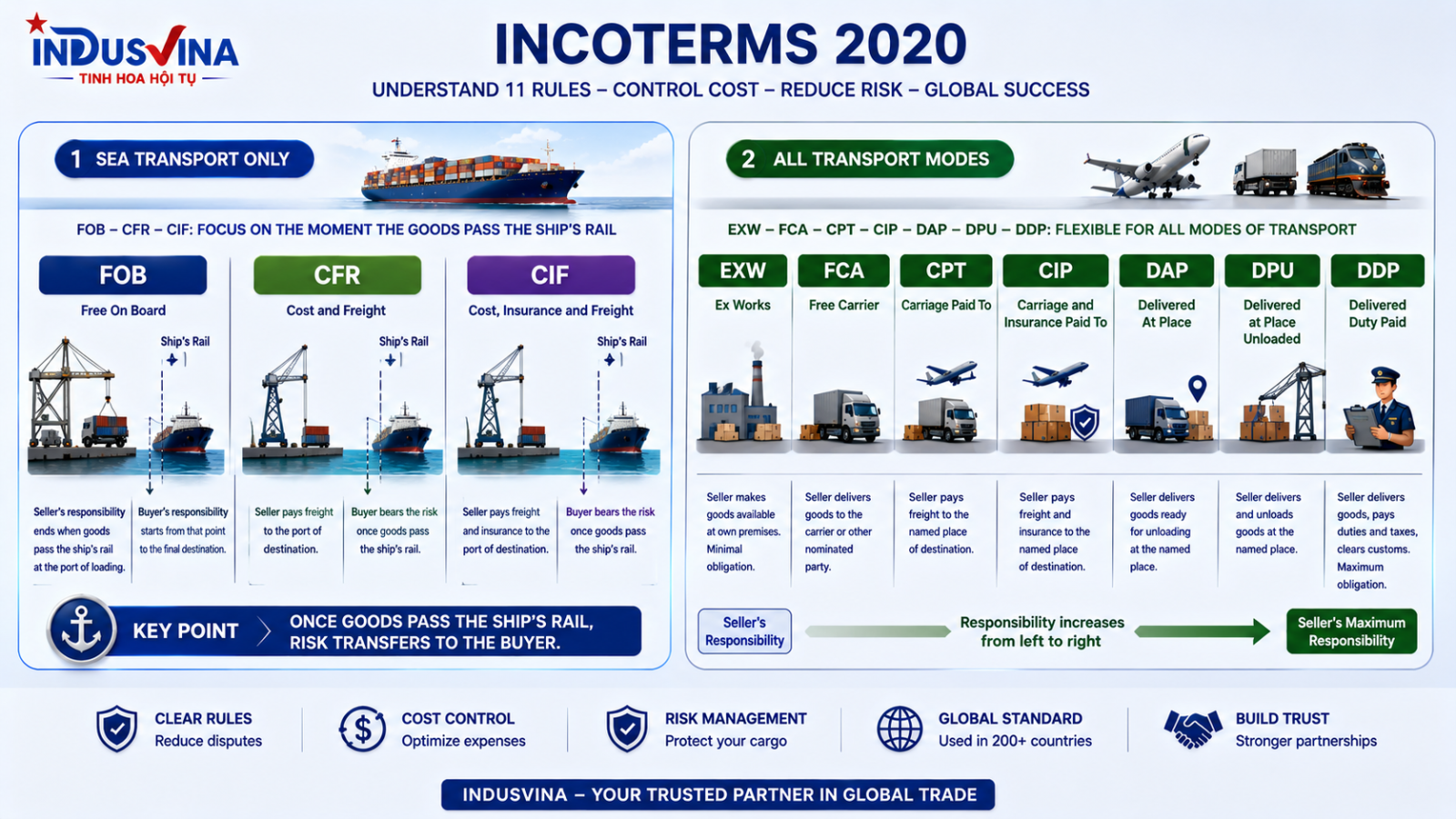
4. Summary table of commonly used rules
| Rule | Nature | Key note |
|---|---|---|
| EXW | The seller delivers the goods at its own premises. | The buyer bears almost all transport, risk and procedures. |
| FCA | The seller delivers the goods to the carrier at the agreed place. | Often more suitable than FOB in many container transactions. |
| FOB | The seller delivers once the goods are loaded on board at the port of shipment. | Often misused for container cargo. |
| CFR | The seller pays freight to the destination port. | Risk still transfers at the port of shipment once goods are on board. |
| CIF | The seller pays freight and buys minimum insurance. | It does not mean the seller bears all risks until the destination port. |
| CIP | The seller pays carriage and buys higher-level insurance. | The insurance level and coverage must be clearly stated. |
| DAP | The seller delivers at destination, not unloaded. | The buyer usually handles import clearance and pays import duties. |
| DPU | The seller delivers at destination and unloads the goods. | Unloading costs and lifting equipment must be carefully calculated. |
| DDP | The seller delivers after import clearance. | Very high legal risk if the seller does not understand the import country’s laws. |
5. The point of risk transfer is the backbone of Incoterms
The point of risk transfer is the moment when the risk of loss or damage to the goods transfers from the seller to the buyer.
This point does not always coincide with the place to which the seller pays freight. This is the biggest source of misunderstanding in practice.
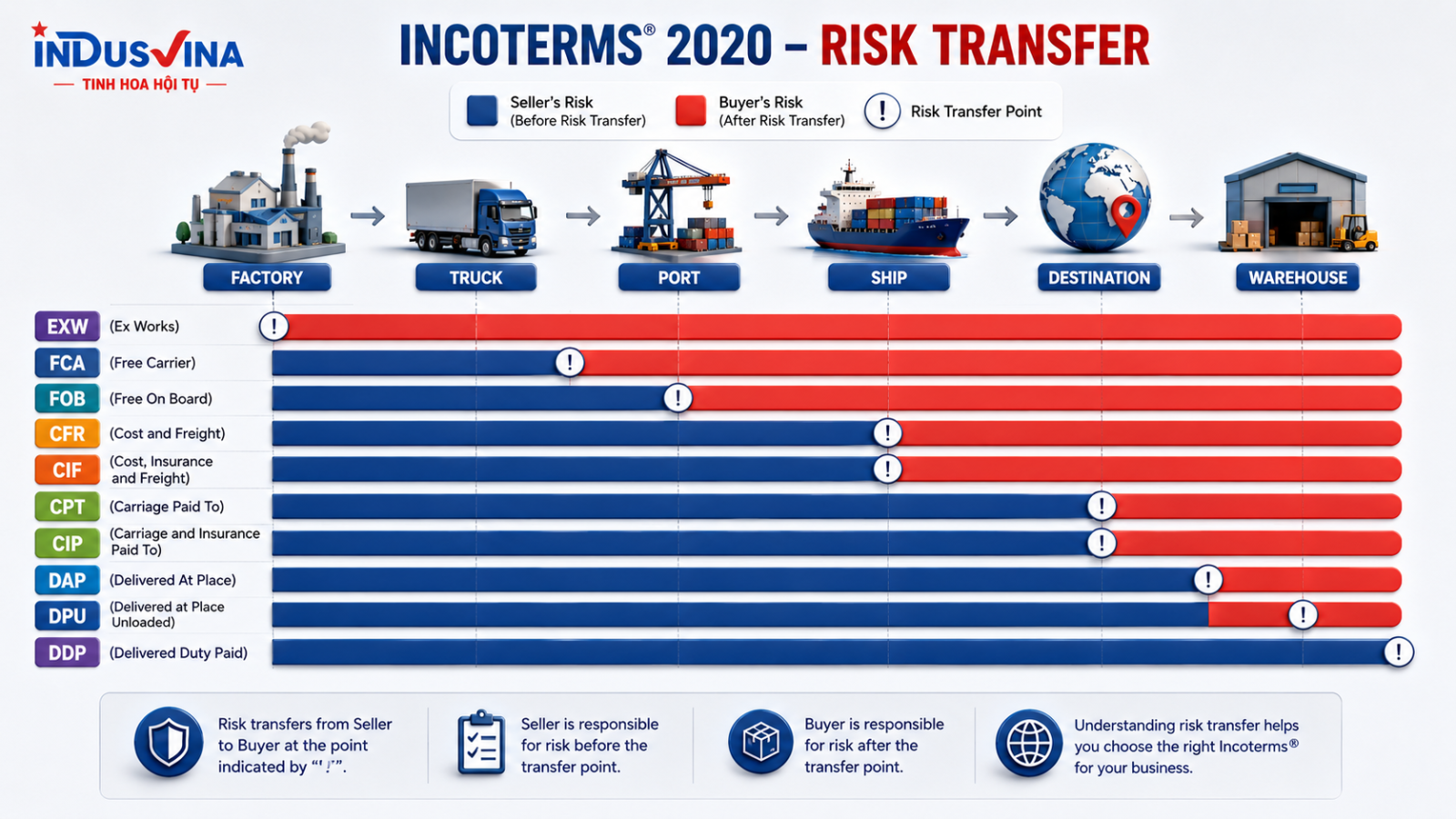
6. CIF, FOB, EXW and DDP – four rules commonly misunderstood
EXW
The seller delivers at its premises. The buyer bears most responsibilities very early. It should not be used mechanically if the buyer cannot control logistics in the export country.
FOB
Popular but often misused for container cargo. For container shipments, FCA is often more appropriate in many cases.
CIF
The seller pays freight and buys insurance, but risk does not transfer at the destination port. The insurance level must be clearly stated.
DDP
The seller bears the greatest responsibility. Taxes, import clearance, permits, technical standards and buyer-country laws must be understood.
7. Common mistakes when writing Incoterms in contracts
- Not specifying the version: Incoterms® 2020.
- Writing an insufficiently specific delivery place.
- Confusing freight payer with risk bearer.
- Not clearly allocating local charges at origin and destination ports.
- Not checking insurance terms.
- Using FOB for container cargo without considering FCA.
- Accepting DDP without the capability to handle import procedures in the buyer’s country.
8. Checklist before signing an import–export contract
Mandatory information
- Incoterms rule.
- Incoterms® 2020 version.
- Specific delivery place.
- Port of shipment, destination port or delivery address.
Risk and costs
- Point of risk transfer.
- Who pays main carriage.
- Who buys insurance.
- Who bears local charges.
Customs and documents
- Who handles export clearance.
- Who handles import clearance.
- Who pays import duties.
- Required document set.
Payment and disputes
- Payment terms.
- Timing of document transfer.
- Applicable law.
- Dispute resolution mechanism.
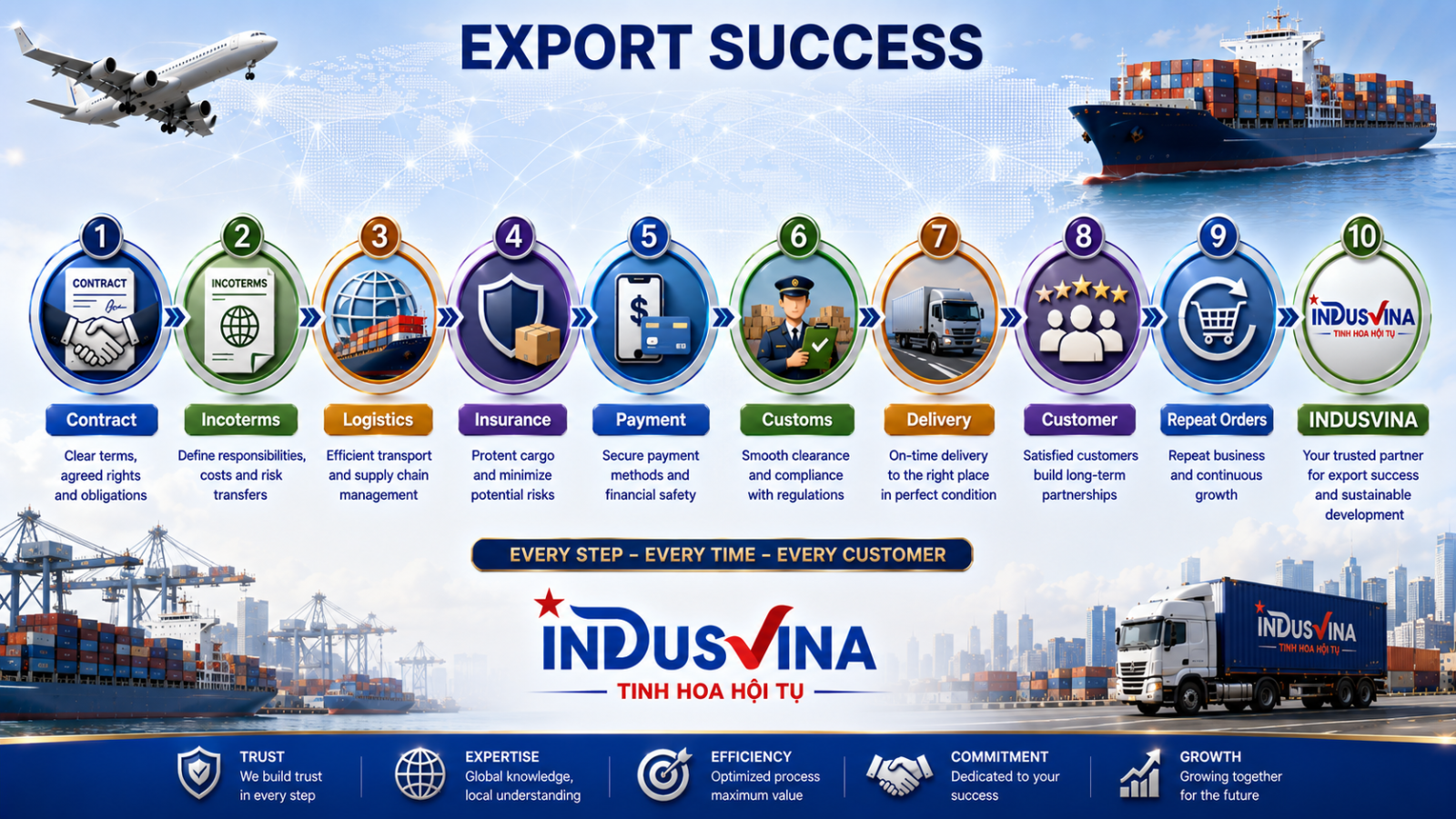
9. INDUSVINA’s perspective
In import–export, Incoterms is not merely a delivery term. It is a tool for businesses to choose their position in the supply chain.
To control the carrier, businesses must understand FCA, CPT and CIP. To reduce legal risk, they must be very cautious with DDP. To protect profit, they must calculate freight, insurance, local charges and cash flow correctly.
10. Conclusion
- Incoterms® 2020 helps allocate obligations between seller and buyer.
- The point of risk transfer is the most important concept to understand correctly.
- CIF does not mean the seller bears all risks until the destination port.
- DDP should not be used without understanding the buyer-country import laws.
- The contract must clearly state version, place, insurance, local charges and documents.
Related articles
FAQ – Frequently asked questions about Incoterms® 2020
Must Incoterms® 2020 be written in the contract?
If both parties want to apply Incoterms, they should clearly state the rule, place and version, for example: FOB Hai Phong Port – Incoterms® 2020.
Does CIF mean the seller bears all risks until the destination port?
No. Under CIF, the seller pays freight and buys insurance, but risk usually transfers once the goods are loaded on board at the port of shipment.
Is FOB suitable for container cargo?
FOB is still widely used in practice, but for container cargo, FCA is often more suitable because the actual delivery point is usually a depot, ICD or terminal.
Is DDP the best rule for the buyer?
DDP is convenient for the buyer but creates very high risk for the seller if the seller does not understand import laws, taxes, permits and standards in the buyer’s country.
What should a business check before choosing Incoterms?
It should check the delivery point, risk transfer point, transport cost, insurance, local charges, customs, import duties, documents and payment terms.
Connect with INDUSVINA
INDUSVINA supports businesses in export, sourcing, logistics, MRO, construction, technical supply and supply chain connection.
0979 823 639
info@indusvina.com
www.indusvina.com
Ho Chi Minh City, Vietnam


