


I. What is an ITP?
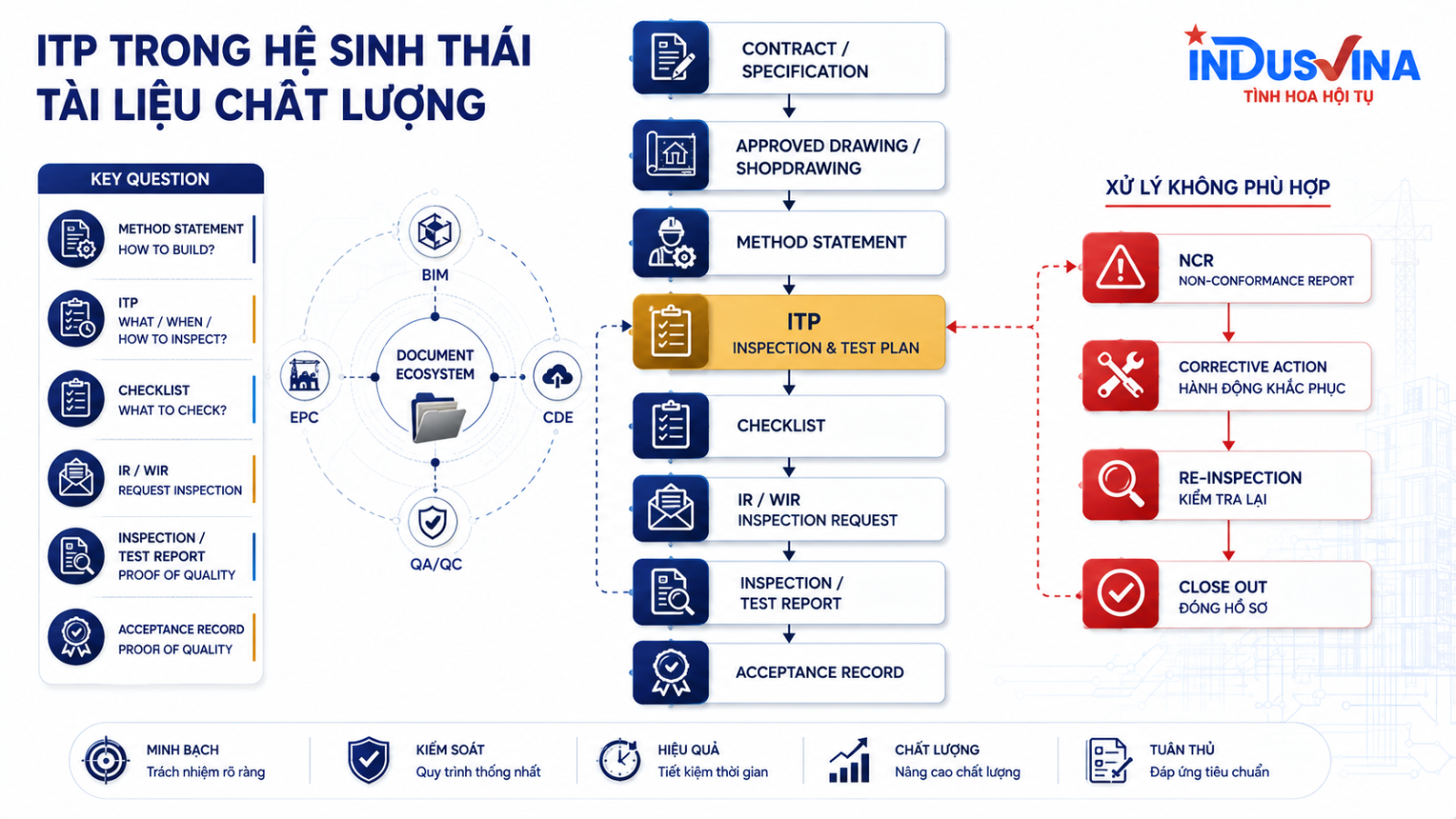
ITP – Inspection and Test Plan is an inspection and testing plan used to control the quality of a work activity, item, or system throughout construction. An ITP clearly defines what must be inspected, which documents provide the reference basis, the inspection or test method, acceptance criteria, frequency, control-point type, participating parties, and records to be retained.
In short: Method Statement answers “how to build?”, while an ITP answers “what to inspect – when – against which criteria – who verifies it – what evidence must be retained?”.

II. Why is an ITP the “quality-control map” of a construction site?
Inspect at the right time
Do not wait until the end of the work to discover errors; inspection points are placed immediately before steps that may conceal the work or make correction difficult.
Prevent error propagation
A small error in reinforcement, materials, welds, or installation parameters can significantly reduce rework cost and schedule delay when detected early.
Trace responsibilities
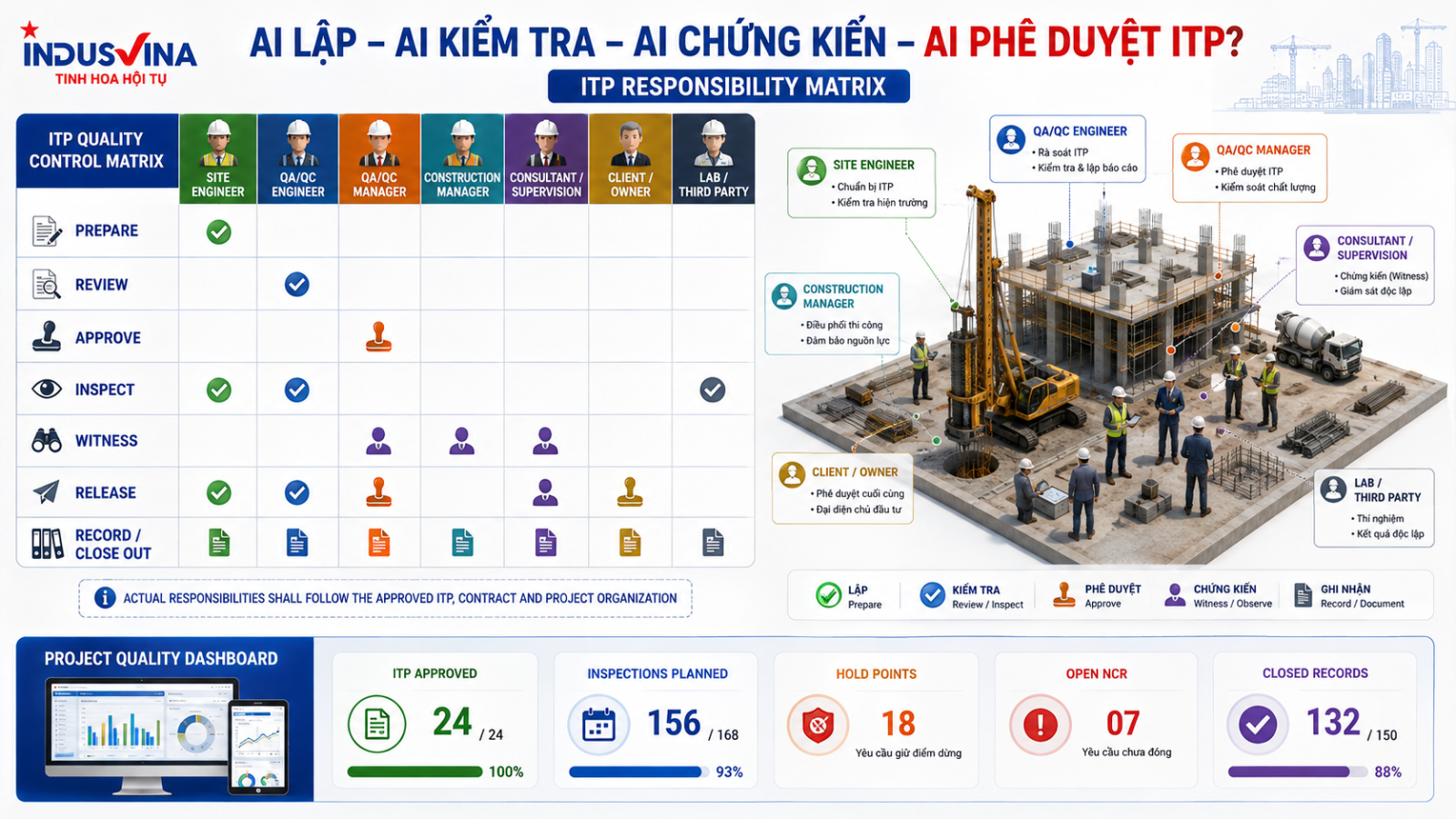
The ITP clarifies who prepares, who inspects, who witnesses, who approves/releases, and what evidence proves that the work has been accepted.
An effective ITP does not slow down site work. On the contrary, it helps the work progress through controlled stages, reduces subjective disputes, and creates a common language among contractors, consultants, clients/owners, laboratories, and third parties.
III. What does an ITP include?
1. Activity / Work Step
Describes each work step that requires inspection or testing.
2. Reference Document
Contract, specification, drawing, shop drawing, applicable standards, and approved Method Statement.
3. Inspection / Test Method
Visual inspection, measurement, field test, laboratory test, NDT, functional test, or document review.
4. Acceptance Criteria
Specific pass/fail conditions used to determine whether the work is acceptable.
5. Frequency
By component, lot, batch, shift, length, quantity, or defined milestone.
6. H / W / R Point
Defines Hold, Witness, Review, or other checkpoint types in accordance with project requirements.
7. Responsibility
Defines who prepares, inspects, witnesses, reviews, approves/releases, and retains the records.
8. Quality Record
Checklist, inspection request, acceptance record, test report, certificate, photographs, and close-out records.

IV. What are Hold Point, Witness Point, and Review Point?
Hold Point (H)
A mandatory stop point. The work must not continue until the checkpoint has been inspected and properly released by the authorized party in accordance with the approved ITP.
STOPAPPROVERELEASEWitness Point (W)
A point at which the invited party has the right to attend and witness the activity. Continuing the work when that party is absent must comply with the ITP, contract, specification, and notification procedure of the project.
NOTIFYWITNESSRECORDReview Point (R)
A point for reviewing documents/records such as certificates, test reports, material approvals, calibration records, inspection records, or other relevant documentation.
DOCUMENTVERIFYRECORD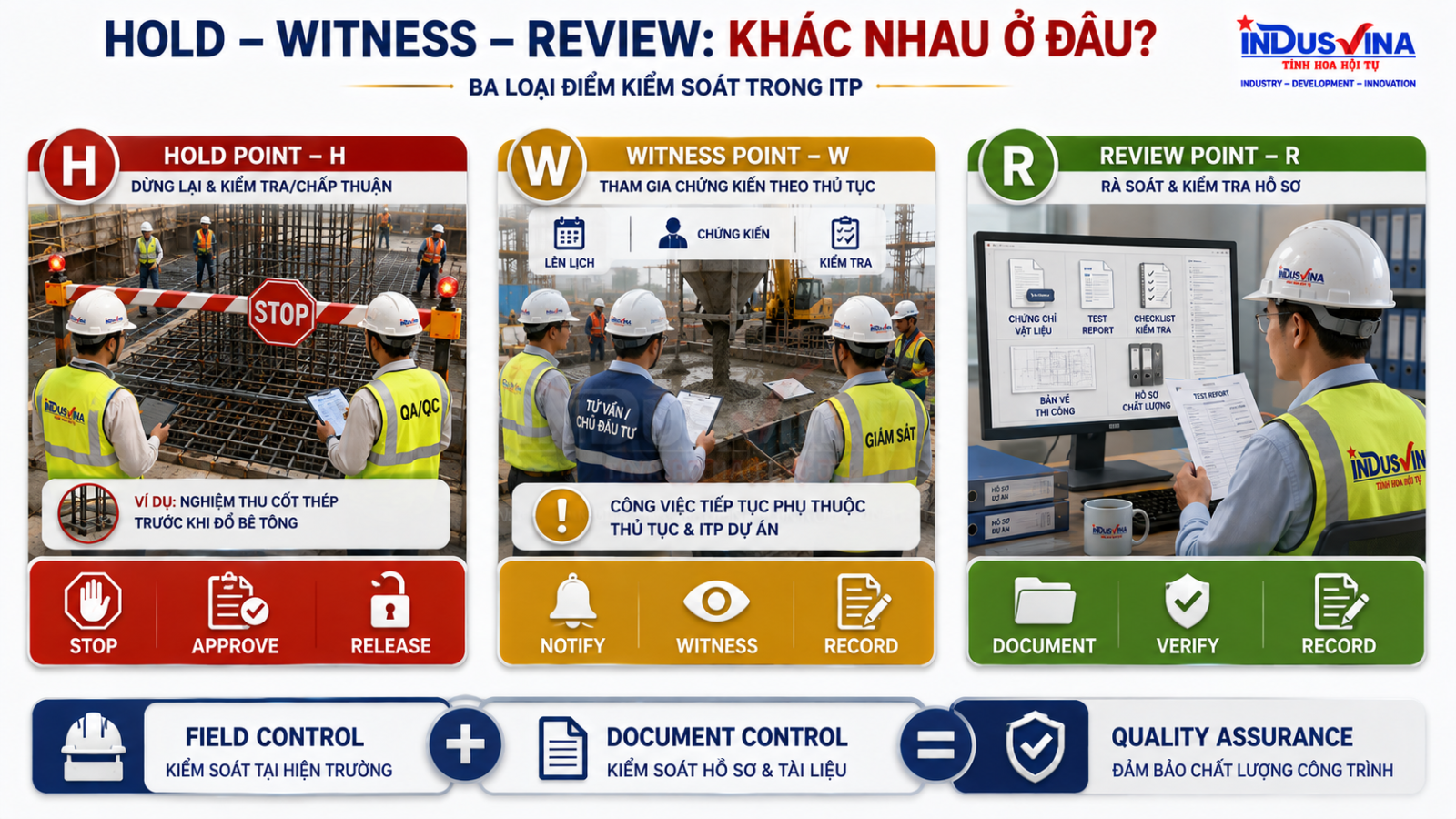
V. How is an ITP different from a Method Statement, Checklist, and Inspection Request?
| Document | Main question answered | Role |
|---|---|---|
| Method Statement | How is the work performed? | Describes the method, sequence, resources, safety controls, and construction organization. |
| ITP | What is inspected, when, and against which criteria? | Coordinates inspection/test activities, H/W/R, Acceptance Criteria, Frequency, and Records. |
| Checklist | Which specific items must be checked? | A detailed list of field/document checks for a specific work step. |
| IR / WIR | When should inspection be requested? | Requests the authorized party to attend for inspection, witnessing, or acceptance. |
| Test Report | What is the test result? | Provides evidence through data, measurements, or test results. |
| NCR | What should be done when a nonconformity occurs? | Records the issue and governs disposition, corrective action, re-inspection, and close-out. |
VI. How to prepare an ITP in 7 steps
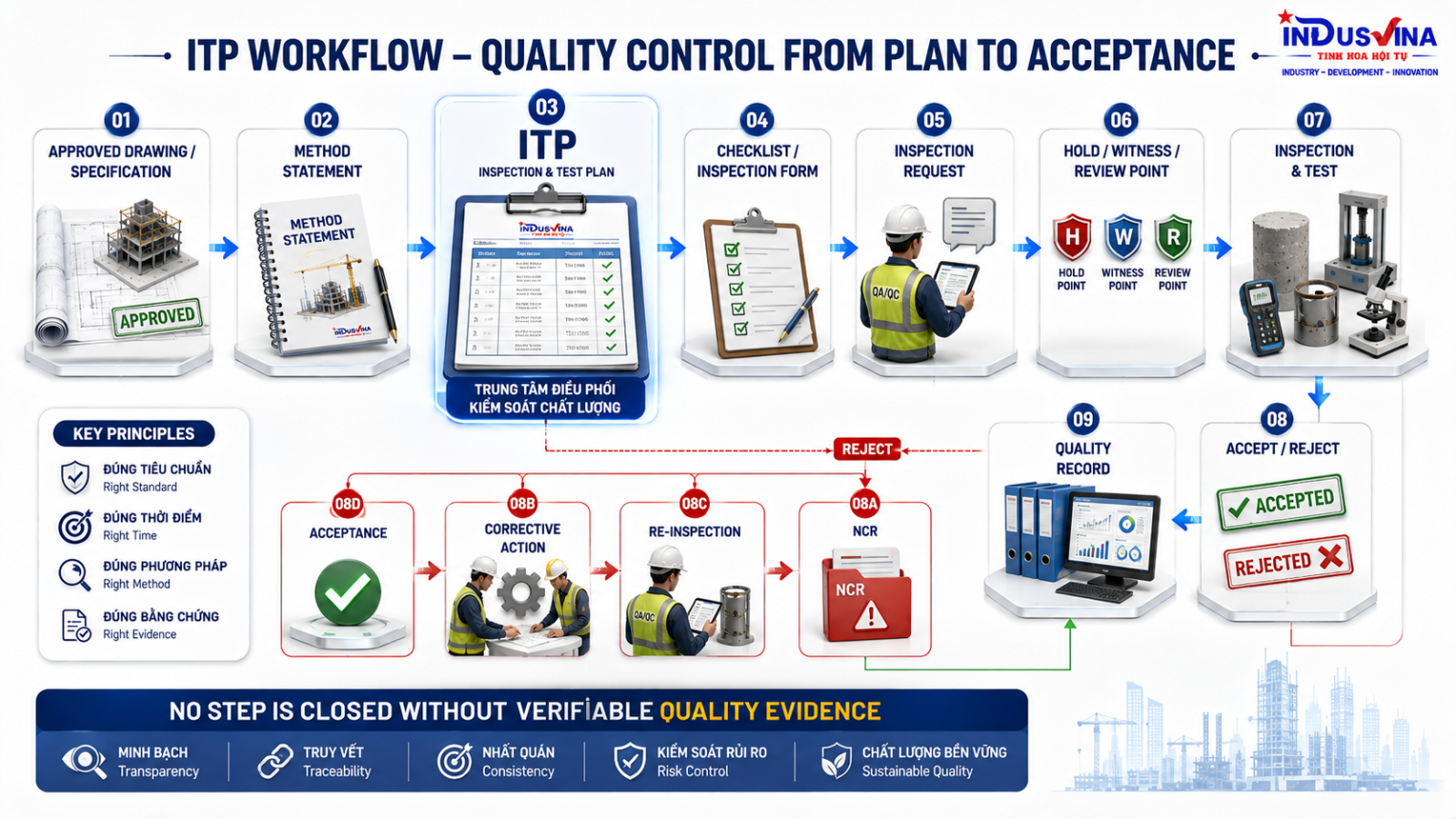
Break the scope into sufficiently clear work steps so that each step can be inspected, tested, or verified before proceeding.
Contract, specification, IFC/approved drawing, shop drawing, Method Statement, material approval, and manufacturer requirements where applicable.
Convert technical requirements into verifiable pass/fail criteria.
Visual, measurement, laboratory test, field test, NDT, functional test, or document review.
Avoid vague wording such as “as required” when frequency can be quantified by lot, batch, component, quantity, length, or work shift.
Define who inspects, witnesses, approves/releases, and the required advance-notification conditions.
Each checkpoint must have corresponding evidence that can be traced during acceptance, handover, or audit.
VII. Where do Acceptance Criteria and standards in an ITP come from?
An ITP does not create its own acceptance criteria. Acceptance Criteria must be traceable to approved technical and contractual sources.
Typical traceability hierarchy
Contract → Specification → Approved Drawing → Applicable Standard → Approved Method Statement → Manufacturer Requirement.
Common standards systems
TCVN, ISO, ASTM, ACI, AWS, ASME, IEC, NFPA, or other standards depending on the project scope and contract.
VIII. Complete example of an ITP for concrete works
The table below illustrates how a concrete ITP can be organized. Specific values must be adjusted to suit the design, specification, applicable standards, and approvals of each project.
| Activity | Inspection / Test | Reference / Criteria | Frequency | H/W/R | Responsibility | Record |
|---|---|---|---|---|---|---|
| Formwork | Location, dimensions, elevation, tightness, stability | Approved drawing / Method Statement / project spec | Each area/component before pouring | W | Site + QA/QC + Supervision | Checklist / IR / photos |
| Reinforcement | Diameter, spacing, lap, anchorage, inserts, starter bars | Approved drawing / rebar schedule / project spec | Each component before concealment | H | Site + QA/QC + Supervision | Checklist / IR / acceptance record |
| Concrete cover | Spacers, cover thickness, stability before pouring | Approved drawing / project spec | Each component | H | QA/QC + Supervision | Checklist / photos |
| Concrete delivery | Delivery ticket, mix, delivery/receipt time, traceability | Approved mix design / project spec | Each truck/batch as required by the project | R | QA/QC + Supplier | Delivery ticket / batch record |
| Slump / field test | Field test in accordance with the specified method | Approved mix / applicable standard | By batch/volume/project-defined frequency | W | QA/QC + Lab + Supervision | Field test report |
| Sample casting | Sampling, specimen casting, identification, curing, traceability | Applicable standard / project spec | At the required frequency | W | QA/QC + Lab | Sample log / test report |
| Concrete pouring | Sequence, compaction, joints, timing, construction conditions | Method Statement / project spec | Continuously during the concrete pour | W | Construction + QA/QC + Supervision | Daily report / pour record / photos |
| Curing | Curing method, duration, and conditions | Method Statement / project spec | According to the curing plan | W/R | Site + QA/QC | Curing log / inspection record |

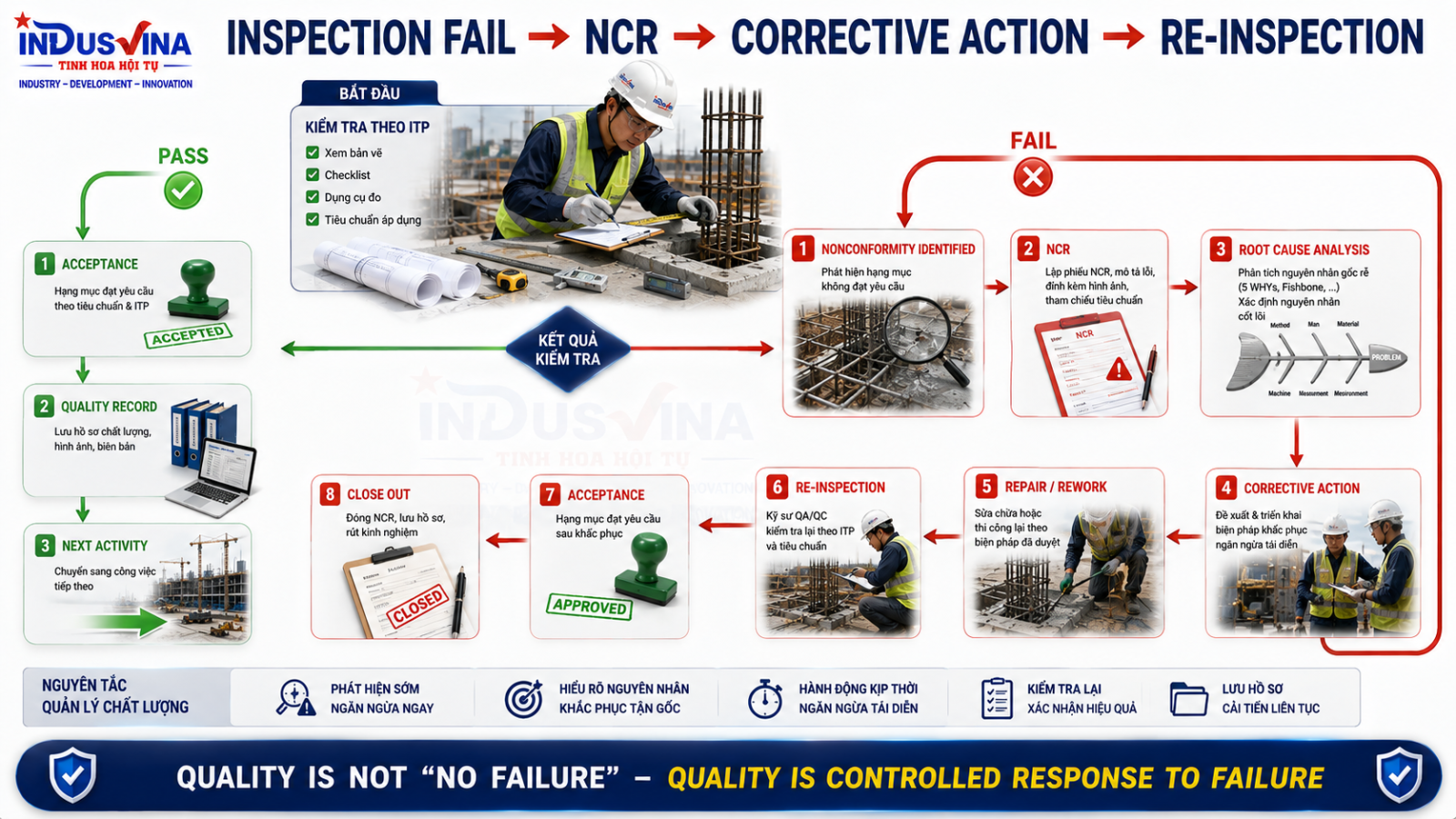
IX. Inspection – Acceptance – NCR – Reinspection process
An ITP does not only describe the path when everything passes. A robust quality system must clearly define how to respond when an inspection or test fails.
PASS path
Inspection/Test → Acceptance → Record → Next Activity.
FAIL path
Nonconformity → NCR/Observation → Root Cause → Corrective Action → Repair/Rework → Re-inspection → Close-out.
An NCR should not be closed simply because the work “has been repaired.” There must be evidence that the cause and corrective actions were addressed, the work was appropriately re-inspected, and the records were closed out by the proper authority.
X. Who prepares, reviews, and approves an ITP?
There is no single responsibility matrix that applies to every project. Roles must follow the contract, project organization, quality plan, and approved ITP. However, responsibilities typically revolve around the following functions:
Prepare
Site Engineer / QA/QC Engineer prepares the technical and control content.
Review
QA/QC Manager, Construction Manager, or discipline lead reviews completeness.
Approve / Accept
Depending on the contract: Consultant, Client/Owner, or the corresponding authorized person.
Inspect
Site + QA/QC + discipline inspector performs inspections in accordance with the ITP.
Witness / Release
The party designated at the H/W checkpoint and under the project procedure.
Record / Close-out
QA/QC / Document Control coordinates record retention, traceability, and turnover.
XI. ITP for Civil – MEP – Industrial/MRO
Civil / Structural
Earthwork, piling, reinforcement, formwork, concrete, waterproofing, structural steel, finishing.
MEP
HVAC, electrical, plumbing, fire fighting, ELV/BMS, pressure testing, insulation, functional testing, and commissioning.
Industrial / MRO
Piping, welding, NDT, alignment, equipment installation, pressure testing, coating, repair, and post-maintenance inspection.
The logical structure of the ITP remains the same, but inspection method, Acceptance Criteria, Frequency, H/W/R, and Records must be designed around the risks and characteristics of each discipline.
XII. 10 common mistakes when preparing and using an ITP
- 1. Copying an ITP from an old project and changing the name without reviewing the specification and drawings.
- 2. Using no clear Acceptance Criteria and writing only “as per specification”.
- 3. Using vague Frequency requirements that cannot be quantified.
- 4. Assigning H/W/R by habit instead of based on risk and contractual requirements.
- 5. Failing to define the release conditions for a Hold Point.
- 6. Failing to define notification timing/procedure for a Witness Point.
- 7. Allowing the Method Statement and ITP sequences to become inconsistent.
- 8. Keeping records that are insufficient to trace a lot, batch, component, or construction location.
- 9. Having an inspection failure without a clearly defined corrective-action and re-inspection loop.
- 10. Approving the ITP but failing to brief the site team and subcontractors.
XIII. Checklist for reviewing an ITP before issue
XIV. FAQ – Frequently Asked Questions about ITP
What is an ITP in construction?
Who prepares an ITP?
How is an ITP different from a Method Statement?
Are an ITP and a Checklist the same?
Can work continue past a Hold Point?
What happens at a Witness Point if the consultant/client is absent?
What is a Review Point?
Where do Acceptance Criteria come from?
Does every work item need a separate ITP?
Does ITP apply to MEP and MRO?
What should be done when an inspection fails?
Does an ITP replace acceptance/inspection approval?
XV. Conclusion
An ITP is not a QA/QC form created merely to “complete the paperwork.” A good Inspection and Test Plan converts technical requirements into control points with defined timing, criteria, accountable persons, and clear evidence.
When the ITP is properly linked to drawings, specifications, Method Statements, checklists, IR/WIR, test reports, and NCRs, quality no longer depends on the memory or experience of an individual; it becomes an operating discipline for the entire project.


