


What is Inspection? The Foundation of Every Effective Maintenance System
Inspection is the activity of checking, observing, measuring and recording equipment conditions to detect early abnormal signs before failures occur.
In plant maintenance, Inspection is the starting point of Preventive Maintenance, Predictive Maintenance and equipment reliability management.

1. Why is Inspection important?
Equipment rarely fails completely “all of a sudden”. Before failure, it usually gives warning signs: increased vibration, increased temperature, abnormal noise, leakage, burning smell, abnormal current or deviation in operating parameters.
- Early detection: recognize abnormal signs before they become failures.
- Reduce downtime: proactively plan repairs instead of emergency shutdowns.
- Create data: record data to monitor failure trends.
- Optimize cost: repair at the right time, the right scope and the right level.
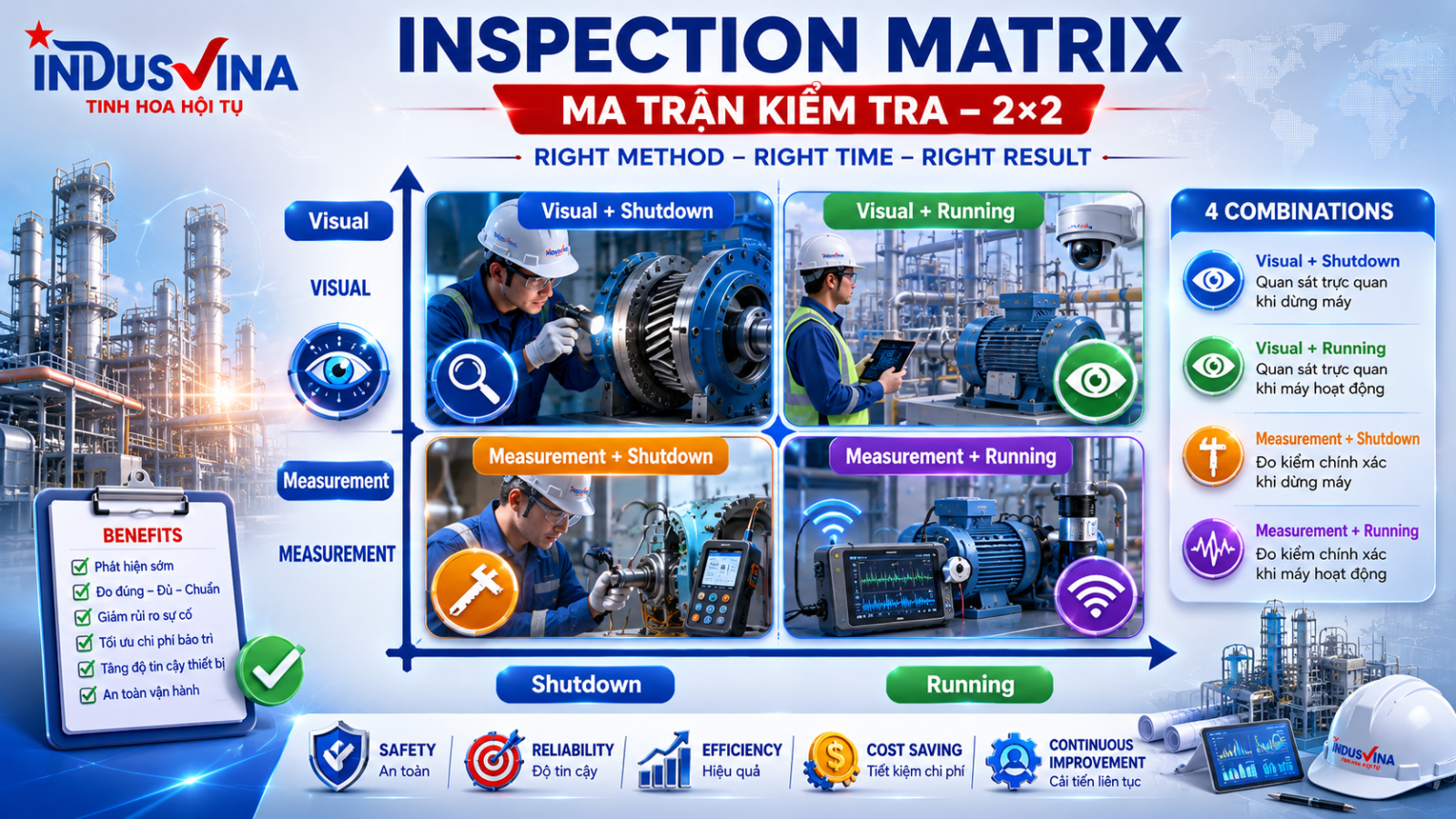
2. The 2×2 Inspection Matrix
Effective Inspection must combine Visual Inspection and Measurement Inspection, while being carried out both during shutdown and during operation.
| Method | During shutdown | During operation |
|---|---|---|
| Visual Inspection Visual checking |
Check leakage, cracks, wear, loose bolts, rust, abnormal dirt, coupling misalignment. | Observe abnormal noise, abnormal vibration, local overheating, burning smell, gauge fluctuation. |
| Measurement Inspection Instrument-based checking |
Measure alignment, runout, clearance, torque, insulation, flatness and straightness. | Measure vibration, temperature, ultrasound, oil analysis, current, pressure, flow and power. |

3. Typical Inspection items
Visual during shutdown
- Check oil, grease, air and water leakage.
- Check cracks, wear, deformation and rust.
- Check bolts, couplings, pulleys and belts.
Measurement during shutdown
- Measure shaft alignment of motor – pump – gearbox.
- Measure runout, clearance and tightening torque.
- Measure insulation of motors, cables and windings.
Visual during operation
- Listen for abnormal noise: rattling, roaring, knocking, squealing.
- Observe vibration, heat, smell and smoke.
- Monitor changes in operating parameters.
Measurement during operation
- Measure vibration and temperature using a thermal camera.
- Use ultrasound to detect air leaks, steam leaks and electrical discharge.
- Analyze oil, current, pressure and flow.

4. Benefits of proper Inspection implementation
Reduce Breakdown
Detect signs of failure before unexpected equipment stoppage.
Increase MTBF
Extend the mean time between failures.
Reduce MTTR
Shorten repair time by knowing the cause in advance.
Increase OEE
Improve overall equipment and production line efficiency.
5. Common mistakes in Inspection
- Only looking by eye, without measurement instruments.
- Inspecting without records, leaving no data for comparison.
- No condition photos, making later traceability difficult.
- No risk classification, treating minor defects and dangerous defects the same.
- No action after inspection, detecting issues but not resolving them.
6. What equipment can Inspection apply to?
- Electric motors, pumps, industrial fans and gearboxes.
- Air compressors, compressed air systems and pressure pipelines.
- Conveyors, rollers, pulleys, bucket elevators and screw conveyors.
- Kilns, crushers, screens and cement industry equipment.
- Electrical panels, MCCs, inverters, power cables and cable lugs.
- Overhead cranes, hoists and lifting equipment.
- HVAC, chillers, cooling towers, exhaust fans and utility systems.
7. Short Case Study
In a continuous production plant, the maintenance team recorded that the bearing temperature of a motor increased by about 12°C compared with the baseline. Visual Inspection showed that the bearing area was unusually dry, while Measurement Inspection confirmed that vibration had started to rise slightly.
Instead of waiting for the motor to fail, the plant made a short planned stop, added lubrication, checked the bearing and realigned the coupling. As a result, an unplanned production line shutdown was avoided.

8. Inspection in modern maintenance systems
| Level | Meaning | Role of Inspection |
|---|---|---|
| Reactive Maintenance | Repair after failure | Inspection is weak or almost absent. |
| Preventive Maintenance | Preventive maintenance | Inspection helps define inspection, maintenance and replacement schedules. |
| Predictive Maintenance | Predictive maintenance | Inspection provides vibration, temperature, oil and current data for trend analysis. |
| Reliability Maintenance | Reliability management | Inspection is the foundation for improving MTBF, MTTR and OEE. |
9. INDUSVINA’s practical capability
INDUSVINA has grown from practical industrial operation experience, connecting the capabilities of MRO – M&E – Construction – Export to serve factories, projects and supply chains.
- Established in 2013.
- Experience in plant maintenance, mechanical and electrical works, construction and technical supply.
- Implementation direction based on responsibility, quality, safety and long-term value.
- Connection between MRO maintenance, M&E construction and technical support after handover.
10. Conclusion
- Inspection is the foundation of effective maintenance.
- Correct Visual Inspection helps detect abnormal signs.
- Correct Measurement Inspection confirms problems with data.
- Correct recording supports trend analysis and decision-making.
- Correct action reduces failures, reduces downtime and improves reliability.
Related Articles
FAQ – Frequently Asked Questions about Inspection
What is Inspection?
Inspection is the activity of checking, observing, measuring and recording equipment conditions to detect early abnormal signs before failures occur.
How is Inspection different from Maintenance?
Inspection means checking and recording conditions. Maintenance means maintaining, repairing, replacing or improving based on inspection results.
How often should Inspection be performed?
The frequency depends on equipment criticality, operating conditions, failure history and safety requirements. Critical equipment may need daily, weekly or shift-based inspection.
Does Inspection require machine shutdown?
There are both types: Inspection during shutdown and Inspection while equipment is operating. A good system should combine both.
How is Inspection related to Predictive Maintenance?
Inspection provides basic data such as vibration, temperature, oil condition, current and operating parameters for trend analysis and failure prediction.
Connect with INDUSVINA
INDUSVINA is ready to accompany Customers and Partners in the needs of Inspection, MRO maintenance, M&E, construction, technical supply and export.


