


Construction & Infrastructure Project Management Process: From Planning to Handover
A construction, infrastructure, MEP, renovation or maintenance project is truly successful only when the scope is clearly defined, technical documentation is controlled, materials are approved, work is inspected at the correct control points, systems are properly tested, and as-built records accurately reflect actual site conditions.
This article presents a systematic project management process connecting Planning – Shop Drawing – Method Statement – Material Approval – ITP – Hold Point – QA/QC – Inspection – As-built – Handover – Warranty. The content is intended for professional reference. Actual application must be based on the contract documents, approved design, site conditions and legislation in force at the time of implementation.

1. What Is Construction & Infrastructure Project Management?
Construction project management is the process of organizing people, documents, finance, materials, equipment, schedule, quality, safety and stakeholders to convert an investment need into an operable facility. For infrastructure and MEP projects, project management must also control interfaces among architecture, structure, electrical systems, HVAC, water supply and drainage, fire protection, controls, transportation, foundations and equipment operation.
Mandatory Objectives
- Correct scope and intended function.
- Compliance with the approved design, applicable standards and mandatory technical regulations.
- Compliance with the approved schedule and budget.
- Safety for people, the facility and the environment.
- Sufficient records for acceptance, operation and maintenance.
Management Principles
- Every important decision must have a documented basis and an accountable person.
- Do not proceed when inputs are incomplete or unapproved.
- Do not conceal deviations behind finishing work.
- Never trade safety for schedule.
- Do not apply standards mechanically outside their scope or context.
2. Legal Framework and Application Principles
Projects in Vietnam must be managed within the legal framework governing construction investment, construction quality, occupational safety and health, fire prevention and fighting, environmental protection, electricity, equipment subject to strict safety requirements and other relevant specialist regulations.
| Legal or Technical Reference | Reference Scope | Application in the Project | Management Note |
|---|---|---|---|
| Law on Construction 2014, amended and supplemented in 2020 | Construction investment activities, entity capability, permits, acceptance and handover | Defines responsibilities of the investor, consultants and contractors; commencement conditions; quality management | Cross-check the specific type and grade of works and the investment form |
| Decree No. 15/2021/ND-CP and valid amending or supplementary documents | Construction investment project management and capability conditions | Project management, appraisal, organizational capability certificates and professional practice certificates | Verify the effective version at the time of submission or contract signing |
| Decree No. 06/2021/ND-CP and valid amending or supplementary documents | Quality management, construction execution and maintenance of works | Material control; acceptance of work, stages and completion; incident management and maintenance | Provides the basis for ITPs, site diaries, minutes and completion dossiers |
| Decree No. 10/2021/ND-CP and related documents | Construction investment cost management | Total investment, estimates, package prices, adjustments and final settlement | Scope changes must be supported by records and cost approval |
| Law on Occupational Safety and Health 2015 | Rights, obligations, training, inspection and risk prevention | Hazard assessment, training, PPE, strictly controlled equipment and incident investigation | Do not allow unqualified persons to perform specialized work |
| QCVN 18:2021/BXD | Safety in construction | Scaffolding, work at height, excavation, lifting, temporary power, construction machinery and site organization | Method statements and safety plans must reflect actual site conditions |
| QCVN 06:2022/BXD and Amendment 1:2023 | Fire safety for buildings and structures | Means of escape, fire compartmentation, firefighting water supply and technical systems | Coordinate design, fire-safety appraisal and acceptance in accordance with current requirements |
| Law on Fire Prevention, Firefighting and Rescue 2024 | Management of fire prevention, firefighting and rescue | Organizational responsibilities, safety conditions, equipment and acceptance | Apply according to scope, effective-date roadmap and implementing guidance |
| TCVN, QCVN and approved foreign standards | Technical requirements for design, materials, construction and testing | Preparation of specifications, ITPs, checklists and acceptance criteria | Do not mix different standard systems without defining a hierarchy of precedence |
Note: The list above is a reference framework. Before issuing official documents, verify newly enacted or amended legislation, local requirements and specialist authority requirements applicable at the time of implementation.
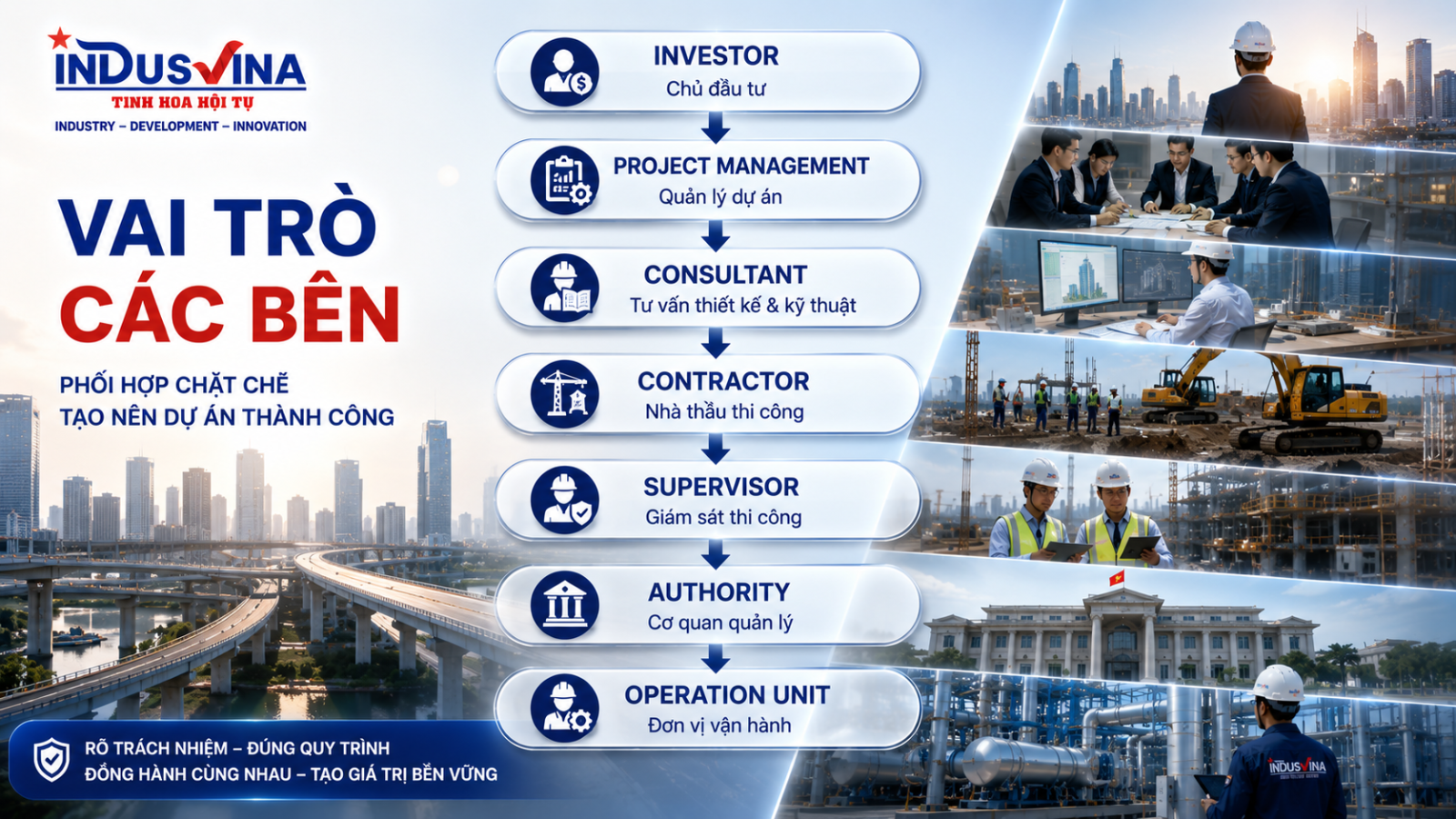
3. Roles and Responsibilities of the Parties
A project cannot be managed effectively when responsibilities overlap or decisions are communicated only verbally. From the outset, establish an organization chart, RACI matrix, authorized signatory list and document approval workflow.
Investor / Owner
Determines objectives, scope and budget, appoints contractors, and organizes quality management, acceptance and handover in accordance with regulations.
Design Consultant
Is responsible for design solutions, technical coordination, design clarifications and changes within the professional scope.
Supervision Consultant
Verifies construction conditions, materials, methods, quality, quantities, safety and acceptance documentation.
Contractor
Organizes labor, equipment, materials, shop drawings, methods, ITPs, construction, self-inspection and completion dossiers.
QA/QC
Establishes the quality plan, controls inputs, tracks inspection points, NCRs, corrective actions and record traceability.
HSE & Operations
Controls safety and environmental matters and participates early to ensure the facility can be operated, maintained, energy-isolated and safely managed during abnormal events.
4. Overview of the Project Life Cycle
The management process is not a rigid sequence. Some activities may proceed in parallel, but mandatory control points must not be bypassed.

5. Stage 1 – Project Planning
Planning converts an investment need into a controllable scope. A plan is not merely a schedule; it must simultaneously address scope, cost, quality, resources, documentation, risk, safety, interfaces and communication.
Minimum Inputs
- Investment objectives and operating criteria.
- Scope boundaries and exclusions.
- Survey data, existing conditions and connection requirements.
- Budget, schedule milestones and legal requirements.
- Quality, safety, environmental and maintenance requirements.
Required Outputs
- Project Execution Plan.
- WBS, master schedule and mobilization plan.
- Risk matrix and response plan.
- Document, approval and responsibility matrix.
- Quality, HSE and communication plans.
6. Stage 2 – Shop Drawings and Technical Coordination
Shop drawings translate design intent into information sufficient for construction: dimensions, elevations, installation locations, connection details, maintenance clearances, erection sequence and interfaces among disciplines. Shop drawings must not independently alter the design principles or reduce safety requirements.
Checks Before Submission
- Compliance with design drawings and specifications.
- Coordination among architecture, structure, MEP and equipment.
- No spatial or service-route clashes.
- Adequate access for operation, removal and maintenance.
- Clear revision, status and checker identification.
Change Management
- Use an RFI where documents are unclear or inconsistent.
- Use a technical query for a specific technical matter.
- Use a design change when principles or parameters are altered.
- Implement field changes only after approval.
- Synchronously update drawings, BOQ, schedule and as-built records.
7. Stage 3 – Method Statement
A Method Statement must describe a safe and controllable implementation approach; it must not be a generic document copied across projects.
| Content | Minimum Requirement | Control Question |
|---|---|---|
| Scope | Work item, location and work limits | Does it overlap with or omit interfaces with other contractors? |
| References | Drawings, standards, specifications and ITP | Is the approved revision being used? |
| Resources | Labor, equipment, tools and certificates | Are operators and equipment properly qualified? |
| Sequence | Preparation, execution, inspection and reinstatement steps | Can quality be controlled and traced? |
| Safety | JSA/RA, permit to work, LOTO, PPE and rescue | Have serious risks been effectively prevented? |
| Environment | Dust, noise, wastewater, waste and chemicals | Are collection and emergency-response measures defined? |
| Inspection | Checklist, Hold/Witness Points and acceptance criteria | Who inspects, when must work stop and what records are produced? |
8. Stage 4 – Material Approval and Material Control
A compliant material is not simply one with the correct trade name. Origin, technical parameters, certificates, samples, compatibility, storage conditions and test results must all be controlled.
Submission Dossier
- Material Submittal / Material Approval Request.
- Catalogue and datasheet.
- Manufacturer certificates and CO/CQ where required by contract.
- Test results or conformity certificates.
- Material samples, color samples or mock-ups where required.
- Specification compliance statement.
Site Delivery Inspection
- Correct code, type, dimensions and quantity.
- No damage, deformation or expired shelf life.
- Proper labels, batch/lot identification and traceability.
- Suitable storage conditions.
- Use only after successful MIR and incoming inspection.
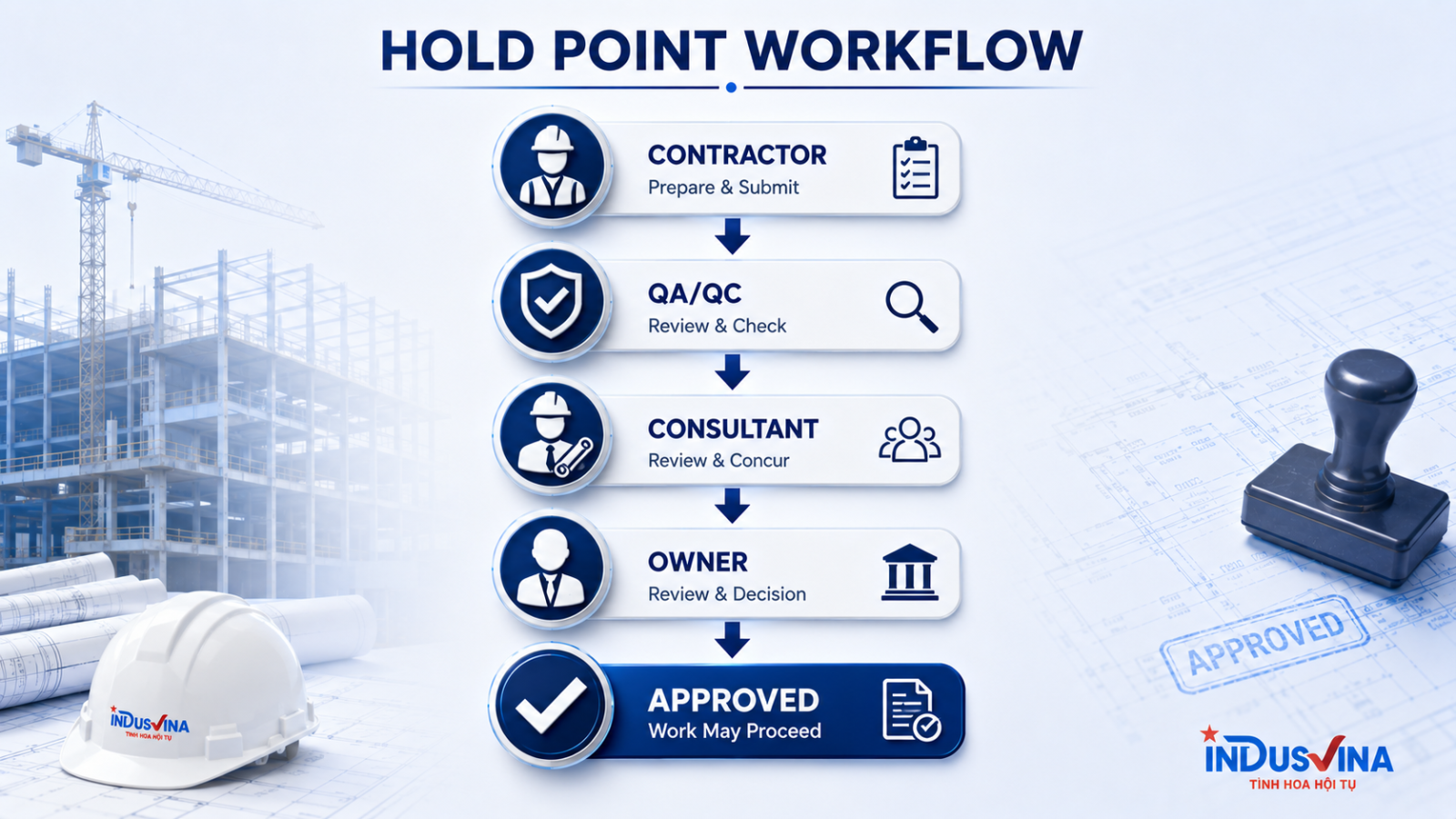
9. Stage 5 – ITP, Hold Point and Witness Point
An Inspection & Test Plan (ITP) is the quality-control map for each work item. It defines what must be inspected, which criteria apply, who participates and which records must be retained.
| Code | Meaning | Implementation Principle | Example |
|---|---|---|---|
| H – Hold Point | Mandatory stop point | Do not proceed without approval in accordance with the ITP | Reinforcement acceptance before concrete placement; pressure test before concealment |
| W – Witness Point | Point requiring invitation to witness | Provide notice within the required period; proceed in accordance with the rules if the invited party does not attend | Load test, leakage test, system balancing verification |
| R – Review | Document review | Records are reviewed before or after the activity as specified in the ITP | Material certificates and test reports |
| S – Surveillance | Random or continuous surveillance | QA/QC or the consultant performs site surveillance | Welding, installation and concrete curing |
10. Stage 6 – QA/QC During Construction
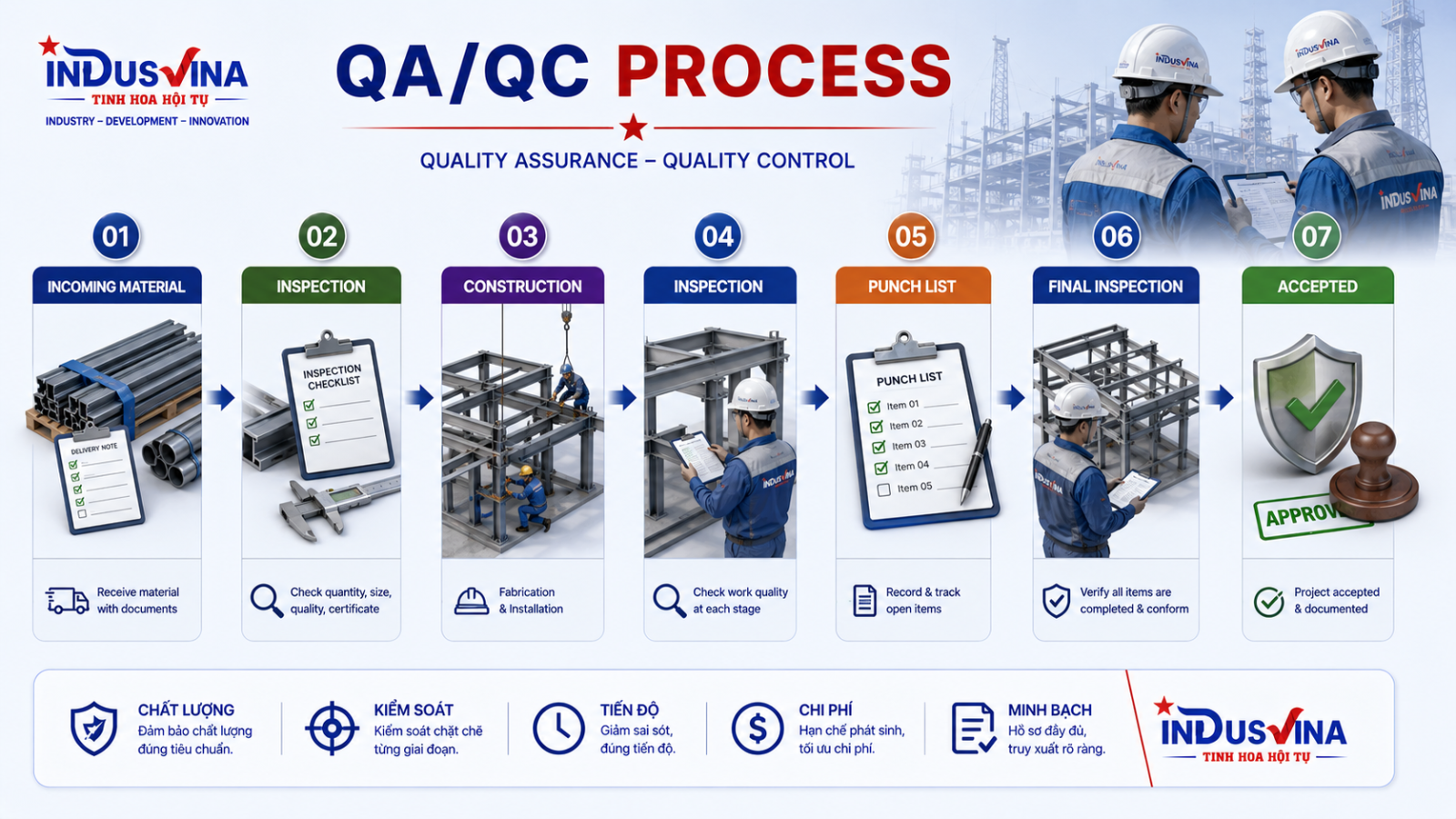
QA establishes systems to prevent defects; QC verifies the actual product and process. Both functions must operate together.
Quality Assurance
- Project quality plan.
- Document-control procedures.
- Supplier and material approval.
- Training, internal audits and change management.
- Root-cause analysis and improvement.
Quality Control
- Incoming inspection.
- In-process inspection.
- Measurement, testing and verification.
- Acceptance of work, stages and completion.
- Punch list, NCR and closure verification.
11. Stage 7 – Inspection, Acceptance and Deviation Management
Acceptance is more than signing a form. Before requesting inspection, the contractor must complete self-inspection and confirm that all conditions are satisfied.
Conditions for Requesting Inspection
- Work completed in accordance with approved drawings.
- Materials approved and incoming inspection completed.
- Required measurement results, test results and checklists available.
- No remaining defect affecting safety or the next activity.
- Area clean, accessible and safe for inspection.
Nonconformity Handling
- Issue an NCR or deviation record.
- Isolate the affected scope where necessary.
- Perform root-cause analysis.
- Propose repair, rework or conditional acceptance.
- Reinspect and close the NCR with evidence.
12. Stage 8 – Testing, Commissioning and Operating Qualifications
For MEP systems, industrial equipment and technical infrastructure, installation completion does not mean operational readiness. Testing must be planned from individual equipment to integrated systems and from no-load to loaded conditions in accordance with approved requirements.
| Test Level | Content | Output Records |
|---|---|---|
| Pre-commissioning | Installation check, cleaning, flushing, pressure test, insulation test and alignment | Checklist, test record and calibration certificate |
| Functional test | Functional verification of each item of equipment and each system | Trial-operation record and operating parameters |
| Integrated test | Interlock testing of BMS, SCADA, fire protection, emergency power, alarms and interlocks | Test script and cause-and-effect record |
| Performance test | Capacity, efficiency, flow, temperature, vibration and load verification | Performance report and acceptance criteria |
| Training & certification | Operator training and handover to appropriately authorized or certified personnel | Training records, attendance list, certificates and O&M manual |
13. Stage 9 – As-built Drawings and Completion Dossier
As-built drawings must accurately represent what has been constructed and installed, including approved changes, elevations, coordinates, underground routes, valve, panel and connection-point locations and information required for operation.

Typical Handover Dossier
- As-built drawings.
- Acceptance minutes and test results.
- CO/CQ, certificates and material records.
- O&M manuals.
- Equipment register, serial numbers, spare parts and consumables.
- Training records, permits and relevant certificates.
Document-Control Principles
- Each document has a code, revision and status.
- Superseded drawings are not used on site.
- Red-line records are updated regularly rather than left until project completion.
- Digital data and hard copies remain consistent.
- Access rights and retention periods are clearly defined.
14. Stage 10 – Handover, Warranty and MRO Integration
Effective handover enables the operating team to understand the system, access the necessary documents and spare parts and respond to abnormal conditions. After handover, the project moves from a “construction completion” mindset to an “asset reliability” mindset.
Before Handover
- Close punch-list items according to priority.
- Confirm completeness of legal and technical records.
- Conduct operation and maintenance training.
- Hand over keys, passwords, software and licenses.
- List approved outstanding items and completion deadlines.
During the Warranty Period
- Establish a fault-reporting contact point.
- Classify defects arising from construction, equipment or operation.
- Commit response and rectification times.
- Analyze recurring failures and update instructions.
- Connect the preventive-maintenance plan and spare-parts strategy.
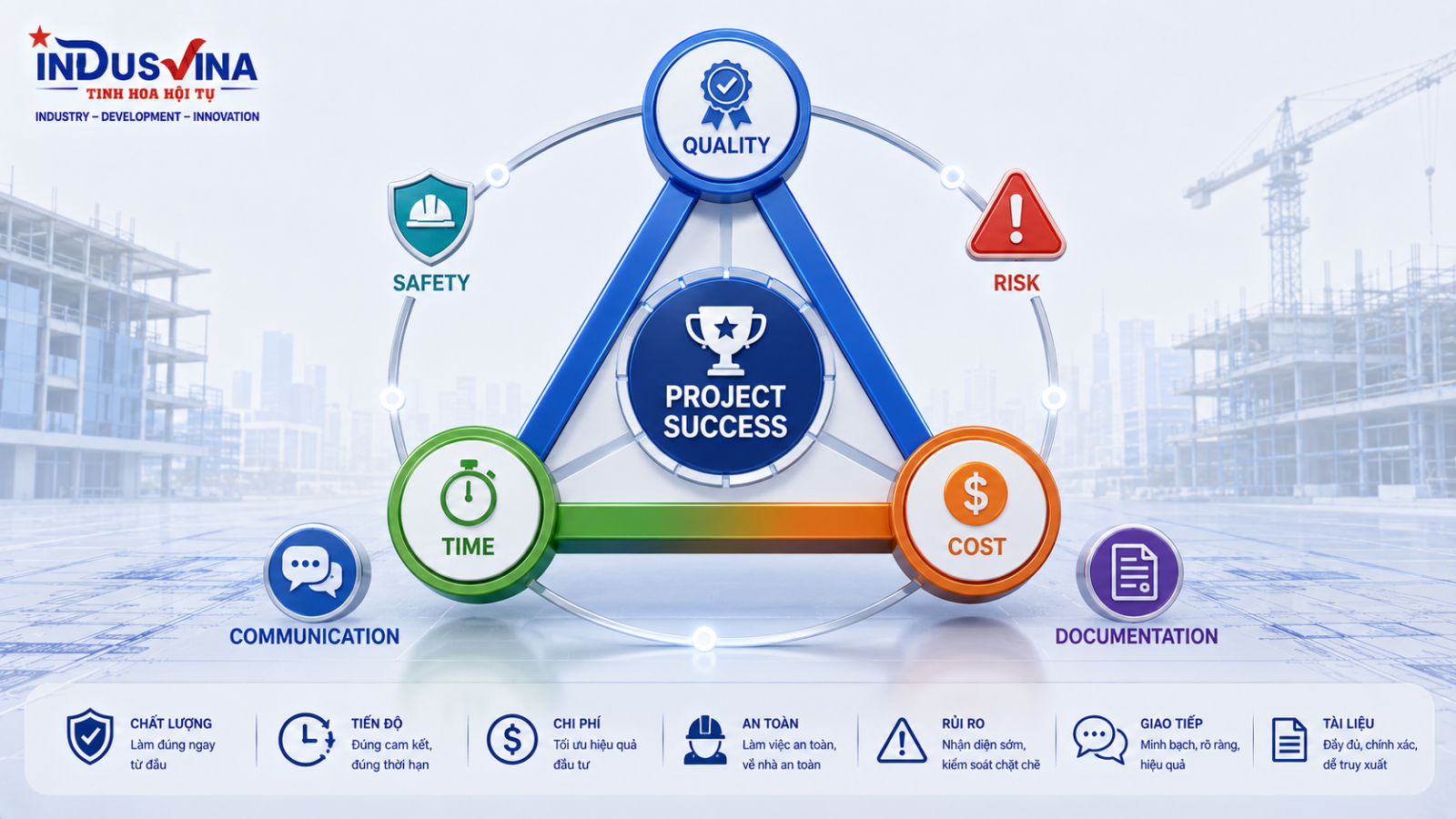
15. Balancing Quality – Time – Cost
Quality, schedule and cost cannot be managed in isolation. A decision to shorten the schedule may increase safety risk and repair cost or reduce maintainability. Every change must therefore be evaluated from multiple perspectives.
| Decision | Impacts to Be Evaluated | Documents to Be Updated |
|---|---|---|
| Material substitution | Performance, service life, compatibility, warranty and lead time | Material approval, specification, BOQ and as-built |
| Change of construction method | Safety, quality, resources, time and environment | Method Statement, JSA/RA, ITP and schedule |
| Schedule acceleration | Work shifts, quality, fatigue, logistics and inspection | Recovery plan, HSE plan and inspection plan |
| Design change | Function, legal compliance, loads, interfaces and life-cycle cost | RFI, design change, approval, shop drawing and as-built |
16. Common Mistakes
Documentation Mistakes
- Constructing from unapproved drawings.
- Shop drawings that are not coordinated among disciplines.
- Copied method statements that do not reflect site conditions.
- Preparing as-built records only at project completion, creating major discrepancies.
Management Mistakes
- Failing to identify authorized decision-makers.
- Bypassing Hold Points to protect the schedule.
- Using standards as debating tools instead of control criteria.
- Failing to involve operations and maintenance from the design stage.
17. Reference Project Management Checklist
| Stage | Gate Condition | Verification Records |
|---|---|---|
| Planning | Scope, budget, milestones and responsibilities defined | Project plan, WBS, schedule, RACI and risk register |
| Shop Drawing | Coordinated and approved | Approved shop drawing and RFI log |
| Method Statement | Method suitable for site conditions and safety | Approved method, JSA/RA and permit plan |
| Material | Material approved and incoming inspection completed | MAR, MIR, CO/CQ and test report |
| Construction | Adequate labor, equipment, certificates and work fronts | Daily report, checklist, permit and calibration records |
| Inspection | ITP criteria achieved with no critical defects remaining | IR, test records and NCR closure |
| Handover | Commissioning passed and documentation and training completed | As-built, O&M, training and handover minutes |
| Warranty/MRO | Contact point, SLA and maintenance plan established | Warranty log, PM plan and spare-parts list |
18. INDUSVINA’s Role
INDUSVINA is positioned as a responsible technical trading company, connecting construction, M&E, MRO and technical supply capabilities. When participating in a project, INDUSVINA prioritizes scope clarity, suitable solution selection and control of documentation, quality, safety, operability and life-cycle value rather than merely completing short-term quantities.
The actual scope must be defined according to capability, certificates, contract requirements and the legal requirements applicable to each project. Work in regulated fields may only be performed by organizations and individuals that fully satisfy the relevant conditions.
19. Related Articles and Services
20. FAQ – Frequently Asked Questions
When should construction project management begin?
It should begin when the investment need is first defined, before design and contractor selection. The later management starts, the less opportunity remains to correct the scope and optimize cost.
Do shop drawings replace design drawings?
No. Shop drawings develop approved design information into construction details and must not independently alter the design principles.
What is the difference between a Method Statement and an ITP?
A Method Statement describes how the work will be performed; an ITP defines inspection and testing steps, acceptance criteria, responsibilities and records.
Must work stop at a Hold Point?
Yes, where the ITP or project rules designate a Hold Point. Work may proceed only after approval by the appropriate authority.
Are CO/CQ documents sufficient to release a material for use?
Not necessarily. The material must also comply with the approved submission, specifications, actual condition, origin and required inspection and test results.
Who may sign acceptance records?
The signatory must hold the correct role, be formally assigned or authorized, satisfy competency requirements and comply with applicable law, contract conditions and project procedures.
Which equipment requires safety inspection?
Machinery, equipment and materials subject to strict safety requirements must be inspected according to the lists and validity periods prescribed by current law.
When should as-built records be prepared?
They should be updated continuously during construction using red-line records and site verification data, then compiled into an approved completion dossier.
Does project management apply to MRO work?
Yes. Shutdowns, overhauls, renovations and equipment replacements also require scope control, methods, materials, permits, LOTO, inspection, testing and handover.
Can foreign standards be applied in Vietnam?
Yes, where they are appropriately selected and approved and do not conflict with mandatory Vietnamese technical regulations or law. The edition, scope and precedence rules must be clearly defined.
21. Project Life-Cycle Summary
A sustainable project does not end with the handover minutes. Real value appears only when the facility operates safely, achieves its intended function, is maintainable and generates data for continuous improvement.
Connect with INDUSVINA
INDUSVINA is ready to discuss construction, infrastructure, MEP, MRO, technical documentation, supply and operating solutions suited to each project.
0979 823 639
info@indusvina.com
www.indusvina.com
Ho Chi Minh City, Vietnam


