


Construction Project Management – From Concept to Facility Operation
Construction project management is the process of organising, coordinating and controlling the entire project life cycle: from identifying the investment need, preparing the project, designing, selecting contractors and executing the works to acceptance, operation, warranty and maintenance.
1. Legal basis and scope of this article
Legal update: From 1 July 2026, Law on Construction No. 135/2025/QH15 takes effect. Accordingly, this article is structured in line with the currently applicable construction law and does not continue to treat the 2014 Law on Construction, as amended in 2020, as the sole legal basis.
The content below systematises general knowledge and practical management principles. The authority to decide, appraise, approve, license and inspect a particular project depends on the project type, capital source, scale, construction grade, location and the applicable laws on public investment, investment, bidding, land, environmental protection, fire prevention and fighting, together with relevant transitional provisions.
Principal legal documents referenced
- Law on Construction No. 135/2025/QH15, promulgated on 10 December 2025 and effective from 1 July 2026.
- Decree No. 15/2021/ND-CP detailing several provisions on construction investment project management, to the extent that it remains effective and consistent with current legislation.
- Decree No. 06/2021/ND-CP on construction quality management, construction execution and maintenance, together with effective amending and implementing documents.
- Relevant specialised legislation on investment, public investment, bidding, land, environmental protection, fire prevention and fighting, and construction investment cost management.
2. What is construction project management?
Construction project management is not a stand-alone duty performed only by the Project Management Unit. It is a coordinated system involving the investment decision-maker, investor, Project Management Unit, survey consultants, designers, verification consultants, construction contractors, supervision consultants, equipment suppliers, state authorities and the operating entity receiving the completed facility.
Management objectives
- Achieve the investment objectives and intended function.
- Control quality, schedule and cost.
- Ensure occupational safety and environmental compliance.
- Manage contracts, changes and risks.
- Prepare adequate conditions for operation and maintenance.
Management scope
- Legal procedures and construction investment formalities.
- Survey, design and technical standards.
- Contractor selection and contract administration.
- Construction, supervision and acceptance.
- Completion records, handover and asset life-cycle management.

3. Detailed table of construction project management steps
The table below describes a common project workflow. Depending on the project, some steps may be exempted, simplified, carried out in parallel or supplemented by specialised procedures.
| No. | Stage | Item | Required work | Implementing entity/organisation/person | Approving or accepting authority/entity | Notes |
|---|---|---|---|---|---|---|
| 1 | Project formation | Identify the investment need and objectives | Assess production, business or public-service needs; define the preliminary function, scale, proposed location, resources and expected benefits. | Investor, project-preparation body, strategy team and initial consultants. | Investor, competent person or competent authority depending on the project type. | This may be an internal management step, but it determines the quality of every subsequent stage. |
| 2 | Investment preparation | Investment policy | Prepare an investment-policy proposal where required; clarify necessity, objectives, scale, location, capital, duration and preliminary impacts. | Investor, project-proposing body and consultants. | Competent authority/person under investment or public-investment legislation. | Not every project requires an investment-policy decision or approval. |
| 3 | Investment preparation | Initial survey and site selection | Collect planning, land, utility-connection, preliminary topographical and geotechnical, environmental, traffic and energy-supply data. | Investor and planning, survey, legal and environmental consultants. | Investor; specialised authorities issue approvals for individual procedures where required by law. | The feasibility of the site should be verified before detailed design development. |
| 4 | Investment preparation | Pre-feasibility study report, where required | Conduct a preliminary assessment of necessity, scale options, technology, location, capital, schedule, effectiveness and major risks. | Investor/project-preparation body and qualified consultants. | Investment decision-maker or competent authority depending on project type. | Applicable only where required by law. |
| 5 | Investment preparation | Feasibility study report or equivalent dossier | Analyse design solutions, technology, total investment, capital sources, effectiveness, schedule, site clearance, environment, fire safety, management organisation and risks. | Investor and survey, project-preparation and basic-design consultants. | Investment decision-maker after completion of the statutory appraisal. | Some projects require only an Economic–Technical Report or a simpler dossier. |
| 6 | Investment preparation | Appraisal and investment decision | Appraise legal conformity, planning, technical solutions, safety, total investment and specialised requirements; finalise and issue the investment decision. | Construction-specialised authority, appraisal lead agency, verification consultants and investor. | Investment decision-maker/competent authority. | The appraisal scope and competence depend on capital source, project group and construction type. |
| 7 | Implementation preparation | Post-basic-design engineering and cost estimate | Perform detailed surveys; prepare technical design or construction drawing design; prepare estimates; coordinate architecture, structure, MEP and process systems. | Survey contractor, design consultant, cost consultant and investor/Project Management Unit. | Investor or competent person; construction-specialised authority where statutory appraisal is required. | The number of design steps depends on the project scale, nature and requirements. |
| 8 | Implementation preparation | Construction permit and specialised procedures | Obtain a construction permit where required; complete land, environmental, fire-safety, utility-connection and other relevant approvals. | Investor, Project Management Unit and legal/specialised consultants. | Corresponding competent state authorities. | Permit exemptions and specific commencement conditions must be checked carefully. |
| 9 | Implementation preparation | Prepare and approve the contractor selection plan | Divide packages; determine selection method, procedure, timing, contract type and capital source. | Investor, procuring entity and bidding consultant. | Competent person/investor under bidding legislation. | The plan must align with the project schedule and implementation strategy. |
| 10 | Implementation preparation | Contractor selection and contract execution | Prepare bidding/request dossiers; evaluate capacity, technical and financial proposals; negotiate, finalise and sign contracts. | Procuring entity, expert team, investor and participating bidders. | Investor/competent person in accordance with applicable regulations. | Contracts should clearly define scope, price, schedule, payment, changes, insurance, warranty and responsibilities. |
| 11 | Investment implementation | Mobilisation and commencement | Hand over the site and control points; approve construction methods; mobilise personnel and equipment; verify commencement conditions and the safety plan. | Investor, Project Management Unit, supervision consultant and construction contractor. | Investor confirms/authorises implementation under the contract; authorities may inspect where required. | Construction must not commence before all applicable legal conditions are satisfied. |
| 12 | Investment implementation | Construction execution and quality management | Construct in accordance with approved design; control materials, equipment, labour, methods, schedule, safety, environment, site diaries and quality records. | Construction contractor; investor/Project Management Unit; supervision consultant; designer when providing author supervision. | Investor carries out acceptance; state authorities inspect within the legally prescribed scope. | All changes must be controlled, impact-assessed and approved by the proper authority. |
| 13 | Investment implementation | Contract, cost and schedule management | Control quantities, payments, variations, price adjustments, design changes, extensions, claims and contractual risks. | Investor/Project Management Unit, cost consultant, supervision consultant and contractor. | Investor/investment decision-maker within the relevant authority. | A clear change log, supporting records and approval workflow are essential. |
| 14 | Construction completion | Testing, trial operation and commissioning | Conduct interlock checks, no-load/load tests, adjustment, parameter measurement and functional verification of systems and equipment. | Construction contractor, equipment supplier, supervision consultant, investor and operating entity. | Investor carries out acceptance; specialised authorities inspect where required. | Especially important for factories, MEP systems, process lines and control systems. |
| 15 | Construction completion | Completion acceptance and as-built documentation | Compile quality records, as-built drawings, test results and specialised certificates/approvals; conduct completion acceptance. | Investor, Project Management Unit, supervision consultant, construction contractor, designer and relevant parties. | Investor; competent authority inspects acceptance work for projects subject to statutory inspection. | The facility may be put into operation only after all applicable conditions are satisfied. |
| 16 | Handover | Handover and commissioning for use | Transfer assets, legal records, as-built documents, O&M manuals, equipment lists, spare parts, training and maintenance plans. | Investor, contractor, equipment supplier and operating entity. | Investor/receiving operating entity. | Handover should not consist only of minutes; full technical data and outstanding obligations must also be transferred. |
| 17 | Operation | Works and equipment warranty | Monitor defects, correct failures, administer warranty retention/guarantees and confirm completion of warranty obligations. | Construction contractor, equipment supplier, investor and operating entity. | Investor/owner confirms completion. | Warranty duration and level are governed by applicable law and contract. |
| 18 | Facility life cycle | Maintenance, repair, renovation and demolition where necessary | Prepare and implement maintenance procedures; conduct periodic/extraordinary inspections; monitor, service and repair; assess safety; renovate or demolish when service life expires or safety can no longer be assured. | Owner, facility manager/user, maintenance contractor, inspection body and specialised consultants. | Owner/facility manager; competent authority where required by law. | Project management does not end at acceptance; it continues throughout the asset life cycle. |
Note: The “approving or accepting authority/entity” column describes common arrangements only. It must not be used as a substitute for determining the specific authority applicable to an individual project.
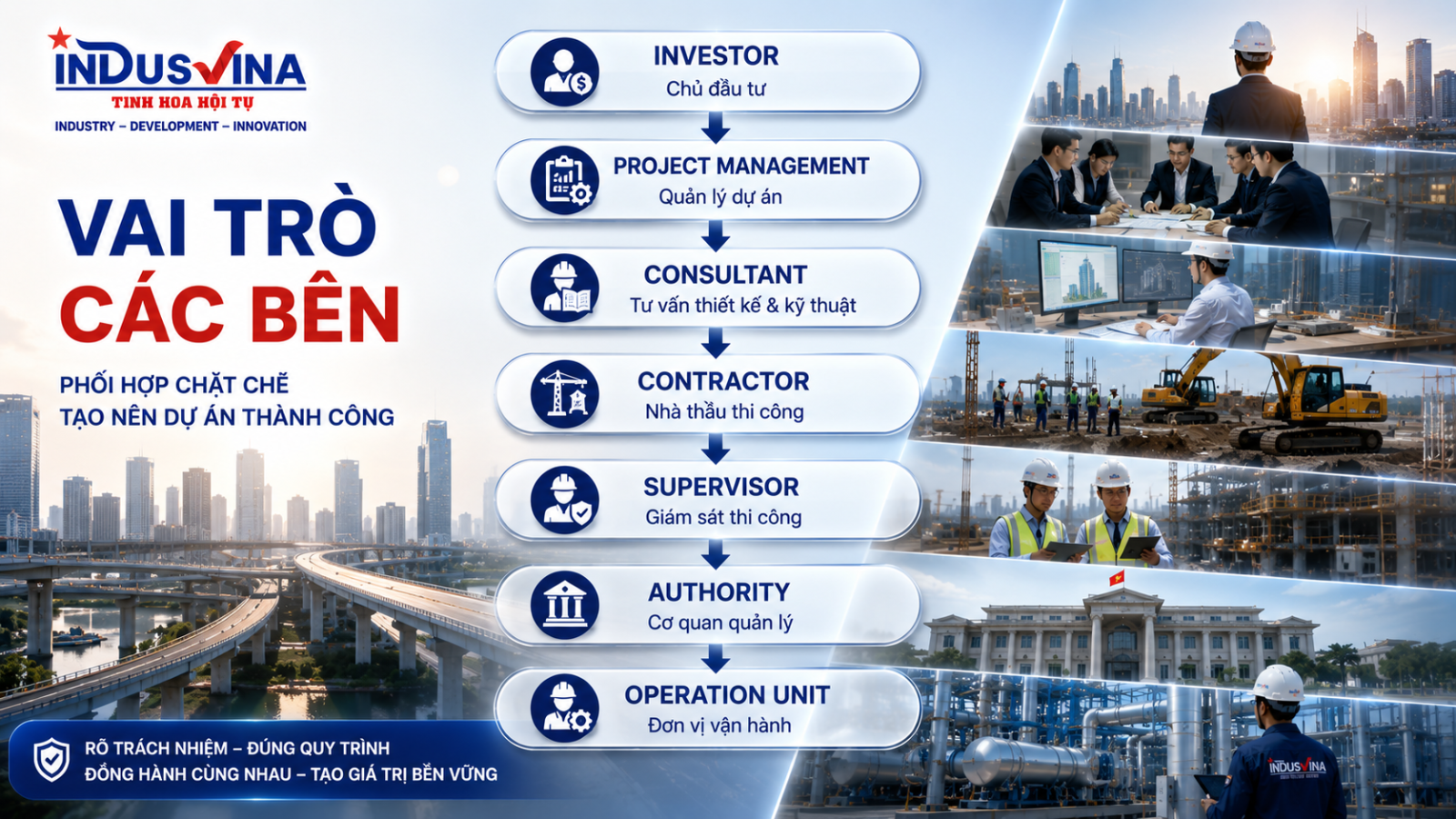
4. Roles and responsibilities of project participants
Investment decision-maker
Decides the objectives, scale, capital source, effectiveness and matters within their authority; supervises the investor’s responsibilities according to the project type.
Investor
Organises project preparation, management and implementation; selects contractors; signs contracts; controls quality, schedule and cost; conducts acceptance and handover.
Project Management Unit
Performs project-management duties under the applicable model and assigned or authorised scope; acts as the coordination point for information, schedule and records.
Consultants and contractors
Are responsible for capacity, quality and compliance within their survey, design, verification, supervision, construction, equipment-supply or specialised-consulting scope.
State authorities
Perform appraisal, licensing, inspection, examination or approval in accordance with their statutory functions and competence.
Operating entity
Should participate early to review operability and maintainability, receive assets and O&M records, and manage the facility after handover.
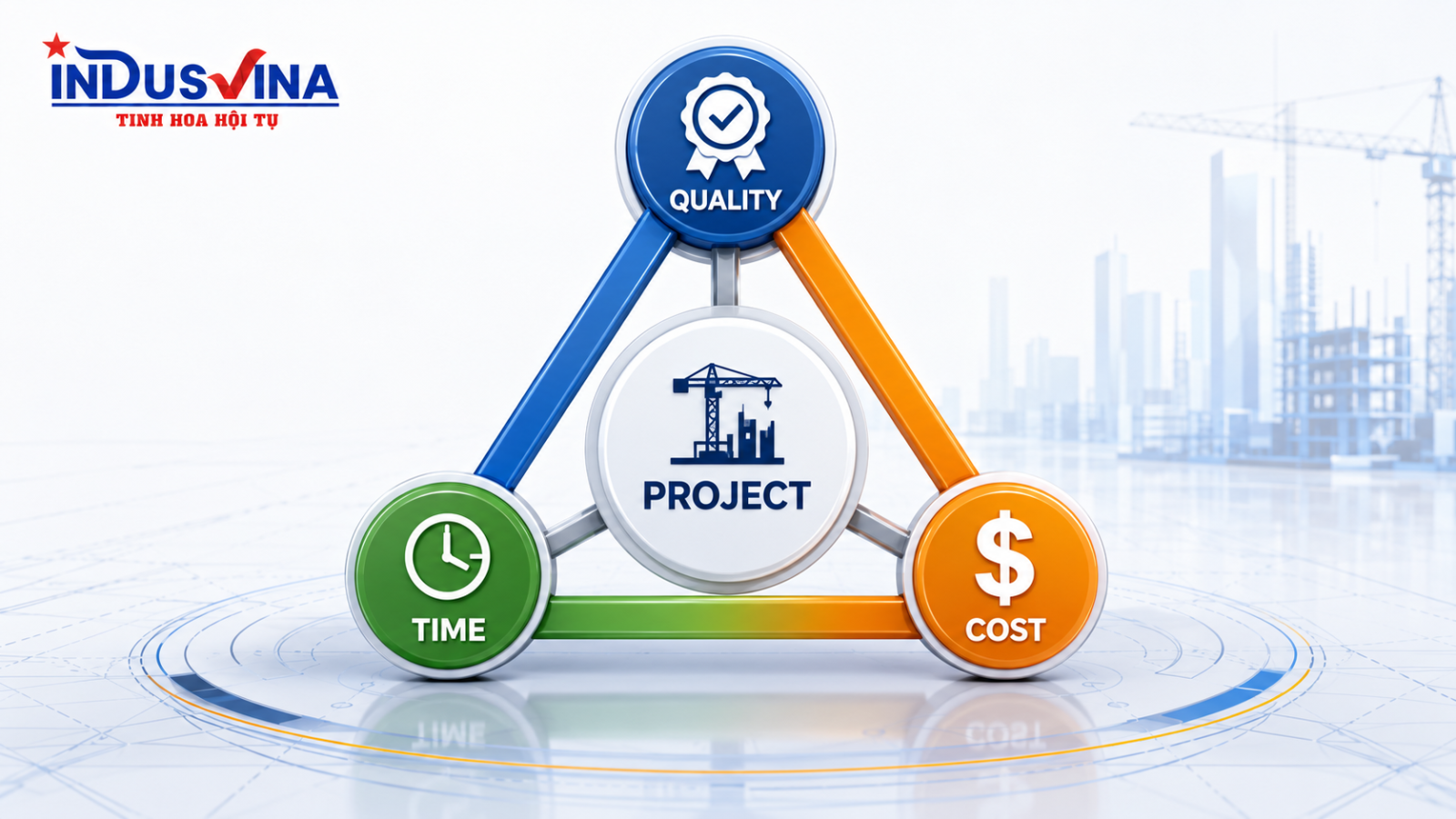
5. Three core objectives: Quality – Time – Cost
The three classic project-management objectives are closely interrelated. Shortening the schedule may increase cost; uncontrolled cost cutting may reduce quality; and a change in quality or scope can affect both schedule and budget.
6. Project management through the PDCA cycle
PLAN
Define scope, objectives, schedule, budget, resources, standards, risks and control plans.
DO
Organise surveys, design, contractor selection, construction, equipment supply and coordination.
CHECK
Measure schedule, quality, cost and safety; carry out inspections and acceptance; assess deviations and compliance.
ACTION
Correct and prevent problems, adjust plans, update risks and standardise lessons learned.

7. Life-cycle cost management
The value of a facility is not determined solely by its initial construction cost. A low-cost investment solution with high energy consumption, difficult maintenance, limited spare-parts availability or frequent downtime can generate a very high total life-cycle cost.
Initial investment cost
- Survey, design and consultancy.
- Construction and equipment.
- Project management, other costs and contingencies.
Operating-life cost
- Energy and operating labour.
- Maintenance, repair and replacement.
- Downtime, production loss and end-of-life treatment.

8. Common project-management risks
Legal and scope risks
- Starting the project before legal procedures are complete.
- Unclear work scope and responsibilities.
- Design changes without approval by the proper authority.
Technical risks
- Insufficient surveys or inaccurate input data.
- Poor coordination among architecture, structure, MEP and process systems.
- Materials or equipment that do not satisfy requirements.
Contract and cost risks
- Weak or incomplete contract conditions.
- Poor control of quantities and variations.
- Late payment or unsupported payment documentation.
Handover and operation risks
- Incomplete testing and commissioning.
- Missing as-built drawings, O&M manuals or training.
- No maintenance procedure or budget established from the outset.
9. Project-management checklist for investors and Project Management Units
10. Practical example: upgrading an operating factory
For a project involving an operating factory, dust-collection system, MEP installation or process-equipment upgrade, project management must address both new construction requirements and the need to maintain ongoing production.
- Survey the existing conditions and verify actual data.
- Define scope boundaries, tie-in points and shutdown windows.
- Develop design solutions and dismantling, lifting and transportation methods.
- Assess conflicts with operating systems and prepare safety measures.
- Prepare a shutdown-based schedule, material plan and contingency plan.
- Execute, inspect, test, accept and hand over the works through defined Hold Points.
- Monitor post-start-up performance to verify capacity, stability and investment effectiveness.
11. Conditions for project success
- Clear objectives: the value expected from the facility is precisely defined.
- Clear scope: included and excluded work is identified for every package.
- Reliable data: surveys, drawings, loads, capacities and site conditions are trustworthy.
- Clear accountability: every decision has an implementer, checker and approver.
- Change control: every change is assessed for legal, quality, schedule and cost impacts.
- Early operational planning: design addresses maintainability, spare parts, safety and expandability.
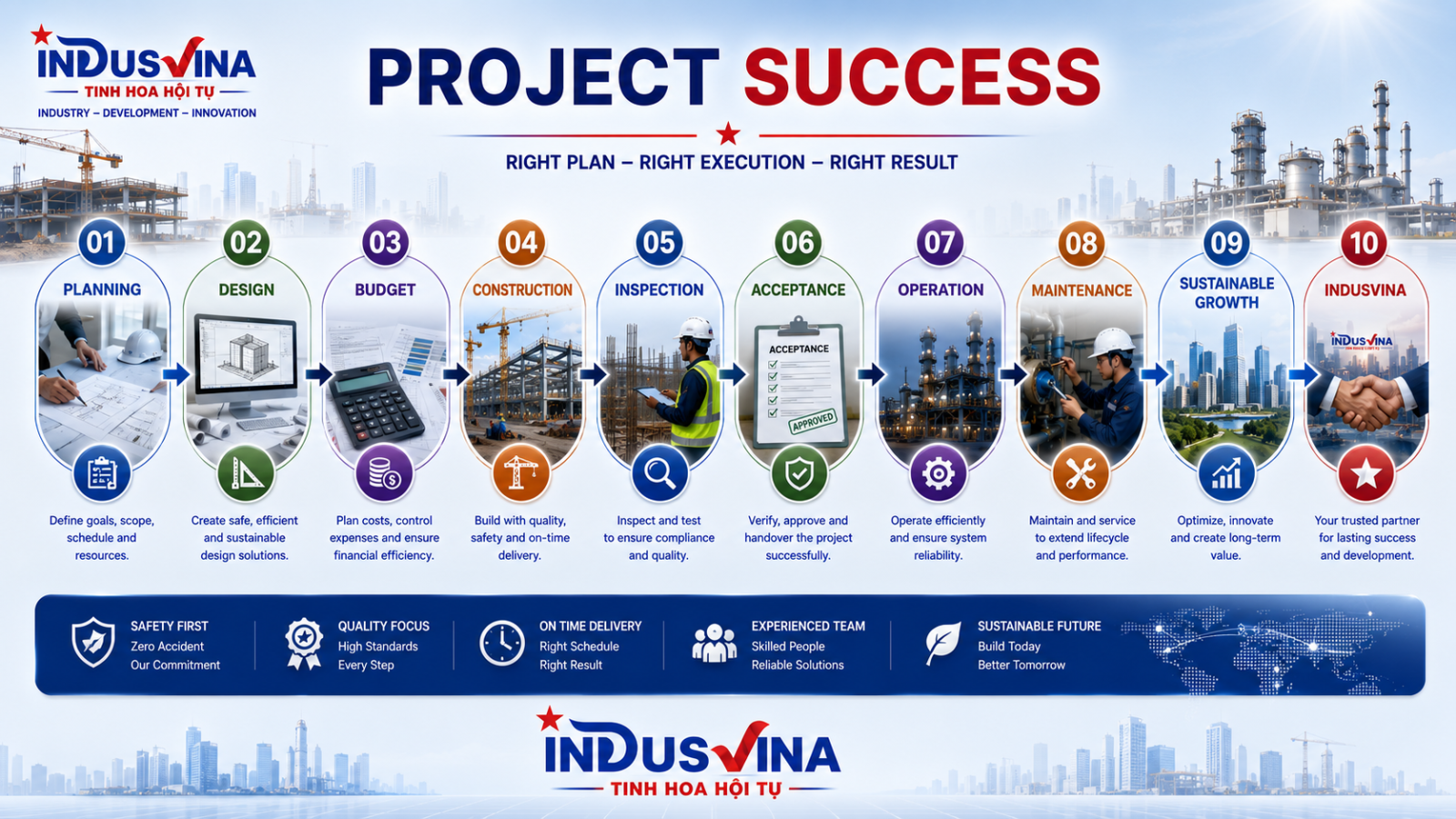
12. Conclusion
Construction project management is a continuous governance process that does not end when construction is completed. A project is genuinely successful only when the facility achieves its intended purpose, complies with the law, meets design requirements, controls cost and schedule, operates safely, supports effective maintenance and produces sustainable value.
For investors, the central requirement is a management system based on reliable data, clear accountability, defined control points and documented evidence. For contractors and consultants, professional capability must be accompanied by execution discipline, transparency and responsibility throughout the facility life cycle.
Related articles
FAQ – Frequently asked questions
What stages are included in construction project management?
They commonly include project formation, investment preparation, implementation preparation, construction, acceptance and handover, warranty and maintenance. The exact sequence depends on the project type and applicable specialised legislation.
Must every project prepare both a pre-feasibility and feasibility study?
No. The required dossier depends on the project type, group, scale, capital source and nature. Some projects require only an Economic–Technical Report or another form of dossier.
Who bears primary responsibility for project management?
The investor directly organises and manages project implementation within its statutory responsibilities. The investment decision-maker, Project Management Unit, consultants and contractors are responsible according to their functions, contracts and the law.
Does the Project Management Unit replace the investor’s responsibility?
Not automatically. The Project Management Unit performs duties under the applicable model and assigned or authorised scope, while the investor remains responsible for duties that the law assigns directly to it.
When may a completed facility be put into operation?
The facility must pass completion acceptance, satisfy safety conditions and meet applicable legal and specialised requirements. Facilities subject to statutory acceptance inspection must complete that procedure before operation.
Why is life-cycle cost management necessary?
Because initial construction cost is only one part of total asset cost. Energy, maintenance, repair, spare parts, downtime and end-of-life treatment may be far higher when design and equipment selections are unsuitable.
Official legal sources
- Law on Construction No. 135/2025/QH15 – Government Portal of Vietnam.
- Decree No. 15/2021/ND-CP on construction investment project management – Government Portal of Vietnam.
- Decree No. 06/2021/ND-CP on quality management, construction execution and maintenance – Government Portal of Vietnam.
This article provides a general knowledge overview and does not replace legal advice or project-specific appraisal. Applicable implementing, amending, replacing and transitional provisions should be checked at the time of project execution.
Connect with INDUSVINA
INDUSVINA is ready to cooperate in surveys, solution development, construction and MEP execution, factory upgrades, MRO maintenance and technical supply.


