


Pile Foundation Construction Method – Standard Procedure for Precast RC Piles, Bored Piles and Pile Caps
Pile foundation construction is not only about driving piles into the ground, but about managing the entire foundation risk chain
Pile foundation is an important foundation solution for structures with heavy loads, weak soil conditions or strict settlement control requirements. At INDUSVINA, pile foundation construction must be managed through the chain: Geotechnical Survey → Pile Design → Method Statement → Trial Pile → Mass Piling → Inspection → Acceptance → Pile Cap → Safe Structure.
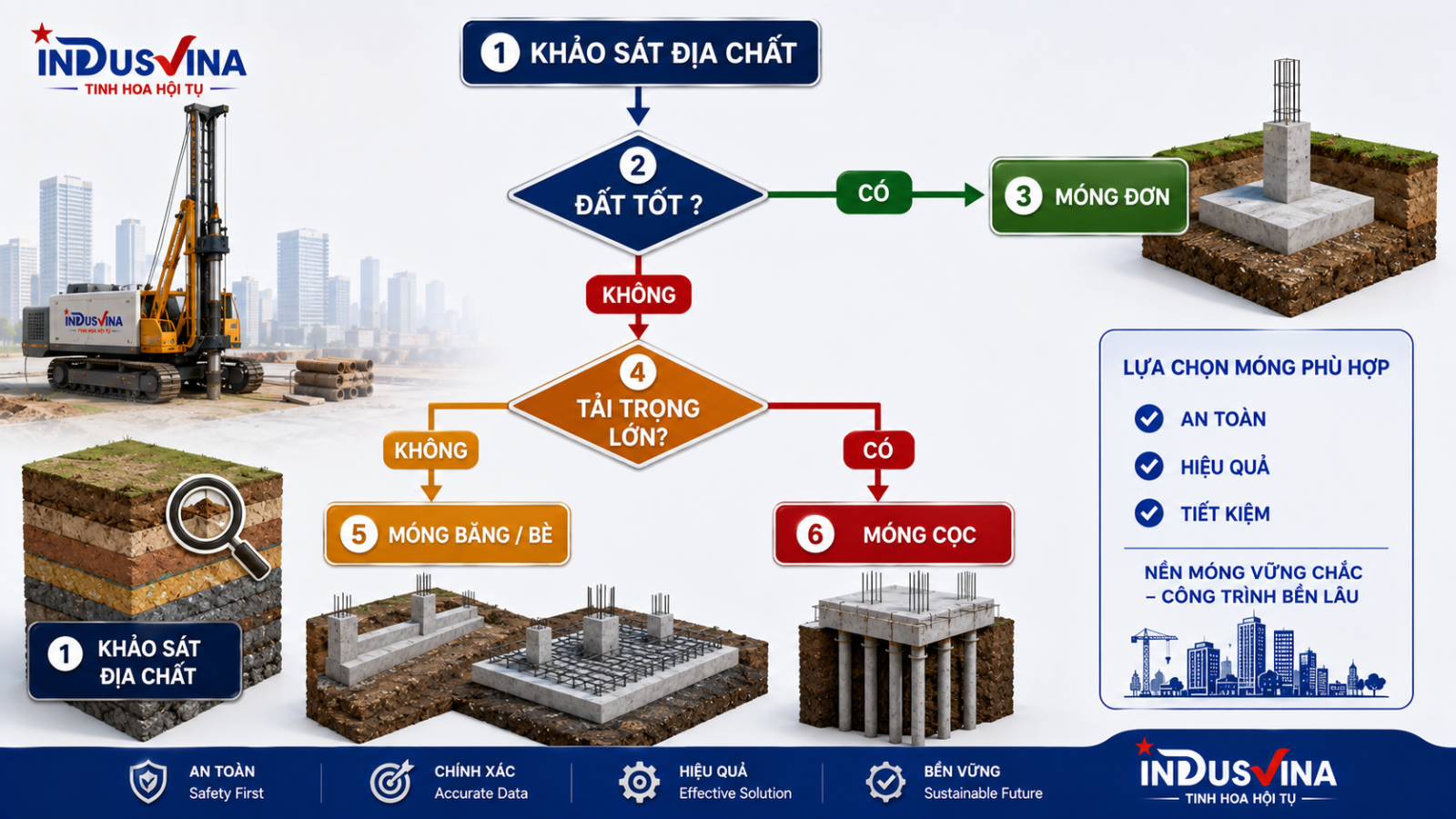
1. What is a pile foundation?
A pile foundation is a foundation system in which the load of the structure is transferred to competent soil layers or deep bearing strata through piles. Piles may include precast reinforced concrete piles installed by static pressing or driving, bored piles or other specialized pile types depending on soil conditions and structural loads.
A complete pile foundation system includes not only piles, but also pile caps, foundation beams, blinding concrete, waterproofing systems, connecting reinforcement and quality acceptance records.
2. When should pile foundations be used?
Weak soil conditions
The competent bearing layer is deep, and shallow foundations are not sufficient for bearing capacity or may cause excessive settlement.
Heavy loads
Industrial factories, multi-storey buildings, silos, tanks, heavy machinery or structures with concentrated loads.
Strict settlement control
Projects requiring high stability, limited differential settlement, reduced structural cracking and minimal impact on adjacent structures.
High groundwater level
Complex construction conditions require deep foundation solutions, groundwater control measures and excavation safety management.
3. Overall pile foundation construction process
A standard pile foundation construction process must be organized in clear steps, with defined transition conditions and technical Hold Points.

4. Hold Point – Mandatory technical stop point
A Hold Point is a mandatory stop in the construction process for checking, confirmation and acceptance before moving to the next step. In pile foundation works, Hold Points help prevent repeated defects across the entire project.

5. Construction of precast RC piles by static pressing or driving
Step 1: Preparation
Review design, geotechnical report, pile length, concrete grade, design pressing force, cut-off level and site conditions.
Step 2: Pile location setting-out
Establish survey benchmarks, set out pile positions and obtain acceptance of pile locations before moving equipment into position.
Step 3: Pile inspection
Check visual condition, factory certificates, cracks, damage, bending, pile head, steel plates and concrete age.
Step 4: Machine installation and alignment
Check machine base, counterweights, hydraulic system, pressure gauge, guide frame and pile verticality.
Step 5: Pressing / driving piles
Monitor pressing force, set, penetration rate, depth and record the construction log for each pile.
Step 6: Completion and acceptance
Terminate the pile when design criteria are achieved. Cut pile heads, check location, level and complete acceptance records.

6. Pile termination criteria
Pile termination must not be based on subjective judgment. Stopping pressing or driving must follow design criteria and actual site conditions.
| Criterion | Control meaning | Note |
|---|---|---|
| Design depth | Confirms that the pile reaches the required level or soil layer | Do not shorten piles without technical approval |
| Design pressing force | Evaluates soil resistance at pile toe and along pile shaft | Pressing force must be recorded by each segment |
| Set / penetration resistance | Applied for driven piles or when required by project criteria | Do not continue driving when pile head damage appears |
| Abnormal conditions | Pile inclination, cracks, sudden force increase, obstruction | Stop and check; do not “force completion” |
7. Bored pile construction
Bored piles are suitable for heavy-load structures, projects requiring reduced vibration or sites where driven or pressed piles are not practical. However, bored pile quality depends heavily on borehole control, stabilizing slurry, reinforcement cage installation and concrete placement by Tremie pipe.

Step 1: Setting-out and casing installation
Accept pile location, install casing, check verticality and stabilize the borehole mouth.
Step 2: Drilling
Drill through soil layers, monitor soil samples, control diameter, depth and inclination.
Step 3: Slurry management
Maintain slurry level and check density, viscosity, sand content and borehole wall stability performance.
Step 4: Borehole bottom cleaning
Circulate and clean the base, check sediment thickness, and accept the borehole base before lowering cage and concreting.
Step 5: Lowering reinforcement cage
Check diameter, length, joints, spacers, cover thickness and safe lifting method.
Step 6: Tremie concreting
Place concrete continuously, keep the Tremie pipe end embedded in concrete, and control slump, volume and test samples.

8. Trial Pile
A trial pile is a very important step before mass piling. It is the basis for verifying design, soil conditions, equipment, construction method and acceptance criteria.
Design verification
Check the suitability between the design documents and actual site conditions.
Geotechnical verification
Compare survey data with actual response during pressing, driving or drilling.
Standard for mass piling
Establish construction parameters, sample logs, termination criteria and control measures.
9. Pile quality testing methods
| Method | Purpose | Common application |
|---|---|---|
| PIT | Checks pile integrity and detects preliminary abnormalities | Precast RC piles, bored piles |
| CSL | Checks defects in bored pile shafts using sonic logging tubes | Large-diameter bored piles |
| PDA | Assesses dynamic bearing capacity and pile behavior | Driven piles, pressed piles or as required by the project |
| Static load test | Confirms actual pile bearing capacity | Trial piles or representative piles |
10. Pile cap construction after pile acceptance
Pile cap construction may only start after all piles within the foundation zone have been fully accepted: pile location, cut-off level, construction logs, test results and as-built records.
Excavation and subgrade treatment
Excavate to correct level, control slope failure, drainage, and avoid over-excavation followed by uncontrolled backfilling.
Pile head cutting
Cut to the design level, protect main reinforcement and clean the pile head concrete.
Reinforcement installation
Control bar diameter, spacing, lap length, anchorage, cover thickness and starter bars.
Pile cap concreting
Control slump, vibration, construction joints, curing and settlement/crack monitoring if required.
11. Common risks in pile foundation construction
- Pile position deviation: caused by incorrect surveying, machine base settlement or poor guide frame.
- Pile inclination: caused by poor alignment, obstruction or non-axial pressing/driving.
- Pile breakage or pile head cracking: caused by improper pressing/driving, poor joints or sudden force increase.
- Borehole collapse: caused by poor slurry quality, low slurry level or abnormal weak soil.
- Concrete segregation: caused by insufficient Tremie embedment, interrupted pouring or discontinuous concrete supply.
- Pile cap cracking: caused by poor temperature control, shrinkage, poor curing or incorrect concrete cover.
12. Quality checklist before pile foundation acceptance
| Inspection group | Items to confirm |
|---|---|
| Geotechnical | Survey report, bearing strata, groundwater level and foundation recommendations. |
| Design | Pile type, length, section/diameter, load, level and pile cap arrangement. |
| Method statement | Method Statement, ITP, JSA, PTW, equipment, manpower, site conditions and sequence. |
| Pile construction | Pile location, pressing force/set, depth, joints, pile-by-pile log, abnormalities and corrective actions. |
| Testing | PIT, CSL, PDA, static load test, concrete samples and inspection results as required by the project. |
| Pile cap | Pile head cut-off level, connecting reinforcement, blinding concrete, waterproofing, formwork, concrete and curing. |
13. What should the Owner check before signing acceptance?
- Geotechnical investigation report and pile foundation design.
- Approved construction method statement.
- Construction log for each pile.
- Acceptance records for pile location, trial pile and mass piling.
- Pile testing results as required by the project.
- As-built drawings of pile positions and pile head levels.
- Acceptance records for reinforcement, formwork and pile cap concrete.
- Site photo records and technical corrective actions, if any.
14. Summary of a safe foundation process

15. Conclusion
Pile foundation is an important solution for structures on weak soil, with heavy loads or strict settlement control requirements. However, pile foundations are truly safe only when implemented with a strict quality management system.
For INDUSVINA, pile foundation construction is not merely a construction activity. It is the integration of geotechnics – design – method statement – quality control – safety – acceptance – long-term responsibility.
FAQ – Frequently Asked Questions about Pile Foundation Construction Method
1. When should a pile foundation be selected instead of a shallow foundation?
When the soil is weak, the load is heavy, the competent soil layer is deep or the project requires strict settlement control.
2. Which is better: precast RC piles or bored piles?
There is no absolutely better option. Precast RC piles are suitable for faster installation and better control of factory-produced elements. Bored piles are suitable for heavy loads and reduced vibration, but depend heavily on site quality control.
3. Is a trial pile mandatory?
For important projects or heavy-load structures, a trial pile is highly necessary to verify design, soil conditions and construction method before mass piling.
4. Can pile testing be omitted to save cost?
It is not recommended. Pile testing is the technical basis for confirming actual quality and reducing future risks.
5. When can pile cap construction start?
Only after all piles within the pile cap area have been fully accepted in terms of location, level, logs, testing and as-built records.
Connect with INDUSVINA
INDUSVINA is ready to accompany Customers and Partners in infrastructure construction, foundation works, MEP, MRO, technical supply and export needs.
Hotline / Zalo: 0979 823 639
Email: info@indusvina.com
Website: www.indusvina.com
Area: Ho Chi Minh City, Vietnam


