


1. A Sustainable Structure Is the Result of a Governed System
A sea-crossing bridge, a mountain road, a river embankment, a factory, a hospital or an industrial complex may be seen as a physical structure. Behind that visible form, however, is a complex operating system involving the owner, project management board, consultants, contractors, suppliers, laboratories, inspection bodies, authorities, communities and thousands of workers.
On major projects, the workload cannot be measured in only a few dozen tasks. Every day may generate hundreds of technical requests, drawing clarifications, inspection forms, mobilisation orders, acceptance records, material demands, lifting plans, work permits and site coordination decisions. A small deviation, if not detected at the right time, can spread across multiple work packages, alter the construction sequence and trigger rework costs.
This becomes even more critical when work is carried out over fast-flowing rivers, offshore, on islands, in steep mountains, deep tunnels, confined spaces or at significant height. In such environments, weather, tides, wind, geology, access, rescue capability and transport conditions all become parameters of the construction method. Operations cannot be managed through intuition, slogans or fragmented experience.

2. Reality: A Project Can Lose Control Through Very Small Failures
Most management failures do not immediately appear as a major accident or a demolished work item. They often begin with small signs: a drawing is issued to a crew before it is updated; materials arrive before approval is complete; equipment inspection has expired; the work shift changes but the method is not re-briefed; the crew does not understand the inspection hold point; or a site change is not reflected in the as-built records.
When these deviations occur individually, management may assume they are not yet serious. A project, however, is an interconnected system. An incorrect drawing revision can lead to incorrect installation; that installation affects the next activity; the delayed activity changes equipment, labour and delivery schedules; and the final result is additional cost, quantity disputes and difficulties in acceptance.
Superficial management also creates a less visible risk: each individual develops a personal way of working. When a process depends on the memory of a few people, the project becomes vulnerable if they leave, change shifts or are absent from site. A sound system must instead ensure that information is retained, traceable and clear enough for another authorised person to take over.
Site culture therefore cannot be expressed only through rules posted on a noticeboard. It must be visible in how drawings are received, work is assigned, logs are recorded, materials are inspected, equipment is managed, incidents are reported, changes are answered and work packages are closed before the next step begins.

3. Discipline Begins with Individuals and Is Sustained by the Organisation
Individual discipline means performing the correct duty, at the correct time and under approved conditions. Equipment operators must inspect machines before the shift; engineers must use the correct drawing revision; safety personnel must verify working conditions; storekeepers must check documents and material condition; and foremen must brief workers on the method and work boundaries.
Individual discipline cannot replace organisational discipline. A project cannot expect everyone to remember every requirement correctly at all times. The organisation must design systems that help people do the right thing: standard forms, document coding, distribution lists, inspection schedules, material trackers, three-week look-ahead plans, coordination meetings, pre-shift checklists, inspection hold points and deviation-reporting mechanisms.
Individual discipline
- Be on time, at the correct location and within the assigned scope.
- Do not change drawings, materials or sequence without approval.
- Report unsafe conditions or technical deviations immediately.
- Record data honestly, completely and in a verifiable form.
Organisational discipline
- Define authority and approval channels clearly.
- Maintain one official source of issued data.
- Assess the impact of every change.
- Do not proceed when prerequisites have not been met.
The site manager plays a central coordination role but cannot replace the entire system. A good site manager is not someone who personally decides everything, but someone who establishes the operating rhythm, requests information at the correct level, resolves interface conflicts, protects the technical sequence and ensures that important decisions are evidence-based.

4. Document Control: The Foundation of Every Site Decision
A major project usually contains multiple layers of documentation: owner requirements, applicable standards, design documents, issued-for-construction drawings, shop drawings, method statements, inspection and test plans, risk assessments, material submittals, technical clarification requests, site instructions, meeting minutes, acceptance records, as-built drawings and handover documents.
The core value of document control lies in revision and status control. Site teams must know which document is valid, which is awaiting approval, which has been superseded and who is authorised to issue it. If an obsolete drawing remains on site, the risk is not the sheet of paper itself, but the possibility that it may be used as an official instruction.
A disciplined document cycle must ensure
- Consistent coding: the document title, work package, discipline, revision and status can be identified quickly.
- Controlled distribution: to the correct recipient, for the correct scope and at the correct time.
- Time-bound response: documents awaiting approval must be tracked so they do not become schedule bottlenecks.
- Traceable changes: the revised content, reason and impact must be recorded.
- Site linkage: site logs, acceptance records and as-built documents must reflect the work actually performed.
Without complete documentation, quality is difficult to verify; without verified quality, acceptance becomes difficult; and without acceptance, payment and cash flow are affected. A document missing a signature or an outdated drawing can therefore cause losses greater than the value of an entire material shipment.

5. Material Management: Correct Type, Correct Time, Correct Quality
Both major materials and auxiliary consumables can affect final quality. Steel, cement, cables, pipes, bolts, welding materials, chemicals, fittings, gaskets, adhesives, waterproofing materials and consumables must all be controlled according to their level of risk.
The process should not begin when the delivery truck reaches the gate. It begins with technical requirements, the approved vendor list, material submittals, samples, certificates, delivery planning and storage conditions. Upon arrival, quantity, type, condition, documents, batch numbers and testing requirements must be checked. Materials must then be stored and issued according to their intended location, avoiding mix-ups or loss of traceability.
Control before purchase
Technical specifications, standards, brand, origin, supplier documents, testing requirements and delivery time.
Control upon receipt
Correct order, correct certificates, no damage, sufficient batch identification, suitable storage conditions and compliance with the approved submittal.
Control in storage
Zoning, moisture protection, corrosion protection, end protection, shelf-life control, FIFO and periodic stocktaking.
Control during use
Issue to the correct work package, record batch numbers, inspect before installation and link usage to acceptance records.
If nonconforming material is used, replacement after installation usually costs far more than the original inspection. Material discipline is therefore a direct component of project life-cycle cost control.

6. Plant and Equipment Management: One Failed Link Can Stop the Entire Chain
An infrastructure or industrial project may simultaneously use crawler cranes, mobile cranes, bored-pile rigs, excavators, bulldozers, forklifts, concrete pumps, batching plants, generators, welding and cutting equipment, barges, tugboats and many specialised machines. Each has different capacity, operating radius, load, ground requirements, inspection requirements and operating limits.
Equipment management is more than maintaining a list. It requires inspection records, operator certificates, shift logs, maintenance schedules, fuel status, critical spares, mobilisation plans, recovery arrangements and evaluation of working conditions. Lifting operations additionally require control of load, radius, crane configuration, lifting accessories, support conditions, exclusion zones and communication signals.
In river and marine environments, equipment is also affected by corrosion, waves, wind, tides and the stability of floating plant. In mountainous areas, access roads and refuelling capability may determine the schedule. At height, wind-speed limits and rescue plans must be treated as stop-work conditions, not optional recommendations.
7. Construction Sequence: The Science of Prerequisites
Schedule performance does not mean starting as many activities as possible. A reliable schedule is created when each activity has sufficient inputs, workfront, equipment, materials, documentation and safety conditions. If a work package begins before its prerequisites are complete, the project may appear extremely busy while delivering low actual productivity.
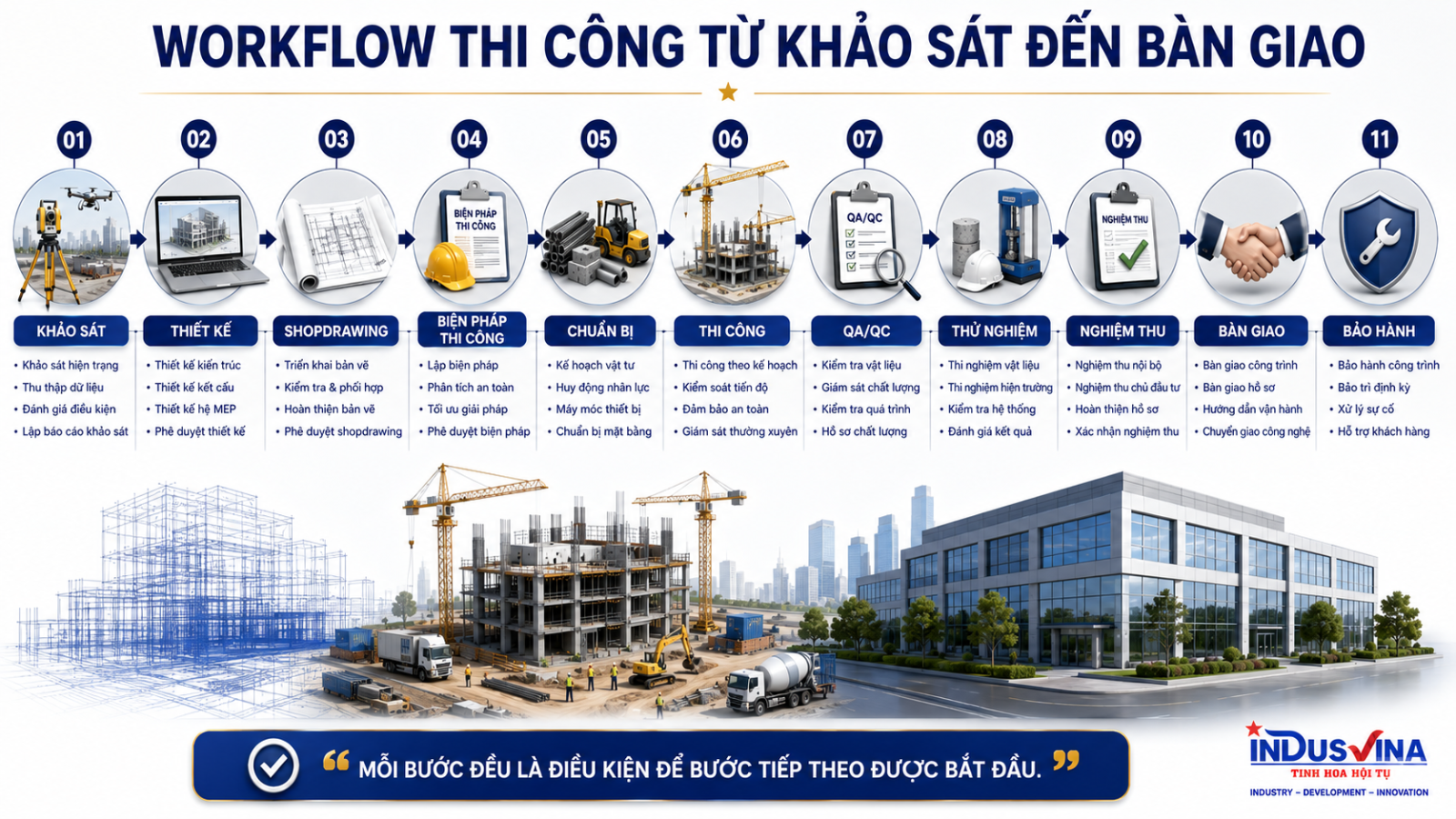
The basic sequence generally runs from survey, design, shop drawings, method statements, approval, procurement and site preparation through construction, inspection, testing, acceptance, as-built documentation, handover and warranty. Each work package, however, must be analysed in greater detail through its construction method, ITP, checklist, resources, duration, interfaces and acceptance criteria.
A construction method must answer practical questions
- Where will the work be performed, and under what terrain and environmental conditions?
- Which equipment will be used, and are its capacity and load rating suitable?
- Which materials are required before starting, in what quantity and where will they be staged?
- What is the step-by-step sequence, and where are the inspection hold points?
- What are the principal risks, and which controls are mandatory?
- What are the stop-work thresholds when weather, tides, workfront or equipment conditions change?
- Who is authorised to start, suspend and restart the work?
A good method statement is not intended to make the document package look impressive. It must be clear enough for engineers, foremen, operators and safety personnel to understand it in the same way. If the method cannot be translated into specific site actions, it has not fulfilled its management function.
8. Responsibility: Decision-Making Authority Must Carry Accountability
In a project, responsibility should not be understood merely as accepting blame after an incident. It begins with verifying conditions before deciding, providing truthful information, not concealing deviations and proactively addressing issues within one's authority.
Every level must know exactly what it is accountable for. The owner determines objectives and resources; project management coordinates the overall programme; consultants verify compliance; contractors organise construction; engineering safeguards the solution; QA/QC safeguards quality criteria; HSE controls safety conditions; planning links resources to schedule; materials and equipment functions secure inputs; and foremen convert requirements into site action.
Responsibility must also be reflected in reporting mechanisms. Anyone who detects a deviation must have a clear reporting channel and must not be encouraged to remain silent to “protect the schedule”. A mature project does not reward hidden incidents; it values early detection, containment, root-cause analysis and prevention of recurrence.
9. Connection: Managing Interfaces Between Parties and Disciplines
In a complex project, many issues do not belong entirely to one discipline. Structure affects MEP; MEP affects architecture; process equipment affects foundations; procurement progress affects the construction plan; transport routes affect crane mobilisation; and acceptance records affect payment.
Connection therefore means more than good communication. It is interface management: defining who provides input to whom, in what format, by what time, against what acceptance criteria and what happens when the input changes. Meetings have value only when they produce data, decisions, accountable owners and closure dates.
Technologies such as BIM, document management systems, schedule dashboards, material QR codes and equipment management software can accelerate connection. Technology, however, does not replace data discipline. An attractive dashboard built on late, incomplete or unreliable data will still lead management to make poor decisions.

10. Practical Examples: The Cost of Poor Discipline
Incorrect drawing revision
An obsolete drawing is used → incorrect dimensions or location are built → related work is affected → demolition and rework are required → acceptance is delayed and costs increase.
Unapproved materials
Materials arrive before the submittal is approved → incoming acceptance cannot be completed → storage space is occupied → issue to site is delayed → risk of damage and responsibility disputes increases.
Equipment not ready
Equipment is inadequately maintained or its inspection has expired → it cannot legally operate or fails during the shift → labour waits idle → the construction chain is interrupted.
Inspection hold point bypassed
Subsequent work conceals an uninspected item → quality evidence is insufficient → the work must be reopened for inspection → cost and damage risk increase.
These examples show that discipline is not an abstract concept. It can be translated into time, cost, productivity, safety performance, payment capability and project reputation.
11. Applying the Same Principle to Construction, MRO and International Trade
In construction
Discipline is reflected in the control of drawings, construction methods, labour, equipment, materials, schedule, safety, quality, acceptance and as-built documentation. The objective is to convert design into a compliant asset that can be operated and maintained throughout its life cycle.
In MRO and plant maintenance
A plant is also an asset system that requires structured management. The Asset Register, maintenance plans, work orders, inspection checklists, vibration, temperature and lubrication data, spare parts, shutdown schedules and root-cause analysis all require data discipline. If maintenance depends only on technicians' memory or reacts only after failure, the business will pay through downtime and emergency costs.
Disciplined design and construction also support future MRO: equipment has sufficient access space, lifting points, isolation valves, identification labels, O&M documentation and standardised spares. This is why Design for Maintenance must be considered from the design stage.
In international trade
An export order has a structure similar to a project: technical requirements, purchase order, sample approval, production planning, quality inspection, packing, documentation, freight booking, customs clearance, delivery, payment and after-sales handling. A single error in product description, labelling, dimensions, document timing or delivery terms can delay the entire shipment.
Construction, MRO and export therefore differ in their outputs but rely on the same foundation: correct information, clear processes, defined responsibility, checks at critical points and uninterrupted connection among parties.

12. Building Site Culture Through a Verifiable System
Culture is not formed by slogans alone. It is formed by repeated behaviours and consistently applied standards. When an engineer stops work because a drawing is unclear, a foreman refuses to use unchecked equipment, a storekeeper does not issue untraceable material, QA/QC does not bypass an inspection point, and a site manager defends a technically correct decision under schedule pressure, site culture is being created.
To sustain that culture, the project needs specific mechanisms: concise pre-shift meetings, clear task assignment, performance indicators, cross-checking, competency assessment, task-based training, change management, near-miss reporting, root-cause analysis and lessons learned. Managers must verify the system through data rather than relying only on the feeling that “everything is fine”.
Discipline must also support learning. When conditions change, the project must update methods and processes on the basis of risk assessment rather than preserve an approach that is no longer suitable. Scientific discipline means following a sound decision-making method, not repeating actions mechanically.
13. Conclusion: A Sustainable Structure Is Created Before the Concrete Hardens
Final quality is not inspected only at handover. It is formed during survey, solution selection, design control, method development, material approval, equipment mobilisation, labour organisation and construction sequencing. Every correct early-stage decision reduces a later-stage risk.
Discipline enables the project to follow the correct process. Responsibility ensures that every decision has an accountable owner. Connection prevents information, resources and actions from breaking down between parties. When these three elements are converted into a concrete management system, the project gains the foundation required for quality, safety, schedule, efficiency and long-term operation.

Related articles
Verify the internal-link slugs in the CMS before publication. The URLs above follow the current content structure of the website.
FAQ – Frequently Asked Questions
What is construction project culture?
It is a system of behaviours, responsibilities, processes and coordination standards maintained consistently throughout the project life cycle. Culture is demonstrated through the daily organisation of work, not only through slogans.
Why is discipline important in construction?
Discipline ensures that work follows the correct drawings, methods, sequence, safety conditions and quality control points. Poor discipline can lead to rework, delay, increased cost and disputes.
Which data groups must a major project manage?
The principal groups include documents, labour, plant and equipment, materials, schedule, cost, quality, safety, risk, changes, acceptance, payment, as-built records and handover.
What are the responsibilities of a site manager?
The site manager organises resources, coordinates engineering, controls schedule, quality, safety and documentation, manages interfaces between parties and resolves site issues within authorised limits.
Can project discipline be applied to MRO and export?
Yes. MRO requires discipline in assets, work orders, inspections, maintenance, spare parts and failure data. Export requires discipline in technical requirements, quality, packing, documents, logistics and payment.


