


History and Development of Pre-Tensioned Concrete Technology
Pre-tensioned concrete is an important advancement in modern structural engineering. It helps overcome the tensile weakness of concrete, reduces cracking and deflection, and expands the span capability of structures.
Large-span flat slab solution – cost optimization
Introduction to prestressed concrete technology
Structure & classification of prestressing tendons
Advantages & disadvantages of prestressed concrete
Construction management & quality control
1. Where did prestressing originate?
In large-span or heavy-load structures, traditional reinforced concrete can easily develop cracks, excessive deflection and require relatively large beam or slab sections. This is why engineers searched for a more efficient structural solution.
In 1928, French engineer Eugène Freyssinet proposed the use of high-strength steel that is tensioned to create an initial compressive stress in concrete. As a result, part of the tensile stress generated during service is neutralized, making the member more durable and less prone to cracking.

2. What is pre-tensioned concrete?
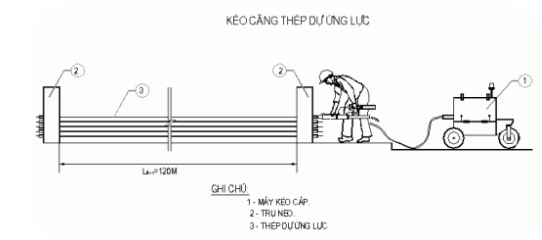
Pre-tensioned concrete is a type of concrete in which steel tendons are tensioned before concrete is placed. After the concrete reaches the required strength, the tendons are cut or released from the stressing bed. The tensile force in the tendons is then transferred to the concrete through bond, creating permanent compressive stress in the member.
3. Why use prestressed concrete?
| Problem of ordinary reinforced concrete | Benefit of prestressing |
|---|---|
| Cracking easily occurs in tensile zones | Reduces cracking, improves durability and appearance |
| Large deflection in long spans | Controls deflection more effectively |
| Beams and slabs often need greater depth | Reduces section size and optimizes usable space |
| High self-weight | Reduces load on foundations and supporting structures |
4. Key advantages
- Large span capability: suitable for factories, warehouses, parking structures, bridges and infrastructure works.
- Reduced cracking and deflection: improves long-term durability of the structure.
- Material optimization: reduces beam depth and structural self-weight.
- Better space efficiency: creates open layouts with fewer columns and more flexible functions.
- Life-cycle efficiency: when properly designed and constructed, long-term costs can be more favorable.
5. Limitations and risks to control
| Limitation | Risk if not properly controlled |
|---|---|
| Higher cost of tendons, anchorages and equipment | Incorrect cost estimation may increase investment cost |
| Construction requires high technical standards | Loss of prestress, hidden cracks or quality deviation |
| Concrete shrinkage and creep | Causes prestress losses over time |
| Risk of tendon corrosion | Affects service life if waterproofing and maintenance are poor |
6. When should it be applied?
It should be used when:
- The structural span is large, usually from about 8–12 m or more;
- The project requires wide, open spaces with fewer columns;
- There are heavy loads or strict requirements for crack and deflection control;
- The owner considers life-cycle cost, not only initial cost;
- The project has experienced design, construction and supervision teams.
It should be carefully considered when:
- The project is a small residential building with short spans and simple technical requirements;
- The owner selects only based on the lowest price;
- The contractor lacks experience in prestressed concrete;
- There is no long-term inspection and maintenance plan.
7. Basic process of pre-tensioned concrete
- Arrange tendons on a rigid stressing bed.
- Tension the tendons to the designed force.
- Place concrete while the tendons are held in tension.
- Cure the concrete until it reaches the required strength.
- Cut or release the tendons to transfer force into the concrete.
- Check quality, prestress losses and accept the member.
8. Applications in Vietnam
In Vietnam, prestressed concrete is increasingly used in bridges, industrial buildings, logistics warehouses, commercial centers, multi-storey parking structures, flat slabs in high-rise buildings and important infrastructure works.

However, hot and humid climate, marine environments, uneven construction quality and insufficient maintenance attention are factors that must be strictly controlled.
9. Common misconceptions
| Misconception | Correct understanding |
|---|---|
| Prestressed concrete is always better than ordinary concrete | It is only effective when applied to the right project, with proper design and construction |
| Every project should use it | Short-span and light-load projects may not need it |
| Using prestressing always saves money | Total design, construction, maintenance and life-cycle costs must be considered |
| Once construction is completed, no further checking is needed | Inspection, maintenance, waterproofing and corrosion control are still required |
10. Frequently asked questions
How is pre-tensioned concrete different from post-tensioned concrete?
Pre-tensioned concrete tensions the tendons before concrete is placed. Post-tensioned concrete tensions the tendons after the concrete has reached a certain strength.
Should it be used for residential houses?
It should only be considered when the house has large spans, special space requirements or heavy loads. For ordinary residential houses, traditional reinforced concrete is often more economical.
Is prestressed concrete durable?
It can be very durable if properly designed, built with qualified materials, accurately constructed and maintained with an appropriate plan.
What is the biggest risk?
Common risks include prestress loss, incorrect stressing procedures, poor waterproofing, tendon corrosion and inadequate quality control.
When should a specialist be involved?
A specialist should be involved from the preliminary design stage, especially for large-span structures, flat slabs, industrial buildings, parking structures or heavily loaded structures.
Conclusion
Pre-tensioned concrete is an advanced structural technology that enables large spans, reduces cracking and deflection, and improves space efficiency. However, this technology only delivers its full value when selected in the right context, properly designed, professionally constructed and strictly quality-controlled.

INDUSVINA sincerely thanks our readers, customers and partners for taking the time to read this article.
If you need a quotation, technical documentation or construction solution consultation for your project, please send us your request.
REQUEST A QUOTATION – CLICK HERE


