


Prestressing Steel Strand (PC Strand) – Standards, Specifications and Applications in Bridges, Industrial Buildings and Concrete Structures
Prestressing steel strand is a critical material that directly affects load-bearing capacity, crack control, deflection and the service life of bridges, ring roads, expressways, bridge girders, industrial buildings and precast concrete components.
1. What is Prestressing Steel Strand?
Prestressing Steel Strand, commonly called PC Strand, is a high-strength steel product usually made from seven steel wires helically wound together. The strand is tensioned to introduce an active compressive force into the concrete structure.
This compressive force helps control cracking, reduce deflection, achieve longer spans and improve material efficiency compared with many conventional reinforced concrete solutions.
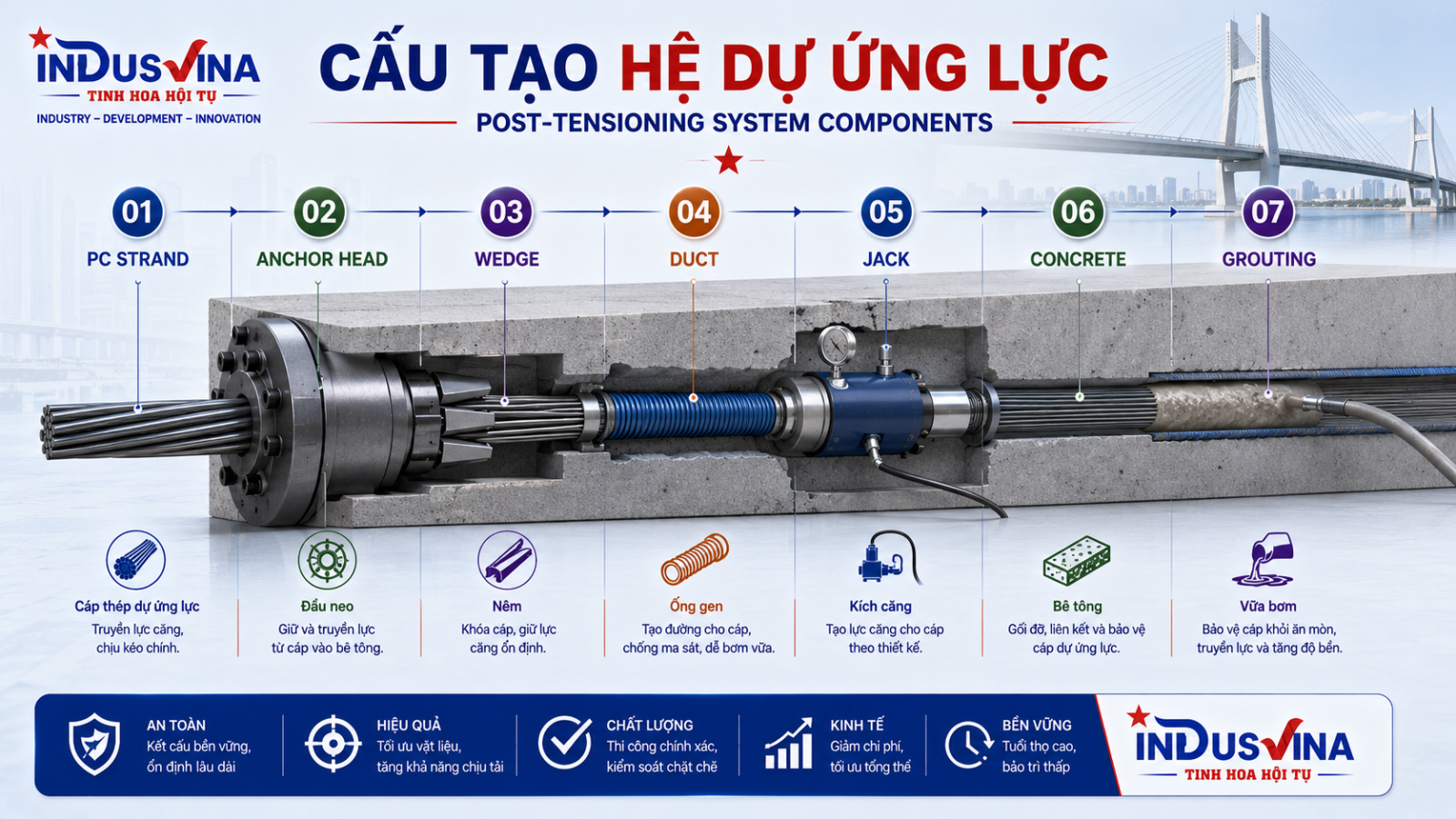
2. Components of a Prestressing System
The strand is only one part of the complete system. Safe force transfer and long-term durability depend on the compatibility of the strand, anchorage, wedges, duct, stressing jack, concrete and grouting work.
3. Commonly Specified PC Strand Standards
The applicable standard must be confirmed in the drawings, technical specifications, tender documents or requirements issued by the design consultant.
A quotation should not propose a supposedly equivalent standard unless a technical comparison has been prepared and approved by the authorised project party.
| Standard | General Scope | Procurement Points to Check |
|---|---|---|
| ASTM A416/A416M | Uncoated seven-wire steel strand for prestressed concrete. | Grade, nominal diameter, cross-sectional area, breaking load, elongation and relaxation. |
| EN 10138 | Prestressing steel under the European standard system. | Product type, mechanical properties, tolerances, testing and certification. |
| BS 5896 | High-tensile steel products used for concrete prestressing. | Strand classification, mechanical properties and testing requirements. |
| JIS G 3536 | Steel wire and strand for prestressed concrete. | Material designation, dimensions, mechanical properties and test documentation. |
| Project-Specific Standard | Requirements issued by the owner, design consultant or regulatory authority. | Always prioritise requirements approved in the project documents. |
4. Specifications to Confirm Before Requesting a Quotation
A quotation is meaningful only when the essential technical parameters are defined. Products may all be called PC Strand, but differences in standards, diameter, relaxation, protective coating, packing or inspection requirements will affect both price and delivery time.
| Item | Information to Confirm | Procurement Impact |
|---|---|---|
| Strand Construction | Normally seven-wire strand, subject to confirmation against the technical specification. | Determines the appropriate product type and supply source. |
| Nominal Diameter | Common sizes include 12.7 mm and 15.2 mm; other sizes may be specified. | Affects cross-sectional area, breaking load, anchorage and stressing equipment. |
| Nominal Tensile Strength | Must comply with the design; 1,860 MPa is common but is not automatic for every project. | Directly affects stressing calculations and acceptance criteria. |
| Relaxation Class | Normal relaxation or low relaxation, as required by the standard and design. | Influences long-term prestress losses. |
| Surface and Protection | Bare strand, sheathed strand, galvanised strand, epoxy-coated strand or another protective system. | Depends on the environment, prestressing method and corrosion-protection requirements. |
| Coil Weight | Nominal weight, tolerance, coil dimensions and required coil division. | Affects transport, unloading, storage and construction planning. |
| Packing | Steel straps, protective wrapping, labels, batch numbers and moisture protection. | Affects traceability and site storage conditions. |
| Inspection | Factory testing, independent laboratory testing or incoming inspection. | Affects cost, delivery schedule and acceptance documentation. |

5. Common Types of Prestressing Steel
PC Strand
Multi-wire steel strand widely used in bridge girders, slabs, beams, piles and prestressed precast concrete components.
Procurement focus: diameter, grade, relaxation, length and coil weight.
PC Wire
Single prestressing steel wire commonly used in certain precast concrete production lines.
Procurement focus: wire diameter, surface condition, mechanical properties and production technology.
PC Bar
High-strength steel bar used for anchoring systems, connections, bracing or specialised prestressing applications.
Procurement focus: strength class, thread type, length and compatible accessories.
Protected Strand
May include PE/HDPE-sheathed, galvanised or epoxy-coated strand, depending on the design and exposure environment.
Procurement focus: protective-system construction and compatibility with the complete prestressing system.
6. PC Strand Applications by Project Type
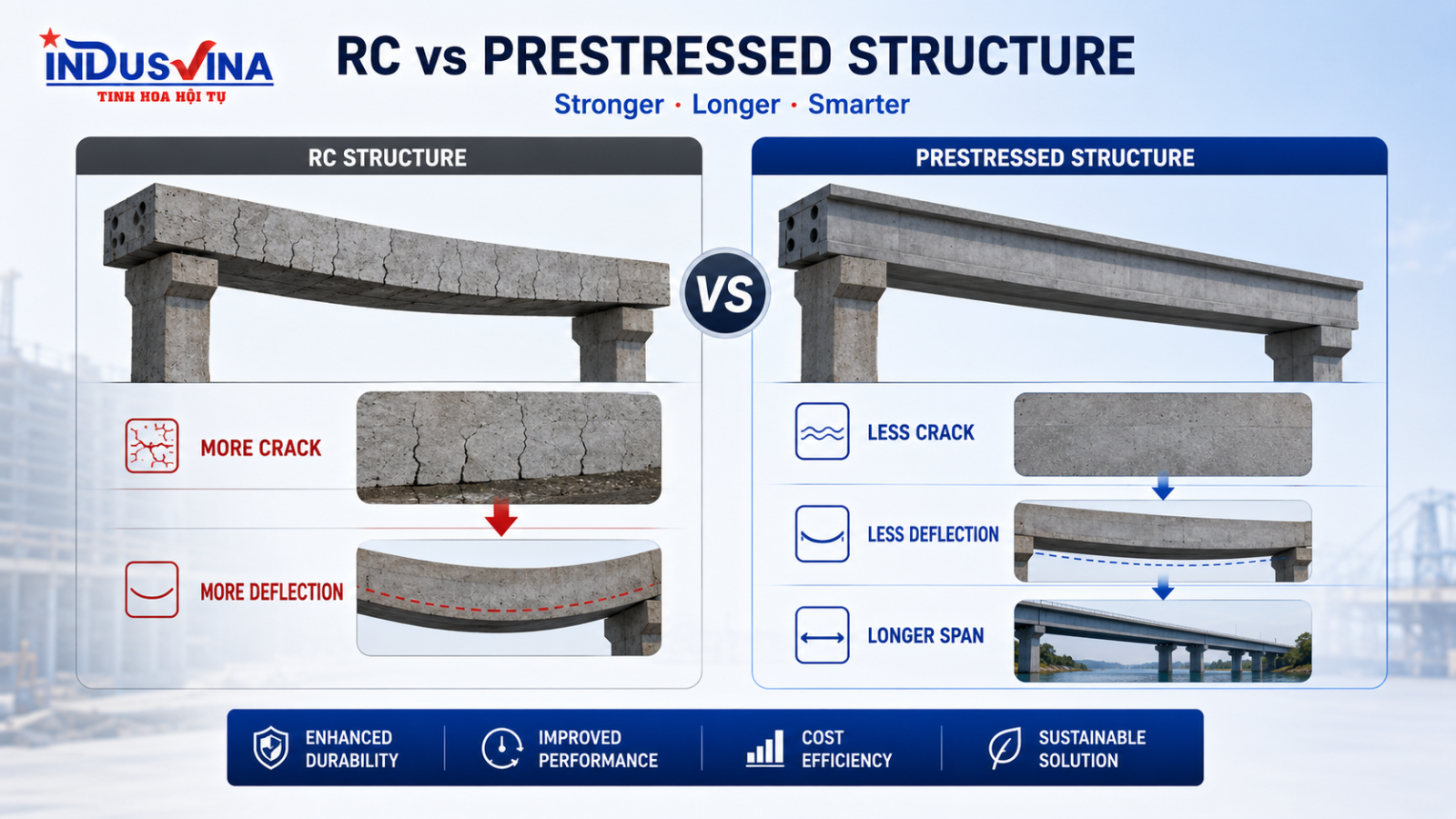
7. How Does Prestressed Concrete Differ from Conventional Reinforced Concrete?
Prestressed concrete is not an automatic replacement for conventional reinforced concrete. Selection depends on span, loading, function, geometry, programme, construction capability and whole-life cost.
| Criterion | Prestressed Concrete Structure | Conventional Reinforced Concrete |
|---|---|---|
| Structural Mechanism | Introduces active compression before or after the concrete reaches the specified condition. | Reinforcement resists tension as the structure is loaded. |
| Crack Control | Can provide effective crack control when properly designed and constructed. | Cracking is controlled through reinforcement detailing and member dimensions. |
| Deflection | Beneficial for long spans and members requiring limited deformation. | May require greater depth or stiffness. |
| Construction | Requires compatible anchorage, calibrated equipment, stressing procedures and strict QA/QC. | More common and generally less dependent on specialised stressing equipment. |
| Acceptance Records | Requires material records, stressing force, elongation, anchorage locking and grouting documentation. | Mainly focuses on reinforcement, concrete, geometry and related tests. |

8. Prestressing System Construction Process
The exact sequence depends on whether the system is pre-tensioned, bonded post-tensioned, unbonded post-tensioned or based on a project-specific design.
The following sequence represents the main control stages commonly encountered.

9. Hold Points and QA/QC Control
For bridges, expressways and major infrastructure projects, Hold Points prevent the next activity from proceeding until critical technical conditions have been verified.
| Control Point | Items to Verify | Recommended Records |
|---|---|---|
| HP1 – Incoming Materials | Manufacturer, batch number, standard, diameter, condition and quantity. | CO/CQ, Mill Test Certificate, delivery note and inspection report. |
| HP2 – Anchorage and Ducts | Product type, system compatibility, position, elevation, watertightness and installation condition. | Checklist, approved drawings, photographs and inspection records. |
| HP3 – Before Concrete Casting | Tendon profile, anchorages, reinforcement, grout inlets and vents. | Inspection record for concealed work. |
| HP4 – Before Stressing | Concrete strength, jack and gauge calibration, sequence and stressing force. | Concrete test results, calibration certificates and approved stressing procedure. |
| HP5 – Stressing Results | Pressure, stressing force, elongation, anchorage locking and permitted tolerances. | Stressing record for each tendon or cable group. |
| HP6 – Grouting | Materials, mix proportions, flowability, pressure, sequence and complete filling. | Grouting report, test results and construction log. |
| HP7 – Final Acceptance | Material, construction, test and as-built records, including close-out of outstanding items. | Complete quality dossier for the work package. |

10. Common Errors and Their Consequences
| Error | Potential Risk | Recommended Control |
|---|---|---|
| Incorrect Standard or Grade | Non-compliance with the design, rejection or material replacement. | Freeze the specification and obtain approval before purchasing. |
| Loss of Batch Traceability | Difficulty matching certificates and test results to supplied material. | Manage coil labels, lot numbers and installation locations. |
| Corroded or Damaged Strand | Possible effects on cross-section, surface condition and structural performance. | Store dry, elevate from the ground, cover properly and inspect on delivery. |
| Incompatible Anchorage System | Risk of wedge slip, unstable anchorage or unsuitable force transfer. | Verify compatibility and approved system documentation. |
| Uncalibrated Stressing Jack | Difference between actual stressing force and recorded value. | Manage valid calibration certificates and matched jack-gauge combinations. |
| Pressure Checked Without Elongation | Abnormal friction, incorrect length or tendon-profile problems may go undetected. | Assess both stressing force and measured elongation. |
| Incomplete Grouting | Voids may remain, reducing protection and increasing corrosion risk. | Control materials, equipment, vents, pressure and grouting sequence. |
11. Procurement Checklist Before Purchase
The following checklist helps the procurement team coordinate with engineering, QA/QC, the project management team and the supplier before issuing a purchase order.
Avoid requesting only: “Please quote 15.2 mm strand”
A complete enquiry should identify the standard, grade, relaxation, protective system, quantity, coil weight, quality documents, inspection requirements, delivery schedule and delivery location.

12. Recommended Quality and Delivery Documentation
Technical and Quality Documents
- Applicable Technical Data Sheet or catalogue.
- Mill Test Certificate for each production batch.
- CO/CQ as required by the contract.
- Mechanical test or independent inspection results where required.
- Project specification compliance statement.
- Material approval documentation where applicable.
Commercial and Delivery Documents
- Quotation and commercial conditions.
- Purchase Order or contract.
- Packing List and delivery note.
- Invoice and transport documentation.
- List of coil numbers, batch numbers and actual delivered weights.
- Delivery and incoming inspection records.
13. Site Delivery and Storage of PC Strand
14. Information Required for INDUSVINA to Review and Quote
To reduce technical clarification time, customers and project partners should provide at least the following information.
Technical Information
- Technical specification or material requirements.
- Applicable standard.
- Diameter, grade and relaxation class.
- Surface or corrosion-protection requirements.
- Required coil weight and dimensions.
- Required certificates and testing.
Commercial and Delivery Information
- Total quantity and phased delivery schedule.
- Delivery location.
- Unloading conditions and receiving hours.
- Packing, labelling and traceability requirements.
- Proposed payment terms.
- Required quotation deadline.
15. INDUSVINA’s Role in the Project Material Supply Chain
INDUSVINA approaches PC Strand requirements from a technical-commercial perspective: clarifying requirements, reviewing documentation, connecting suitable supply sources, coordinating inspection and arranging delivery under the agreed conditions.
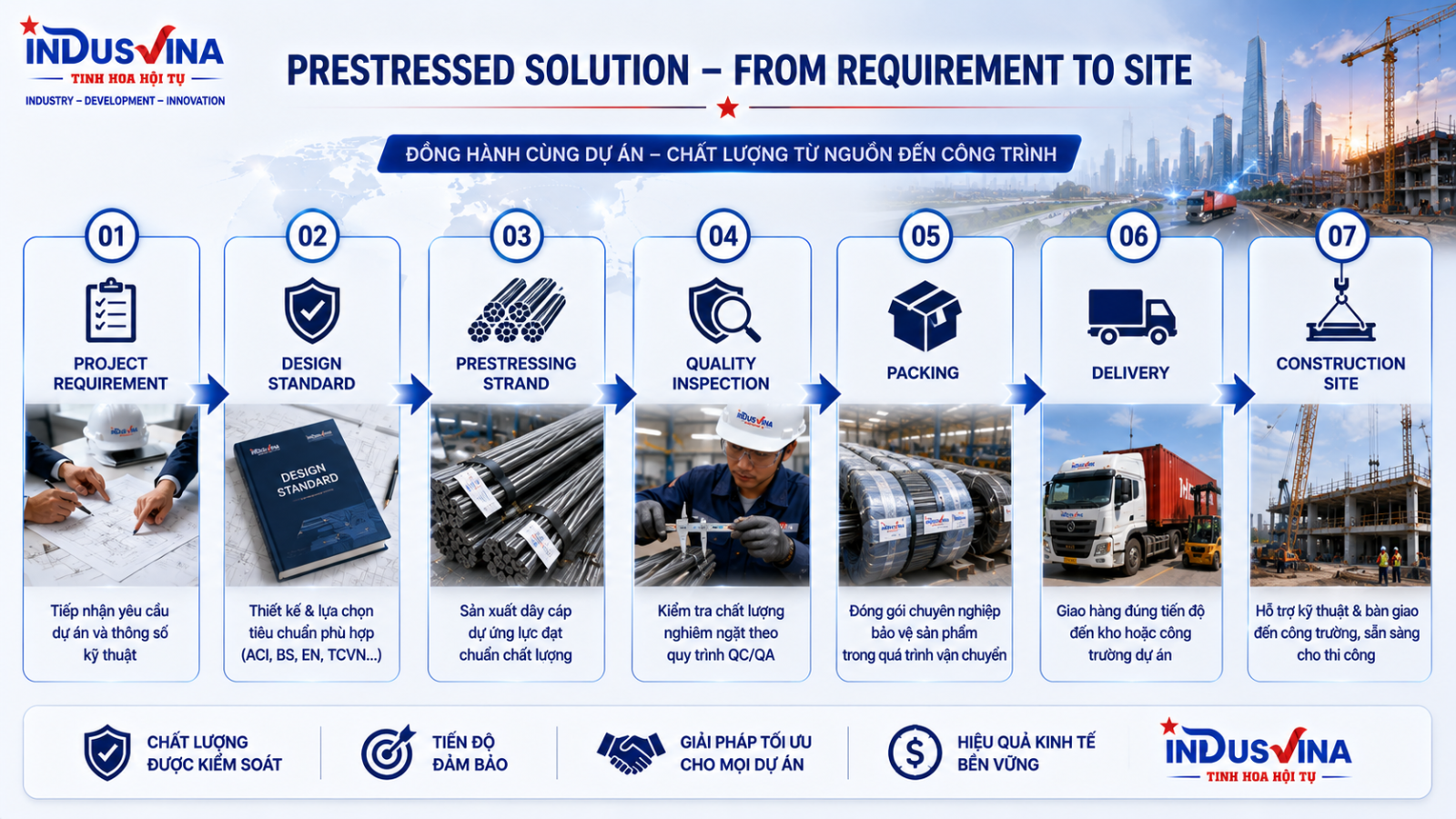
16. PC Strand Selection Roadmap for a Project
17. Conclusion
- PC Strand should not be purchased solely by comparing price per kilogram.
- The standard, grade, relaxation, anchorage system and quality records must be confirmed as one coordinated package.
- Procurement must coordinate with design, engineering, QA/QC and the project management team.
- Coil weight, packing, delivery schedule and unloading conditions should be considered from the ordering stage.
- Batch traceability, Hold Points and acceptance documentation support long-term quality management.
Related Articles and Services
FAQ – Frequently Asked Questions About PC Strand
What is Prestressing Steel Strand?
PC Strand is a high-strength steel strand, normally made from seven helically wound wires, that is tensioned to introduce active compression into a concrete structure.
What is the difference between 12.7 mm and 15.2 mm PC Strand?
They differ in diameter, cross-sectional area, nominal breaking load and compatible anchorage system. Selection must follow the approved design.
What does low relaxation mean?
Low relaxation indicates that the steel is designed to limit prestress loss caused by relaxation over time under specified test conditions.
Is 1,860 MPa PC Strand suitable for every project?
No. It is a commonly specified strength class, but the final grade and mechanical properties must comply with the approved project design and technical documents.
Can PC Strand corrode?
Yes. Steel strand may corrode if exposed to moisture, chemicals, improper storage or inadequate protection.
When should PE/HDPE-sheathed or corrosion-protected strand be used?
Selection depends on the prestressing system, exposure environment, design life and corrosion-protection requirements of the project.
Are CO, CQ and Mill Test Certificate the same?
Not exactly. CO generally relates to origin, CQ is a form of quality certification and the Mill Test Certificate records test results for the production batch.
Should PC Strand be quoted by kilogram or by coil?
It may be priced by weight, but coil weight, tolerance, number of coils, total delivered quantity and delivery conditions must also be confirmed.
Can ASTM A416 be replaced by another standard?
Replacement should be considered only after a technical comparison has been prepared and approved by the design consultant or another authorised project party.
What information is required for a PC Strand quotation?
The enquiry should include the standard, diameter, grade, relaxation, protective system, quantity, coil weight, required documentation, delivery location and required delivery schedule.
Send a Request for PC Strand Quotation
Owners, contractors and construction partners may send the specification, BOQ, delivery schedule and site location for INDUSVINA to review, clarify and coordinate a suitable supply option.


