


Vietnam Tax Policy 2026: Key Changes, Business Impacts and Entitlements
This article systematises the changes directly affecting business operations in 2026 and places them alongside the previous rules to clarify what costs may be reduced, what businesses must change, who benefits, and where compliance risks arise.

Quick-reference contents
1. Scope: what does “Vietnam tax policy 2026” mean?
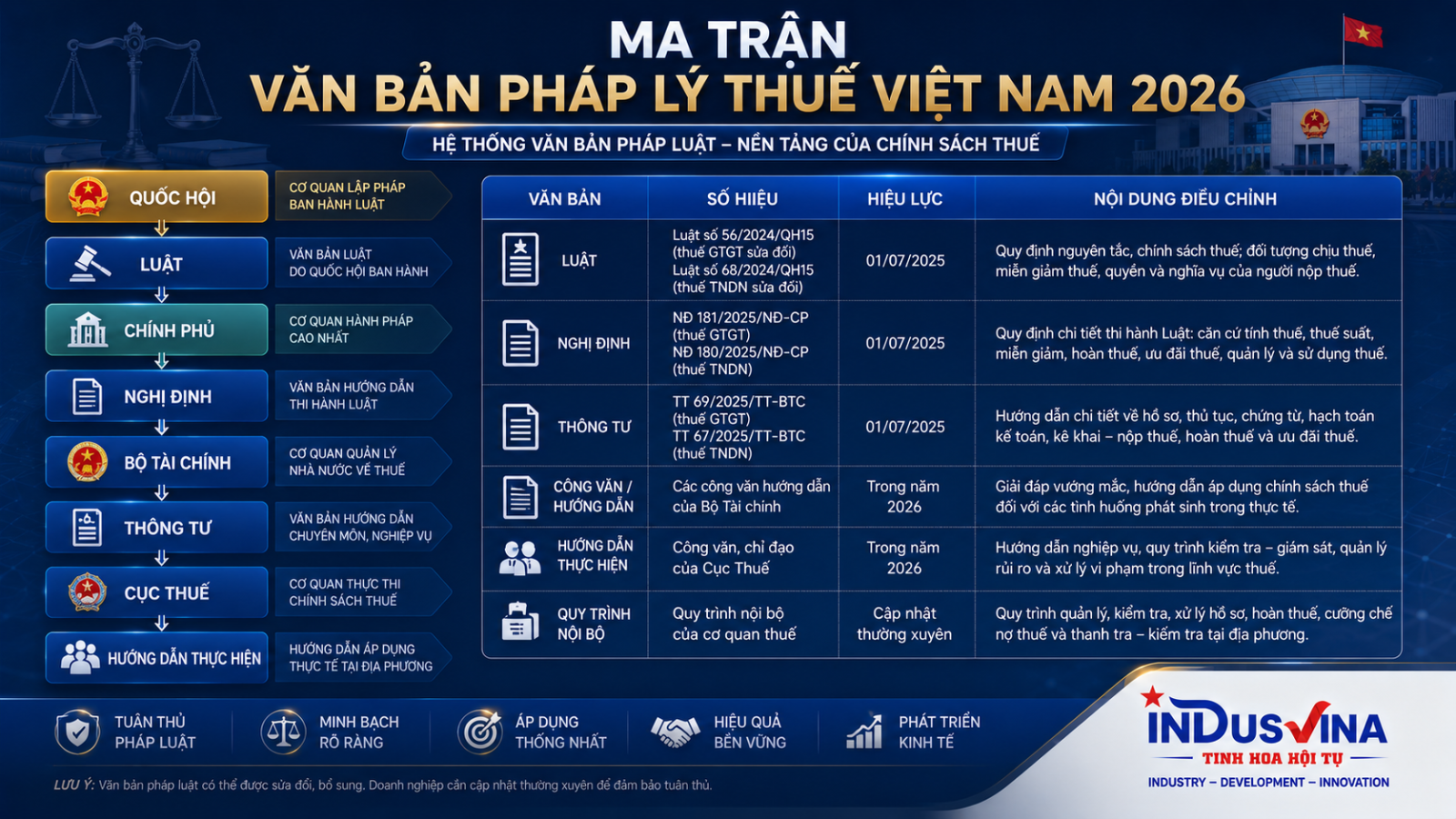
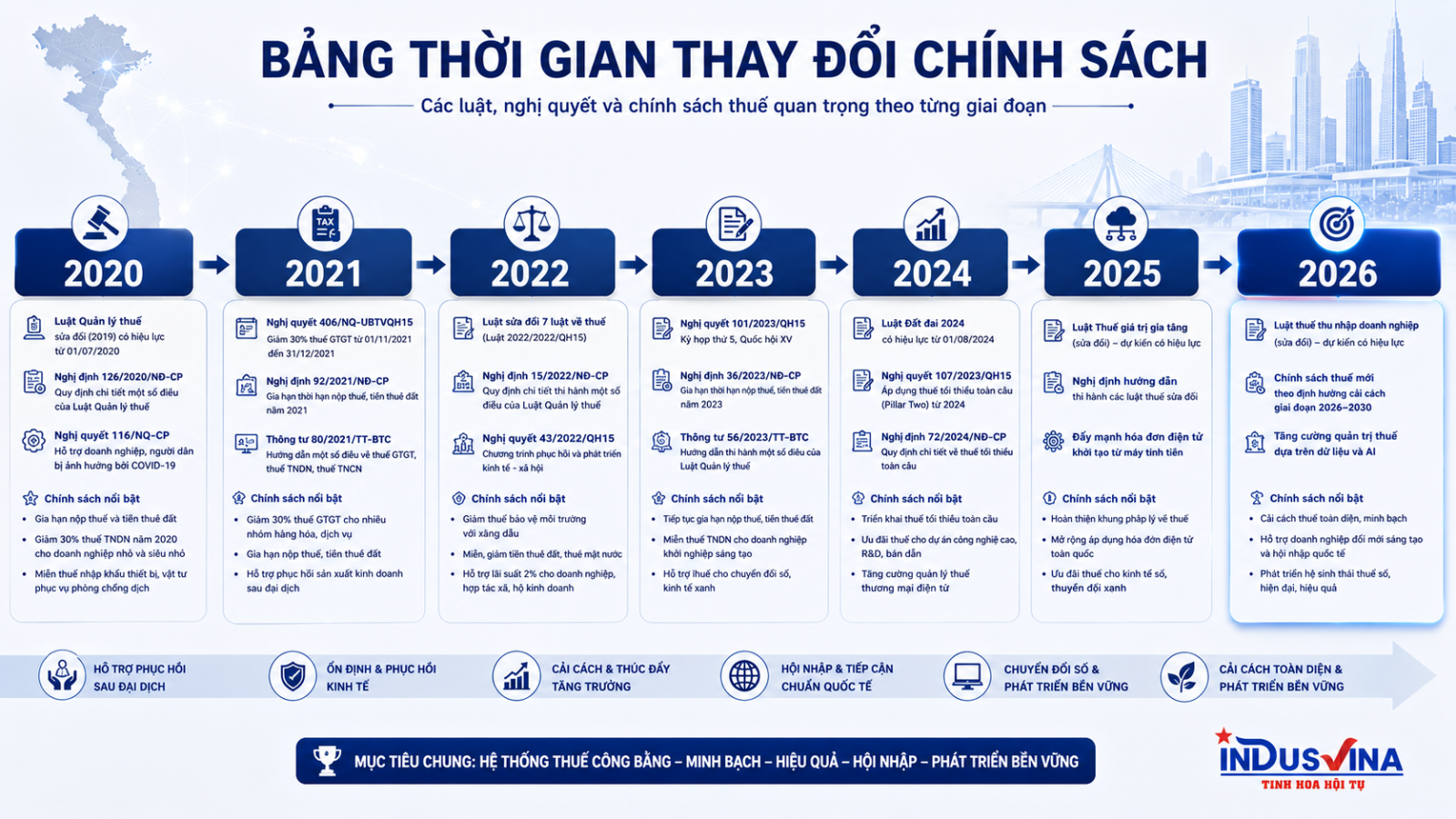
Not every rule discussed below was enacted precisely on 1 January 2026. This article brings together laws, resolutions and decrees that have taken effect or continue to affect businesses during 2026. Therefore, a policy enacted in 2024 or 2025 remains a material 2026 change when it governs a 2026 tax period, invoice, transaction or business activity.
Support measures
VAT reduction, lower CIT rates for small enterprises, termination of the business licence fee, and selected support for business-model conversion.
Structural reform
Ending the presumptive tax method, moving toward declaration based on actual revenue, and standardising invoices and accounting records.
Control measures
Cash-register e-invoices, data connectivity, non-cash payment conditions and stronger cross-checking capabilities.

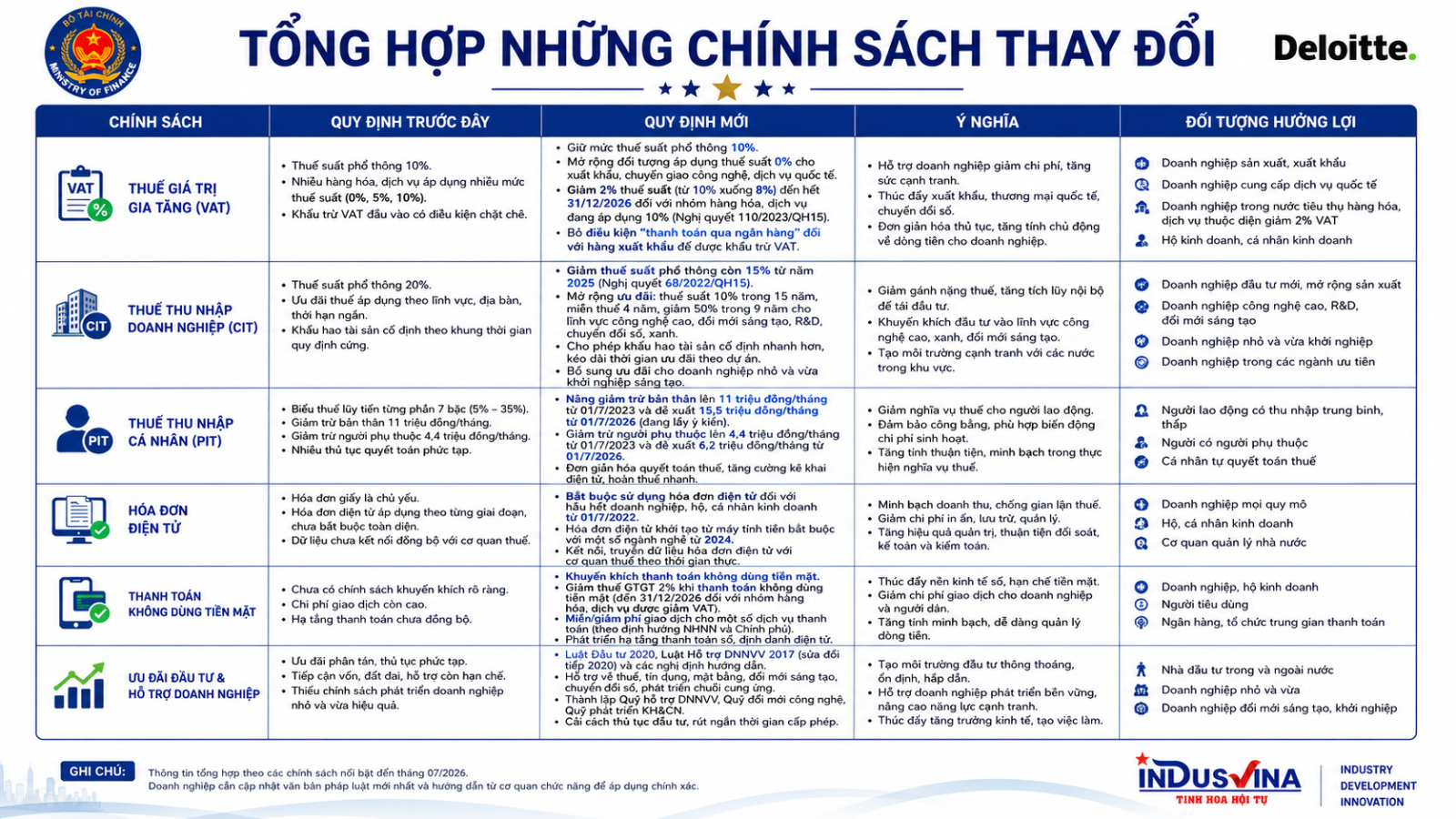
2. Summary table: previous rules – rules applicable in 2026 – meaning of the change
| Policy | Previous rule | Rule applicable in 2026 | Meaning of the change | Who benefits or is affected? | Main legal basis |
|---|---|---|---|---|---|
| Two-percentage-point VAT reduction | The standard rate was 10%; the reduction to 8% was extended in phases and subject to defined scope. | Eligible goods and services continue to enjoy the 8% rate through 31 December 2026, while excluded categories remain subject to the applicable statutory rate. | Direct support Reduces the tax-inclusive price, supports consumption, revenue and cash flow. |
Consumers, eligible businesses and supply chains whose outputs fall within the reduced-rate scope. | Resolution No. 204/2025/QH15; Decree No. 174/2025/ND-CP. |
| Input VAT deduction conditions | Businesses commonly applied the former VND 20 million non-cash payment threshold. | The new VAT Law and Decree No. 181/2025 revise the non-cash payment documentation conditions; businesses must review the new threshold and exceptions. | Stronger control Reduces cash transactions, improves traceability and discourages invoices unsupported by genuine transactions. |
Compliant businesses gain a fairer competitive environment; businesses with weak payment controls risk losing deductions. | Article 14 of Law No. 48/2024/QH15; Decree No. 181/2025/ND-CP. |
| VAT-exempt revenue threshold for household and individual businesses | The commonly applied threshold under the former law was VND 100 million per year. | From 1 January 2026, the annual revenue threshold for non-liability to VAT increases to VND 200 million. | Lower burden Reduces tax and procedural costs for very small businesses. |
Household and individual businesses with annual revenue above VND 100 million but not exceeding VND 200 million. | Clause 25, Article 5 and Clause 2, Article 18 of Law No. 48/2024/QH15. |
| Revenue-based CIT rates | The standard rate was 20%; incentives were mainly linked to sectors, locations and investment projects. | A 15% rate applies to enterprises with annual revenue not exceeding VND 3 billion, and 17% to enterprises with annual revenue above VND 3 billion but not exceeding VND 50 billion, subject to conditions; 20% remains the standard rate. | Lower cost of capital Supports retained earnings, reinvestment and formalisation of small businesses. |
Eligible independent small enterprises; certain related-party or group entities may be excluded. | Article 10 of Law No. 67/2025/QH15. |
| Termination of presumptive tax | Household and individual businesses could pay tax according to a presumptive amount determined by the tax authority. | From 1 January 2026, the presumptive tax method is abolished and administration shifts toward declarations based on actual revenue. | Support and added obligations Promotes transparency and fairness, but requires stronger records, invoices and revenue data. |
Household businesses are directly affected; formal enterprises benefit from reduced unfair competition. | Article 10 of Resolution No. 198/2025/QH15. |
| Termination of the business licence fee | Enterprises, household and individual businesses paid the fee based on charter capital or revenue, unless exempt. | Collection and payment of the business licence fee terminate from 1 January 2026. | Lower fixed cost Removes a recurring charge and simplifies administration. |
All enterprises, household and individual businesses that were previously liable. | Article 10 of Resolution No. 198/2025/QH15. |
| Cash-register e-invoices | The mandatory scope was narrower, and many consumer-facing businesses were not connected in near real time. | The scope expands, particularly for household and individual businesses with annual revenue of at least VND 1 billion in specified consumer-facing sectors. | Revenue transparency Sales data are connected to the tax authority, reducing gaps in tax administration. |
Consumers receive invoices more easily; compliant businesses compete more fairly; businesses not yet digitalised incur transition costs. | Decree No. 70/2025/ND-CP amending Decree No. 123/2020/ND-CP. |
| Support for conversion from household business to enterprise | Support was fragmented, while initial conversion and compliance costs remained barriers. | Resolution No. 198 introduces support and incentives; qualifying newly registered SMEs may receive a three-year CIT exemption under applicable law. | Encourages formalisation Reduces start-up costs and improves access to finance and B2B customers. |
Household businesses converting into enterprises and qualifying newly established SMEs. | Resolution No. 198/2025/QH15 and implementing instruments. |
Note: This table is a policy map. Actual application depends on the goods or services, sector, revenue, related-party status, transaction date and supporting documentation.
3. Value-added tax: which changes reduce costs and which increase risk?
3.1. Reduction from 10% to 8% through the end of 2026
Resolution No. 204/2025/QH15 continues the two-percentage-point VAT reduction for eligible goods and services otherwise subject to 10%, from 1 July 2025 through 31 December 2026. This is a demand-stimulus measure: buyers pay less tax, while businesses can maintain more competitive pricing and support sales.
3.2. The new VAT Law and input VAT deduction conditions
Law No. 48/2024/QH15, principally effective from 1 July 2025, replaces the former legislative framework. A major operational change is the revised non-cash payment documentation condition for purchases. Approval workflows for payments, advances, debt offsets, employee payments and instalments should therefore be redesigned.
3.3. Higher VAT-exempt revenue threshold for household and individual businesses
From 1 January 2026, the annual revenue threshold for non-liability to VAT increases from VND 100 million to VND 200 million. This directly supports very small businesses while allowing tax authorities to focus resources on larger and higher-risk taxpayers.
| Situation | Positive impact | Risk to control | Required action |
|---|---|---|---|
| Sale eligible for 8% VAT | Lower tax-inclusive price and stronger demand. | Applying the reduction to an ineligible item may cause under-declaration. | Maintain an approved item-and-rate master list. |
| Purchase subject to non-cash payment conditions | More transparent cash flows. | Input VAT deduction may be lost if payment is made incorrectly. | Block non-compliant cash payments in the ERP/accounting workflow. |
| Household business with annual revenue not exceeding VND 200 million | No VAT liability within the statutory threshold. | Actual revenue must be evidenced; artificial splitting is not acceptable. | Retain sales data and determine full-year revenue accurately. |
4. Corporate income tax: standard rates are now differentiated by revenue size
CIT Law No. 67/2025/QH15 introduces an important change: alongside the 20% standard rate, lower rates apply to qualifying small enterprises based on annual total revenue, subject to statutory conditions and exclusions.
15%
For a qualifying enterprise with annual total revenue not exceeding VND 3 billion.
17%
For a qualifying enterprise with annual total revenue above VND 3 billion but not exceeding VND 50 billion.
20%
The standard rate for enterprises outside the 15% and 17% groups, unless another incentive applies.
Economic significance
- Direct tax savings: higher retained earnings provide additional internal financing.
- Encouragement of investment and expansion: small enterprises gain room to purchase equipment, hire staff and build systems.
- Formalisation incentive: household businesses have an additional reason to convert into enterprises.
- Anti-fragmentation safeguards: entities with related-party relationships or restructurings designed solely to obtain a lower rate require particular caution.
Illustrative example
| Assumption | At 20% | If eligible for 17% | Difference | Meaning |
|---|---|---|---|---|
| Taxable income of VND 2 billion | VND 400 million | VND 340 million | VND 60 million saving | The saving may support working capital or reinvestment. |
This is a mechanical rate illustration only. It does not account for other incentives, carried-forward losses, exempt income, related-party adjustments or non-deductible expenses.
5. E-invoices and tax data: from retrospective filing to near-real-time risk detection
Decree No. 70/2025/ND-CP amends Decree No. 123/2020/ND-CP and expands and clarifies the e-invoice framework, including e-invoices generated from cash registers. This does not reduce tax rates, but materially affects revenue management, sales systems, software and internal control.
Previously
- Sales and invoice data could be held in separate systems.
- Some consumer-facing businesses did not issue invoices for every transaction.
- Revenue reconciliation often occurred after the filing period.
New direction
- Invoices are more closely linked to the time of sale.
- Cash-register data are connected to the tax authority.
- Revenue, bank accounts and tax returns can be cross-checked.
Businesses requiring particular attention
Household and individual businesses with annual revenue of at least VND 1 billion that sell goods or provide services directly to consumers within the prescribed sectors; retail, food and beverage, hotels, passenger transport, entertainment and specified personal services.
6. Household and individual businesses: a structural change from 1 January 2026
The termination of the presumptive tax method is among the most significant changes. The objective is not merely to increase state revenue, but to move from administratively fixed tax amounts toward actual-revenue-based administration, thereby improving competitive neutrality between household businesses and enterprises.
| Topic | Previous mechanism | From 2026 | Meaning | Preparation required |
|---|---|---|---|---|
| Tax method | Presumptive tax could apply. | The presumptive method is abolished. | Tax more closely reflects actual revenue. | Record revenue, costs and sales data completely. |
| Business licence fee | Payable by revenue band unless exempt. | Collection and payment terminate from 1 January 2026. | Reduces a recurring cost and filing obligation. | Do not continue paying automatically; monitor transitional guidance. |
| Invoices | Many household businesses did not issue an invoice for every transaction. | Expanded e-invoice and cash-register requirements based on size and sector. | Improves transparency and protects buyers. | Select software, equipment and offline/error-handling processes. |
| Conversion into an enterprise | Initial compliance costs were a barrier. | Support and incentives are available under Resolution No. 198 and related laws. | Improves access to financing, tenders and corporate customers. | Compare household and company models based on revenue, labour, assets and risk. |

7. Investment incentives, innovation and the global minimum tax
For major investment projects, high-tech companies and multinational groups, tax planning in 2026 cannot focus solely on the nominal CIT rate. Businesses must assess domestic tax incentives together with the global minimum tax rules and cost-based investment support mechanisms.
Global minimum tax
Vietnam applies a qualified domestic minimum top-up tax and an income inclusion rule to multinational groups meeting the consolidated revenue threshold under Resolution No. 107/2023/QH15.
Investment Support Fund
Decree No. 182/2024/ND-CP establishes cost-support mechanisms for qualifying enterprises and projects to maintain investment attractiveness in the global minimum tax environment.
Significance: Large investors may no longer retain the full benefit of traditional CIT exemptions and reductions where their effective tax rate falls below the minimum level. Policy therefore shifts toward support linked to substantive activities, research and development, workforce, assets and infrastructure.
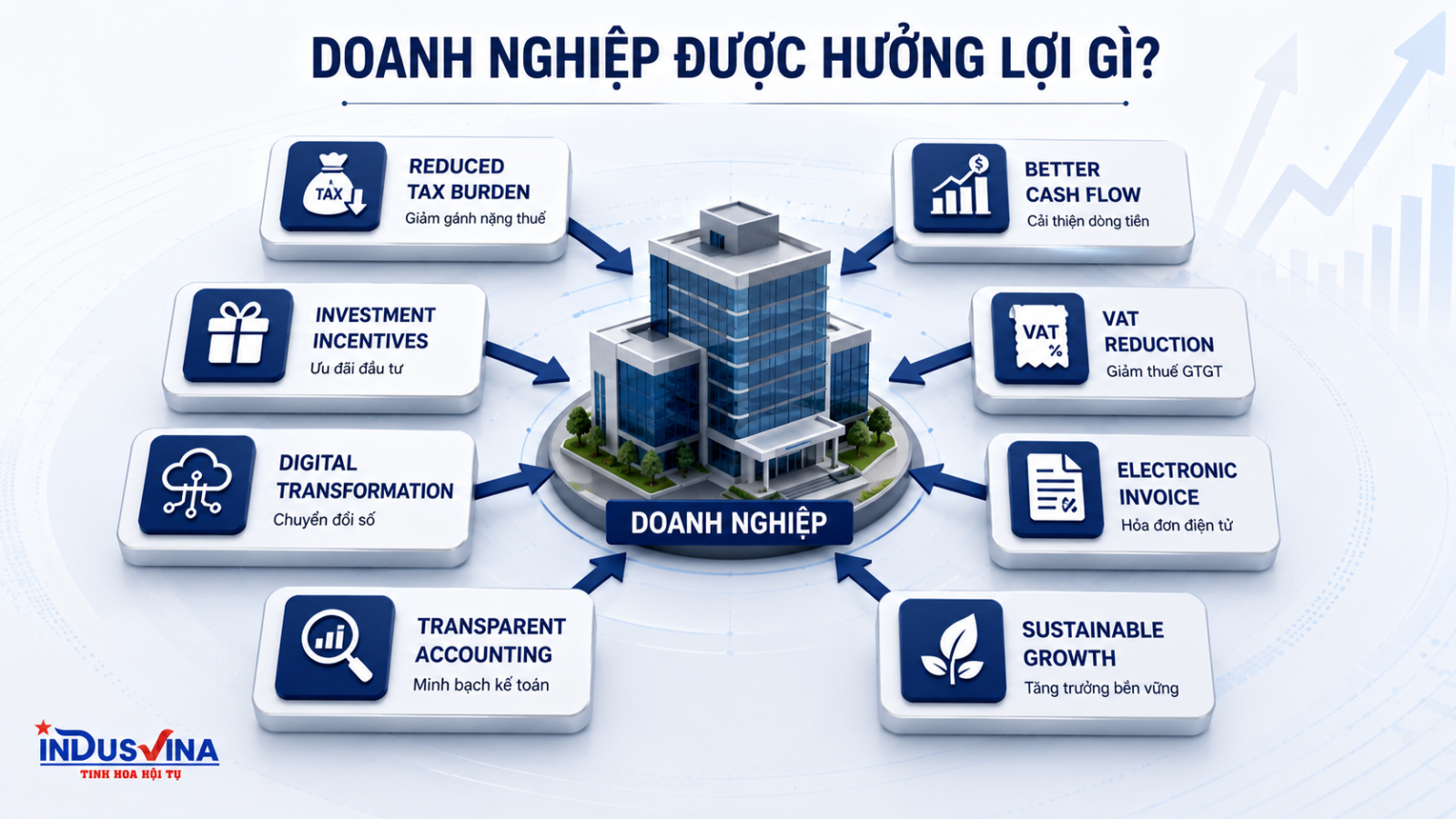
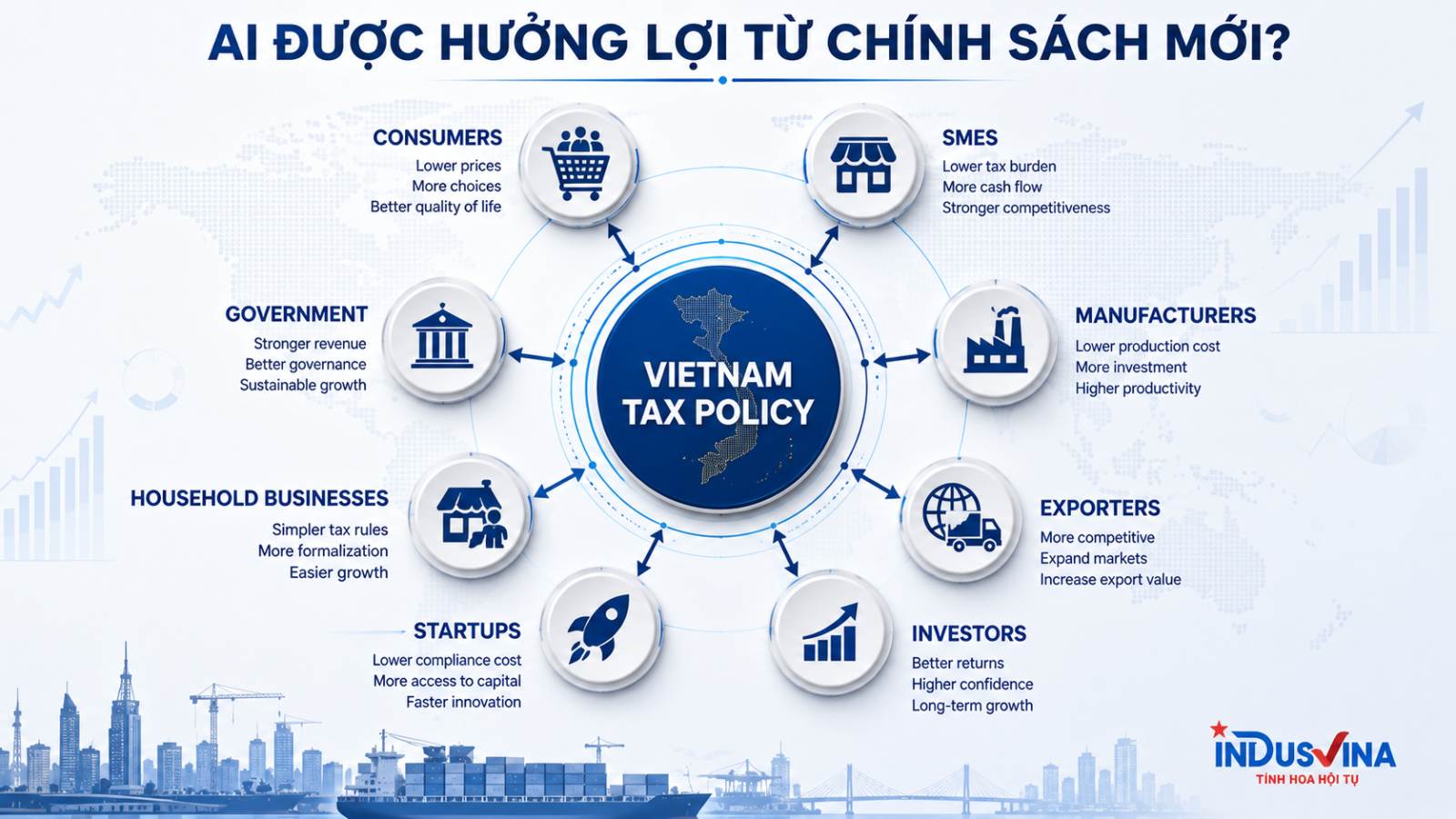
8. Who actually benefits from the new mechanisms?
| Group | Relevant policy | Direct benefit | Indirect benefit | Conditions/risks |
|---|---|---|---|---|
| Consumers | 8% VAT | Lower tax included in the purchase price. | Greater purchasing power. | Only eligible goods and services qualify. |
| Low-revenue enterprises | 15% or 17% CIT | Lower corporate income tax. | More retained capital and reinvestment capacity. | Revenue criteria and exclusions must be satisfied. |
| Very small household businesses | VND 200 million VAT threshold | No VAT where annual revenue does not exceed the threshold. | Lower administrative burden. | Revenue must be determined truthfully. |
| All business establishments | Termination of business licence fee | Removal of a recurring payment. | Simpler administration. | Monitor transitional provisions. |
| Compliant businesses | E-invoices and termination of presumptive tax | No automatic immediate tax reduction. | Less unfair competition from hidden revenue. | Systems and data controls require investment. |
| Strategic investors | Investment Support Fund | Potential support for eligible costs. | Maintains Vietnam's investment attractiveness. | Project, sector, scale and documentation criteria are stringent. |
9. Which policies reduce costs, and which increase compliance costs?
| Policy | Reduces final tax liability | Supports cash flow | Stimulates demand/investment | Raises compliance costs | Assessment |
|---|---|---|---|---|---|
| 8% VAT | Yes | Yes, depending on the transaction chain | Yes | Low–medium | Direct support, but classification must be correct. |
| 15%–17% CIT | Yes | Yes | Yes | Medium | Material benefit for qualifying small enterprises. |
| Termination of business licence fee | Yes | Yes | Indirectly | Reduced | Simple and broadly applicable. |
| Termination of presumptive tax | Not automatically | Case-dependent | Indirectly | High during transition | Promotes fair competition but requires digital support. |
| Cash-register e-invoices | No | Not directly | Not directly | Yes | Initial investment in exchange for long-term transparency. |
| Non-cash payment conditions | No | May affect operations | Not directly | Yes | Protects input VAT deduction when implemented correctly. |

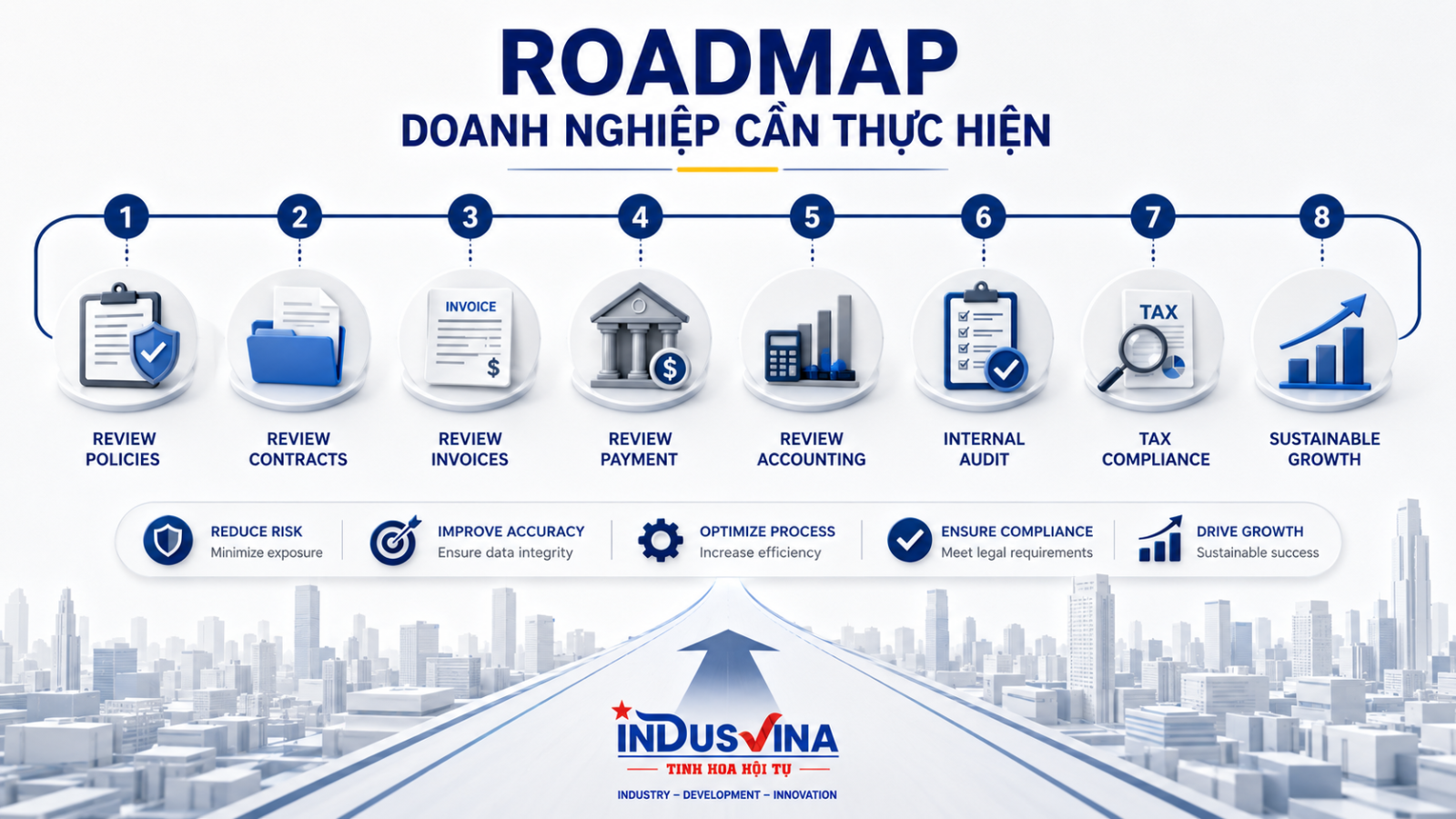
10. Implementation roadmap: what should businesses do in 2026?
Steps 1–3: determine scope
- Prepare a register of applicable legal instruments by sector.
- Classify all goods and services under 8%, 10%, 5%, 0% VAT or non-taxable categories.
- Determine prior-year revenue to assess the applicable CIT rate.
Steps 4–6: revise processes
- Update tax and invoice clauses in contracts.
- Implement controls for non-cash payments.
- Synchronise POS, invoices, banking, ERP and tax returns.
Steps 7–9: verify data
- Reconcile revenue, invoices, bank statements and tax returns.
- Review suppliers and invoice status.
- Prepare documentation proving incentive eligibility.
Steps 10–12: manage risk
- Conduct quarterly internal tax reviews.
- Train sales, procurement, accounting and payment-approval teams.
- Update policies whenever new instruments or transitional guidance are issued.
Short checklist for the Board and CFO
- ☐ Has the enterprise confirmed whether it qualifies for the 15% or 17% CIT rate?
- ☐ Has the list of 8% VAT items and exclusions been formally approved?
- ☐ Does the payment process block transactions that fail deduction conditions?
- ☐ Do POS, invoice, banking and accounting revenue figures reconcile?
- ☐ Have household businesses in the supply chain prepared for the end of presumptive tax?
- ☐ Are incentive, investment, related-party and deductible-expense files sufficiently evidenced?
11. Legal framework matrix and official reference sources
| Instrument | Issuing authority | Effective date/scope | Subject used in this article |
|---|---|---|---|
| Law No. 48/2024/QH15 | National Assembly | Principally from 1 July 2025; selected provisions from 1 January 2026 | VAT, input deduction, revenue threshold for household and individual businesses. |
| Decree No. 181/2025/ND-CP | Government | Guidance for the new VAT Law | Conditions, documentation and non-cash payments. |
| Resolution No. 204/2025/QH15 | National Assembly | Through 31 December 2026 | Two-percentage-point VAT reduction. |
| Decree No. 174/2025/ND-CP | Government | 1 July 2025–31 December 2026 | Detailed scope of goods and services eligible for reduced VAT. |
| Law No. 67/2025/QH15 | National Assembly | From 1 October 2025, subject to transitional rules | 15%, 17% and 20% CIT rates, incentives and tax calculation principles. |
| Decree No. 70/2025/ND-CP | Government | From 1 June 2025 | E-invoices and cash-register e-invoices. |
| Resolution No. 198/2025/QH15 | National Assembly | Various provisions from 2025; presumptive tax and licence fee changes from 1 January 2026 | Private-sector development, end of presumptive tax, end of business licence fee and conversion support. |
| Resolution No. 107/2023/QH15 | National Assembly | From financial year 2024 | Global minimum tax. |
| Decree No. 182/2024/ND-CP | Government | From 31 December 2024 | Establishment, management and use of the Investment Support Fund. |
Official sources for checking legal instruments
- Government legal document portal – search by instrument number.
- National database of legal documents – check full text, legal status and related instruments.
- Tax Department – implementation guidance and tax administration information.
- Ministry of Finance – finance and tax policy and implementation instruments.
- National Assembly portal – laws, resolutions and session information.
12. Frequently asked questions
Does 8% VAT apply to every sector in 2026?
No. Only goods and services otherwise subject to 10% and not excluded under Resolution No. 204/2025/QH15 and Decree No. 174/2025/ND-CP qualify for the 8% rate.
Does every enterprise with revenue below VND 50 billion automatically qualify for 17% CIT?
No. Total revenue, tax period, related-party status and statutory exclusions must be assessed under Law No. 67/2025/QH15 and its implementing instruments.
Does the end of presumptive tax mean household businesses no longer pay tax?
No. It changes the method used to determine and administer tax. Household and individual businesses must still declare and pay applicable taxes when thresholds are exceeded and liabilities arise.
Does terminating the business licence fee remove all tax-registration procedures?
No. Only the business licence fee is terminated. Tax registration, invoicing, declarations and record retention remain subject to the relevant laws.
Can this article replace transaction-specific tax advice?
No. This is a systematised reference document. A specific transaction must be assessed according to its contract, invoice, sector, related parties, timing and the legislation effective at the relevant date.
13. Conclusion: the 2026 changes are not merely about raising or reducing tax
Vietnam's 2026 tax policy reflects three simultaneous directions: supporting consumption and small enterprises; encouraging formalisation of the private sector; and administering tax through digital data. Businesses benefit most when they classify policies correctly, revise payment and invoicing processes, and build supporting files from the moment a transaction occurs.


Connect with INDUSVINA
INDUSVINA shares this document to help businesses approach tax policy systematically, consult it efficiently and translate it into practical action.
Hotline/Zalo: 0979 823 639 · Email: contact@indusvina.com · Website: www.indusvina.com
Disclaimer: This material is provided for information and research purposes and does not replace an opinion from the tax authority, legal counsel or a professional adviser regarding a specific file. In the event of any inconsistency, the full text of the legally effective instrument prevails.


