


From Đổi Mới, ASEAN and more than 11 years of WTO accession negotiations to CPTPP, EVFTA and RCEP, Vietnam’s integration journey was not a sequence of signing ceremonies completed overnight. It was a long process of diplomacy, negotiation, legal reform, implementation and economic adjustment carried forward across generations.

1. Opening Up Does Not Begin with a Signing Ceremony
On 11 January 2007, Vietnam officially became the 150th member of the World Trade Organization. To an outside observer, this may have looked like a diplomatic milestone: a ceremony, a new flag and a new membership status. For those directly involved, however, that day was the result of more than 11 years of preparation and negotiation, hundreds of multilateral and bilateral meetings, thousands of pages of technical documents and intense scrutiny of almost the entire trade-policy system of an economy in transition.
According to the WTO, Vietnam became a full member on 11 January 2007. Published Vietnamese accounts of the accession process record more than 200 negotiations, including 14 multilateral sessions and market-access negotiations with numerous partners. Behind those numbers were policy reviews, legal amendments, decisions over the limits of market opening, efforts to protect essential interests and the need to convince members that Vietnam could implement the commitments it accepted.
Therefore, when we say that Vietnam “opened its doors to the world,” we should not understand this merely as lowering import tariffs or signing another international document. Opening up changes how a country understands the relationship between its domestic market and the global economy. It requires an economy to accept competition, a government to improve transparency, a legal system to become more predictable and businesses to learn how to survive in an environment where quality, origin, delivery, compliance and credibility may matter as much as price.
This is also why this article does not simply ask how many FTAs Vietnam has. The deeper questions are: how is an agreement created, why can negotiations take many years, who must implement the commitments after signature, who benefits, who must adapt and how can international commitments be converted into real value in people’s lives?
References: WTO – Vietnam joined the WTO on 11 January 2007; Nhan Dan – more than 200 negotiations and 14 multilateral sessions.
2. Before FTAs, Vietnam Had to Find Its Way Back to the World
The year 1986 is widely regarded as the beginning of Đổi Mới. Yet “renewal” was not limited to allowing more economic sectors to participate in production or changing management mechanisms. At a deeper level, it marked a shift from a relatively closed economy toward a development model that regarded trade, investment, technology and international economic relations as major sources of growth.
This process unfolded gradually. Vietnam had to normalize and broaden its external relations, join regional institutions, learn to coordinate interests within ASEAN, adapt step by step to multilateral trade principles and build the capacity to negotiate and implement international commitments. There was no perfectly straight path. Some stages moved quickly; others required caution; and many issues took years to reconcile between domestic development priorities and the demands of integration.
From Isolation to Regional Integration
Joining ASEAN in 1995 and participating in AFTA from 1996 placed Vietnam in a regional cooperation framework with rules, obligations and tariff-reduction schedules. This became an important practical school before Vietnam entered the global trading system more deeply.
From Regional Integration to Global Rules
Participation in ASEM, APEC and the WTO accession process required Vietnam to improve transparency, reform procedures and open markets on a broader scale. Integration was no longer a collection of isolated bilateral relationships; it became part of the national development strategy.
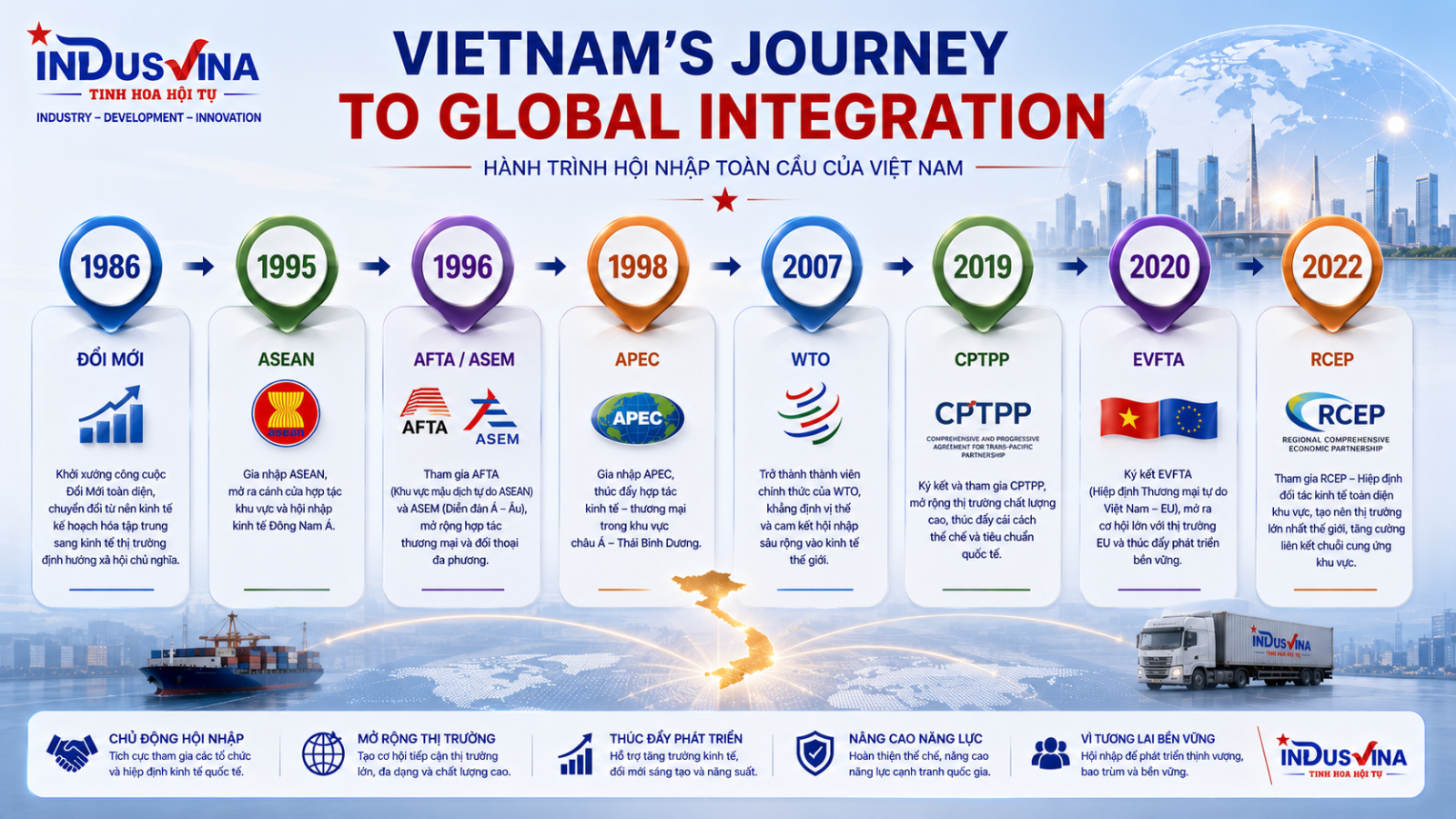
Viewed along a timeline, Vietnam’s opening can be understood in three layers. The first was restoring and expanding international relations. The second was joining regional institutions and learning how to adjust domestic policy within a broader community of interests. The third was deeper integration into the global rules-based system and negotiation of high-standard trade agreements.
These layers do not replace one another. Diplomacy creates political trust. Regional institutions create habits of cooperation. The WTO provides a common framework of rules. FTAs create deeper market opening with specific partners. Businesses must then convert these conditions into products, markets and contracts. If one link is weak, the value of the entire integration chain is reduced.
3. More Than 11 Years to Join the WTO: What Did a Country Have to Prove?
Vietnam applied to join the GATT/WTO system in 1995. From that application until members approved the accession package in 2006, the process lasted more than 11 years. The WTO did not merely ask how many tariff lines Vietnam would reduce. Members also required Vietnam to explain how its economy operated: how state-owned enterprises were treated, whether pricing policies were transparent, how trading rights would be opened, which service sectors would be accessible, how intellectual property would be protected and whether domestic law was compatible with WTO agreements.
In multilateral negotiations, Vietnam had to make its policies transparent and commit to common principles. In bilateral negotiations, each partner could seek specific market access in goods or services. Because every partner had a different structure of interests, Vietnam had to address a wide range of demands simultaneously: agriculture, industry, banking, telecommunications, distribution, transport, insurance, intellectual property and many other sectors.

3.1. Negotiations Did Not Take Place Only in Geneva
A major part of the process took place inside Vietnam. When negotiators received questions or requests from WTO members, many ministries and agencies had to coordinate data, assess impacts and agree on negotiating positions. The National Assembly and Government had to prepare legal amendments. Businesses and industries had to confront difficult questions: how far to open, over what period, which sectors required transition schedules and what the real state of competitiveness was.
WTO accession was therefore not “the work of the Ministry of Trade alone” or of a small group of foreign-policy experts. It was a process of institutional learning across the system. It forced regulators to understand their policies from the perspective of external partners and to express national interests in legal and economic language that could be negotiated.
3.2. WTO Members Receive Rights but Also Accept Discipline
After accession, Vietnamese goods gained access to member markets under common principles; enterprises operated in a more predictable environment; and Vietnam gained the right to use WTO mechanisms to defend its interests. At the same time, Vietnam had to implement its obligations, maintain transparency and accept that partners could apply trade-remedy measures when the legal conditions were met.
The WTO therefore does not eliminate competition, nor does it guarantee acceptance of every shipment. It creates a common framework of rules. Within that framework, competitiveness, compliance and management quality still determine whether a business succeeds or fails.
References: WTO – Vietnam accession documentation; Government News – the 11-year negotiation process.
4. What Is an FTA, and How Is It Different from the WTO?
FTA stands for Free Trade Agreement. In the simplest terms, it is an agreement between two or more economies to reduce or remove certain trade barriers and establish a common set of rules governing economic relations among the parties.
However, the idea that “an FTA is only about tariff reduction” is now far too narrow. A modern FTA may cover trade in goods, services, investment, rules of origin, customs, technical standards, sanitary and phytosanitary measures, government procurement, competition, state-owned enterprises, e-commerce, intellectual property, labor, environment, transparency and dispute settlement.
| Issue | WTO | FTA |
|---|---|---|
| Partner Scope | A multilateral system with a very large membership. | A specific group of partners that agree to open more deeply to one another. |
| Level of Commitment | Provides common rules and general commitments. | May reduce tariffs more deeply, expand services and investment access and introduce additional disciplines. |
| Rules of Origin | Does not provide a single preferential tariff mechanism among all members. | Goods must satisfy the agreement’s rules of origin to receive preferences. |
| Meaning for Business | Improves predictability and supports common trade principles. | Creates specific preferences, but only for businesses that can prove eligibility. |
The most frequently misunderstood point is that a product made in Vietnam is not automatically considered “Vietnamese originating” under an FTA. Depending on the product and agreement, a business may need to satisfy a tariff-shift rule, a regional value-content threshold, a specific processing requirement or other conditions. Preferential treatment also depends on documentation and procedures at the time of export and import.
An FTA is therefore not a universal duty-free ticket. It is more like a conditional gateway: the door may be open, but a business must bring the right product, the right origin, the right documents and the right process in order to pass through it.
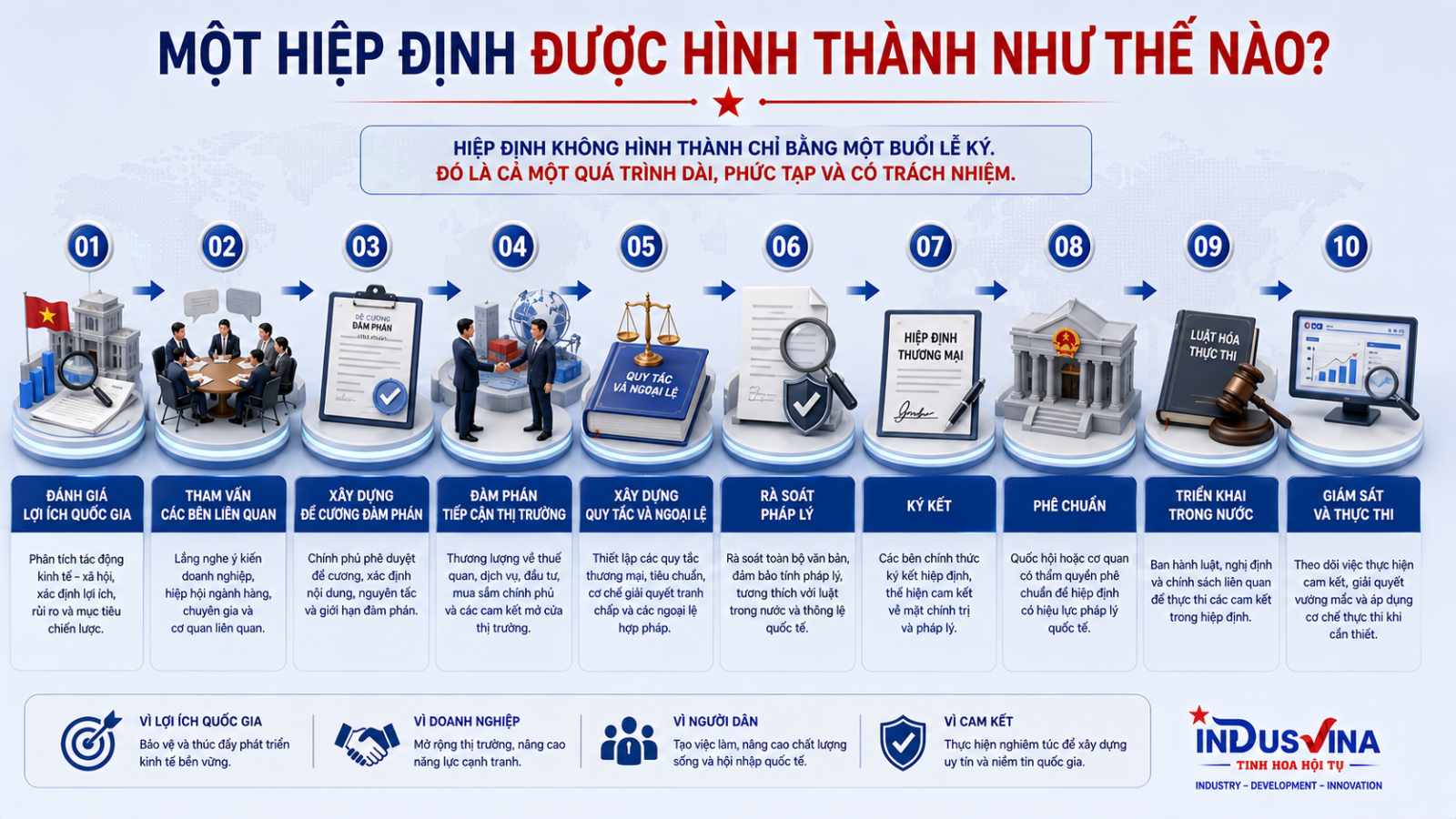
5. Why Can a Trade Agreement Take Many Years?
Every country enters negotiations with a different structure of interests. An agricultural exporter may seek better access for farm products. A services-oriented economy may prioritize finance, transport, telecommunications or digital trade. A country with sensitive industries may seek longer protection periods. Countries also differ in labor, environmental, intellectual-property and state-enterprise policies.
A concession in one sector may affect tens of thousands of workers or an entire domestic production chain. Negotiators therefore cannot simply maximize exports. They must balance market access, economic security, the adjustment capacity of domestic industry, the right to regulate in the public interest and the degree of social acceptance.
Even after technical terms have been agreed, an agreement may still be affected by political change within the participating countries. Legislatures may demand additional clarification. Industries may oppose concessions. A new government may change priorities. Maintaining consensus among several countries over many years is therefore part of the negotiation achievement itself.
This is why a signing ceremony should never be treated as both the beginning and the end. It is only a transition point between international negotiation and domestic implementation—a phase that may last much longer and determine most of the agreement’s real value.
6. From P4 and TPP to CPTPP: An Agreement That Nearly Collapsed
CPTPP did not emerge from a single meeting. Its original foundation was the P4 agreement among a small group of Asia-Pacific economies. The process later expanded into the TPP, with the participation of a larger number of countries, including Vietnam. Expanded TPP negotiations began in 2010, were substantially concluded in 2015 and the agreement was signed in February 2016.
However, the TPP did not enter into force in its original form after the United States withdrew in early 2017. At that moment, an agreement that had consumed years of negotiation could have become a document that would never be implemented. The remaining eleven countries had to choose whether to continue or walk away.

The remaining parties chose to continue. They negotiated to preserve most of the TPP’s standards while suspending certain obligations and redesigning the entry-into-force mechanism. The CPTPP was signed in Chile on 8 March 2018 and entered into force for Vietnam on 14 January 2019.
This history shows that a trade agreement is not only a tariff calculation. It requires political trust, acceptance of compromise, legal capacity and determination to preserve a cooperative framework even when circumstances change. It also demonstrates that a group of countries can defend the value of multilateral cooperation instead of allowing the entire result of negotiations to disappear because of one member’s decision.
At the same time, CPTPP is not proof that every agreement is permanent. Countries may change policies, renegotiate, suspend obligations or withdraw under the relevant legal provisions. Businesses should therefore avoid building strategy around one tariff rate alone. A resilient strategy requires quality, market diversification, adaptability and active management of policy risk.
References: Government of Canada – CPTPP negotiation timeline; Vietnam Ministry of Industry and Trade – CPTPP entered into force for Vietnam on 14 January 2019.
7. From the WTO to a Network of FTAs: Vietnam Has Opened Many Doors, but Every Door Has Conditions
After joining the WTO, Vietnam continued to participate in bilateral, regional and new-generation FTAs. CPTPP created preferential links with economies across the Asia-Pacific and the Americas. EVFTA established a deep trade framework with the European Union and entered into force on 1 August 2020. RCEP entered into force for Vietnam at the beginning of 2022, creating a broad Asian framework with particular value for regional supply chains and cumulation of origin.
This network gives businesses more choices. But “having many FTAs” does not mean a company can use all of them at the same time or that every agreement provides the same benefit. For each shipment, businesses need to compare tariff rates, origin rules, documentation requirements, compliance costs and the conditions of the importing market before selecting the most suitable regime.
CPTPP
A high-standard, broad agreement creating additional opportunities in markets such as Canada, Mexico, Japan and Australia, while requiring a strong understanding of origin rules and related obligations.
EVFTA
Deepens Vietnam–EU trade; in addition to tariffs, it covers standards, geographical indications, services, public procurement and sustainable development.
RCEP
Facilitates regional supply chains, particularly through a common rules-of-origin framework and cumulation among members subject to the agreement’s conditions.
The decisive question is not how many agreements include Vietnam’s name, but how many businesses understand and use the preferences, whether domestic value added rises, whether small firms can participate and whether trade is converted into technological, managerial and skills upgrading.
References: Vietnam Trade Information Portal – FTAs involving Vietnam; European Commission – EVFTA entered into force on 1 August 2020.
8. Does a Signature Automatically Create Orders, Jobs and Income?
The clear answer is: No.
An agreement may open a market and create a legal framework. But it does not build factories, design products, find buyers, prove origin or transfer income to workers by itself.
For an FTA to enter real life, many actors must work together. The government must issue implementation plans and adjust domestic law. Ministries and agencies must translate commitments into clear procedures. Customs and certification authorities must operate efficiently. Local authorities must help businesses access information. Companies must invest in production capacity, quality management, data and market development. Banks, logistics providers and insurers must support the movement of goods, documents and money. Schools and training institutions must provide the skills that value chains genuinely require.

8.1. What Must Government Do?
- Review and amend domestic regulations to align with commitments.
- Publish practical guidance rather than merely posting legal texts.
- Simplify procedures, digitize data and reduce inconsistency among agencies.
- Create consultation mechanisms, receive implementation feedback and update practice.
- Prevent origin fraud, illegal transshipment and conduct that damages partner confidence.
- Support vulnerable groups and sectors facing adjustment costs instead of measuring only total trade.
8.2. What Must Businesses Do?
- Determine the correct HS code, target market and potentially applicable FTA.
- Design supply chains to satisfy rules of origin from the raw-material sourcing stage.
- Maintain auditable records instead of seeking certificates only at the time of export.
- Meet technical, quality, labor, environmental and social-responsibility requirements.
- Manage contracts, transport, insurance, payment and currency risk.
- Invest in brand and customer relationships rather than competing only on low price.
8.3. What Must Workers and the Education System Do?
FTAs may increase demand for skilled labor, but they may also reduce the advantage of low-skill, easily replaceable work. Vocational education, foreign languages, digital skills, quality management, logistics and trade knowledge must therefore be considered part of integration policy. Businesses cannot be expected to upgrade if the workforce is not prepared for that upgrading process.
9. Who Benefits—and Who Must Adapt?
FTAs should not be presented as policies that make everyone better off immediately and equally. Economic opening normally creates both opportunity and adjustment cost. Some export sectors may receive more orders; some domestic sectors may face stronger competition; consumers may gain more choice; but workers in less competitive industries may need new skills or new jobs.

Consumers
Opportunity: wider choice, more competitive prices and access to higher-standard products and services.
Important qualification: tariff reduction does not necessarily produce an equal retail-price reduction because logistics, distribution, exchange rates, domestic taxes and market structure still matter.
Workers
Opportunity: new jobs, training, skills and higher-standard production environments.
Challenge: low-skill work may face pressure; adjustment requires retraining and an appropriate social-safety framework.
Farmers and Producers
Opportunity: market access, organized raw-material zones, traceability and long-term contracts.
Challenge: fragmented production, inconsistent quality and weak data may prevent opportunity from becoming an order.
Businesses
Opportunity: lower tariffs, wider markets, technology, materials and supply-chain access.
Challenge: stronger competition, compliance costs, trade-remedy exposure and higher transparency requirements.
Government and Society
Opportunity: reform incentives, stronger economic activity, broader revenue sources and improved international standing.
Responsibility: maintain fair competition, prevent vested-interest capture, measure distributional effects and support affected groups.
International Partners
Opportunity: a more stable market, clearer rules and a more diversified supply chain.
Requirement: respect commitments, avoid abuse of market power and build balanced, long-term commercial relationships.
10. Can an Agreement Serve Only a Narrow Interest Group?
This question should be answered directly. Any major economic policy can be captured more quickly by groups with better information, capital, networks or technical capability. Large firms usually have legal, import-export and supply-chain teams; small businesses, cooperatives and individual producers may not even know which preferences exist.
This does not necessarily mean that the agreement itself was designed only for one group. It does mean that benefits will not be distributed fairly by themselves. If information is difficult to access, procedures are complex, certification costs are high, competition is not transparent or support policies reach only a few businesses, the gap in benefits may widen.
A sound implementation system requires at least five layers of protection:
- Transparency: publish commitments, tariff schedules, rules and implementation data.
- Consultation: listen to businesses, workers, farmers, consumers and local authorities.
- Competition: prevent monopoly, collusion and abuse of market position.
- Accountability: assess who gains, who bears adjustment costs and whether support policies work.
- Adaptability: update implementation programs as economic, technological and trade conditions change.
It is also important to distinguish between a country withdrawing from or changing its position on an agreement and simply “tearing it up when it is no longer useful.” International agreements normally contain provisions on amendment, withdrawal, dispute settlement and transition periods. Politics may change, but parties must still act within a legal framework if they wish to preserve trust. Businesses should therefore study both the opportunities and the risk mechanisms of an agreement rather than looking only at preferential tariffs.
11. When Does an Agreement Remain Only “On Paper”?
An agreement may be highly regarded in legal terms yet create limited real value if the economy lacks the capacity to absorb the opportunity. This occurs when businesses do not know how to use preferences, products fail rules of origin, quality does not meet market requirements, logistics are too expensive, trade finance is weak, procedures are inconsistent or domestic value added remains low.
Signs That Opportunity Has Not Reached Real Life
- Low utilization of preferential tariffs.
- Exports rise while domestic value added does not rise proportionately.
- Small businesses remain outside supply chains.
- Workers are not upskilled.
- Origin violations and trade-remedy cases increase.
Signs of Deep Implementation
- Businesses move from processing toward design and branding.
- Domestic suppliers participate more deeply.
- Records, data and traceability are standardized.
- Productivity and wages rise.
- Opportunity spreads to localities and smaller enterprises.
Trade turnover is important but insufficient as a measure of success. An economy may export more while profits, technology and market control remain largely outside the country. Integration must therefore be measured in both breadth and depth: number of markets, number of contracts, domestic value-added ratio, productivity, wages, technology capability, enterprise health and resilience to shocks.
12. How Can International Commitments Become Value for All?
An FTA creates possibility. To turn possibility into value, a continuous chain of conversion is needed—from the national level down to every business and worker.
12.1. Translate Legal Language into Actionable Guidance
FTA texts are long and complex. A small enterprise cannot reasonably be expected to read thousands of pages and identify every obligation by itself. Regulators, associations and support organizations should develop tools by sector, HS code, market and practical scenario. Guidance should answer: what product is being sold, to which country, under which FTA, what origin rule applies, what documents are required and what risks must be controlled.
12.2. Build Rules of Origin into Supply-Chain Design
Origin should not be addressed on the last day before shipment. Businesses need to calculate origin from the moment they select materials, suppliers, production processes and data systems. A competitively priced product that fails origin requirements may lose the entire tariff preference. A correctly designed supply chain, by contrast, can create a durable advantage and increase domestic value added.
12.3. Strengthen Small-Enterprise Capability
Small enterprises create many jobs but often lack capital, legal staff, data and market relationships. Effective support must go beyond seminars. It should include advisory work on real files, supplier standardization, certification support, digital management and direct connection with buyers.
12.4. Link Training to Contracts and Productivity
Training creates value only when skills are used in real work. Schools, enterprises and associations should jointly identify missing capabilities: commercial language, quality management, traceability, machine operation, automation, logistics, contracts, data and product development.
12.5. Build a Logistics–Finance–Insurance Ecosystem
An international contract does not end when goods leave the factory. Businesses must manage freight bookings, bills of lading, insurance, documents, payments and counterparty risk. If logistics costs are too high or document control is lost, tariff advantages may be erased. Deep integration therefore requires control of the flow of goods, documents and money.
12.6. Measure Benefits Through People’s Lives, Not Only Trade Turnover
Implementation indicators should answer: what jobs were created, whether income rose, whether domestic firms moved deeper into value chains, how consumers were protected, which regions were left behind and which groups require adjustment support. When data stop at total imports and exports, it becomes difficult to understand how benefits are actually distributed.

13. INDUSVINA Perspective: The Value of Integration Is Found in Every Contract Performed Responsibly
INDUSVINA does not view integration as a slogan, nor does it see an FTA merely as a tariff-reduction instrument. In business practice, an opportunity becomes value only when the product meets requirements, the supplier is capable, records are transparent, trade terms are understood, transport is controlled and the contract is performed responsibly.
For Vietnamese enterprises, the priority should not be exporting at any cost. A contract that fails to control quality, payment or obligations may create revenue while destroying cash flow and credibility. Sustainable integration requires the right market, the right partner, the right delivery terms and the right level of commitment that the enterprise can genuinely perform.
For international importers, Vietnam is not only a competitive-cost location. Its long-term value lies in its ability to connect multiple trade spaces, an expanding production base, a business community that is learning and a policy system increasingly aligned with international rules. Yet this potential will be sustainable only when both sides build transparent relationships, respect quality, share data and develop suppliers instead of pursuing the lowest price alone.
14. Conclusion
Vietnam opened its doors to the world through a journey lasting several decades: Đổi Mới, normalization of external relations, ASEAN integration, participation in APEC and ASEM, more than 11 years of WTO negotiations and the gradual creation of an increasingly broad and deep FTA network.
Behind every agreement are the efforts of generations of diplomats, negotiators, legal experts, regulators, businesses and workers. Respect for those efforts should not stop at celebrating milestones. The best way to protect the achievements of integration is to implement commitments seriously, assess outcomes honestly and ensure that opportunity does not remain concentrated only among those with the strongest initial advantages.
The WTO and FTAs do not automatically make a country prosperous. They create rules, opportunities and pressure to reform. A country captures value only when enterprises can produce competitively, workers have the right skills, regulators operate transparently and society can help those facing adjustment costs find a new path.
The true value of integration is not found in the number of pages in an agreement. It is found in products that meet international standards, contracts performed transparently, stronger enterprises, better jobs and families who can genuinely feel that a door opened to the world has also opened a real opportunity for their lives.
Related Articles
FAQ – Frequently Asked Questions
What is an FTA?
An FTA is an agreement between two or more economies to reduce trade barriers and establish common rules on goods, services, investment, origin, customs and related fields.
How is the WTO different from an FTA?
The WTO provides a common multilateral framework, while an FTA allows a smaller group of partners to open more deeply and grant preferences to one another subject to agreed conditions.
How long did Vietnam’s WTO accession process take?
The process from the 1995 application to approval of the accession package in 2006 lasted more than 11 years. Vietnam became a WTO member on 11 January 2007.
Does an FTA automatically reduce tariffs for every business?
No. A business must satisfy rules of origin, procedures and agreement-specific requirements, and the goods must still meet the importing market’s standards.
How do ordinary people benefit?
Through jobs, income, product choice, better standards, investment and institutional reform. However, benefits are not automatically equal and adjustment support is needed for affected groups.
Connect with INDUSVINA
INDUSVINA connects Vietnam’s manufacturing, construction, technical supply and export capabilities with customers, importers and global value chains in a transparent, responsible and sustainable manner.
+84 979 823 639
info@indusvina.com
www.indusvina.com
Ho Chi Minh City, Vietnam


