


WHO CONTROLS MARITIME TRANSPORT CONTROLS CASH FLOW IN INTERNATIONAL TRADE
Who Controls Maritime Transport Controls Cash Flow in International Trade
In exports, goods create revenue, but documents open the path to payment. Booking, sailing schedules, Shipping Instructions, bills of lading, insurance, and banks form one continuous chain of control. A company that gives away all transport control without retaining access to records may still manufacture and deliver correctly, yet collect late, incur avoidable costs, or lose leverage in a dispute.

1. The core lesson: shipping the goods does not mean receiving the money
A Vietnamese exporter signs a sales contract, manufactures on schedule, and packs the goods correctly. The buyer asks to book the vessel because it has a better freight contract. The seller agrees and focuses only on delivering the container to the terminal.
The sailing schedule then changes, the booking is rolled over, the buyer's forwarder prepares the Shipping Instruction, and the draft bill of lading arrives late with an incorrect consignee. The documentary set cannot be completed within the L/C presentation period. The cargo has already sailed, but the money has not arrived, while the seller must still pay for materials, labour, taxes, interest, and production for the next order.
The strategic question is therefore not merely “who pays the freight?” It is also: who receives information, who approves the documents, who instructs the carrier, who can correct errors, and who bears the consequences when schedules or documents do not match the payment terms?

2. What does transport control actually include?
Transport control does not mean owning the vessel. In a trade transaction, it means having direct or joint control over the following decision points:
Before shipment
- Select a competent carrier or forwarder.
- Review the route, transit time, sailing schedule, and rollover risk.
- Receive the booking confirmation and all cut-off times.
- Clarify freight, surcharges, and local charges.
During document issuance
- Control the Shipping Instruction.
- Approve the draft Bill of Lading before the deadline.
- Verify shipper, consignee, notify party, ports, cargo description, and number of originals.
- Control whether the shipment uses an Original B/L, Sea Waybill, or surrender/telex release.
During transit
- Monitor ETD, ETA, transshipment, and route changes.
- Maintain a direct contact for incident handling.
- Collect official carrier notices.
- Coordinate with the insurer and bank when loss occurs.
At payment and delivery
- Ensure the B/L complies with the contract and L/C.
- Control the document presentation period.
- Do not release cargo contrary to the payment terms.
- Retain transport records for claims and reconciliation.
3. Carrier records: one missing link can delay the entire chain
Missing “carrier records” does not automatically mean the cargo will be lost. It does mean the exporter may lack the evidence and tools needed to verify, correct, allocate responsibility, or prove delivery. The precise effect depends on the payment method, type of transport document, governing law, and contract terms.
| Record / document | Management purpose | If the seller has no access | Minimum control |
|---|---|---|---|
| Booking Confirmation | Confirms space, vessel/voyage, ports, cut-offs, and container details. | The seller cannot plan stuffing proactively and may miss cut-offs or face rollover without a basis for escalation. | Receive a copy immediately upon confirmation and after every amendment. |
| Shipping Instruction | Provides the source data used by the carrier to issue the B/L. | B/L data may be incorrect or inconsistent with the L/C, contract, or customs declaration. | The seller must approve all data relating to itself and the goods before submission to the carrier. |
| Draft Bill of Lading | Allows review before final issuance. | The seller may lose the free correction window, incur amendment charges, and face documentary discrepancies. | Specify a draft deadline and the authorised approver. |
| Original B/L | Serves as carrier receipt, evidence of the contract of carriage, and in some cases a document capable of transferring control over the goods. | The seller may be unable to present the required documents, may lose payment leverage, or may face an improper release mechanism. | Specify place of issuance, number of originals, endorsement, and custody. |
| Sea Waybill / Telex Release | Allows delivery without traditional presentation of an original B/L. | Cargo may be released faster than payment control if used at the wrong time. | Approve only when payment security and counterparty creditworthiness permit. |
| Manifest / VGM / Gate-in records | Support verification of cargo data, weight, and container handover time. | It becomes harder to prove responsibility for data errors, late delivery, or penalties. | Retain submission confirmations and evidence of terminal/carrier acceptance. |
| Arrival Notice / Delivery Order | Provides destination arrival and cargo release information. | The seller has limited visibility over delivery status, local charges, and storage exposure. | Require the buyer or agent to share arrival and delivery status. |
| Freight and surcharge invoices | Establish the true logistics cost. | The seller cannot verify surcharges or calculate the real margin. | Agree the tariff, validity period, and approval process for additional charges. |

4. Why can documents determine cash flow?
Under an L/C, UCP 600 establishes that banks deal with documents, not with goods, services, or performance to which the documents may relate. Banks examine the presentation against the documentary credit and the applicable rules. Good cargo accompanied by non-complying documents may therefore still be refused, held for waiver, or paid late.
ISBP 821 provides standard banking practice for applying UCP 600 to documentary examination. For collections, URC 522 may apply when the collection instruction expressly incorporates it. No set of rules automatically governs every transaction merely because it is international.
How the main rules and conventions differ
| Rule or framework | Main subject | When relevant | What it does not automatically resolve |
|---|---|---|---|
| Incoterms® 2020 | Delivery obligations, cost allocation, and transfer of risk between seller and buyer. | When the sales contract identifies a specific rule and named place/port. | It does not replace payment terms, transfer of title, breach remedies, or the full contract of carriage. |
| UCP 600 | Rules for documentary credits. | When the L/C states that it is subject to UCP 600. | It does not inspect the physical quality of goods and does not automatically apply to T/T or open account. |
| ISBP 821 | Banking practice for examining documents under UCP 600. | When handling an L/C presentation under UCP 600. | It cannot repair an impractical or contradictory L/C term. |
| URC 522 | Rules for documentary collections. | When the collection instruction incorporates URC 522. | The bank does not guarantee payment by the buyer as an issuing bank independently undertakes under an L/C. |
| Hague / Hague–Visby / Hamburg | Carrier liability, bills of lading, cargo loss, and limitation of liability. | Depending on the jurisdiction, route, governing-law clause, forum, and convention scope. | No single convention applies uniformly to every sea route. |
| Rotterdam Rules | A modern framework for international carriage involving a sea leg, including electronic transport records and door-to-door carriage. | Only where the required legal conditions are met and the convention is in force and applicable in the relevant system. | It should not be presented as a rule that automatically applies worldwide. |
This article provides a management and general knowledge framework. It is not legal advice for any specific contract, jurisdiction, or dispute.

5. What happens when a company gives away transport control without conditions?
Working-capital impact chain
Vessel delay or document error → late presentation → late collection → longer receivables cycle → insufficient funds for materials → reduced capacity for the next order → more short-term borrowing → lower profit margin.

6. The seller does not always need to book the vessel
The correct position is not “never surrender transport control.” In many FOB/FCA transactions, the buyer has a global logistics network, favourable freight contracts, and strong import procedures. Buyer-controlled booking can lower total cost and benefit both parties.
The danger is delegating the booking while retaining no joint-control mechanism. The seller still needs visibility, review rights, and confirmation rights over data that affects shipment and payment.
Buyer booking may be appropriate when
- The buyer has a strong reputation and good payment history.
- The forwarder/carrier is competent and contact channels are transparent.
- The contract clearly defines duties and deadlines.
- The seller receives the booking, draft B/L, and tracking information.
- Payment security does not depend on the seller retaining the original B/L.
Do not surrender control unconditionally when
- The buyer is new and financial capacity is unverified.
- The L/C contains strict documentary requirements.
- The goods are high-value, customised, or difficult to resell.
- The route is volatile and rollover risk is high.
- The buyer requests Sea Waybill or telex release before payment.

7. Decision matrix for CEOs and export teams
| Situation | Control to retain | Protective terms | Management decision |
|---|---|---|---|
| Long-standing buyer, open account | Joint control of booking and tracking; review draft B/L. | Credit limit, payment date, and trade credit insurance where appropriate. | The buyer may book, but information must not be surrendered. |
| New buyer, customised goods | High control; favour documentary mechanisms that preserve leverage. | Deposit, workable L/C, and no release before agreed conditions. | Do not accept Sea Waybill or telex release casually. |
| L/C requires an ocean B/L | Approve SI, draft B/L, on-board date, and number of originals. | L/C terms must be practical and aligned with the booking. | Pre-check documents before shipment. |
| Seller has strong freight rates | Seller controls carrier, route, and freight. | Bunker/surcharge adjustment mechanism and limits on local charges. | Consider CFR/CIF or another suitable rule to create value. |
| Buyer has a global freight agreement | Buyer books; seller retains access to records and data approval. | Booking deadline, amendments, rollover, and additional-cost allocation. | Use the buyer's logistics advantage while protecting documentary security. |
| High-risk or congested route | Control schedule, contingency plans, and insurance. | Force majeure, route change, delay notice, and claim procedures. | Prioritise continuity over the lowest freight rate. |
Checklist before signing the contract

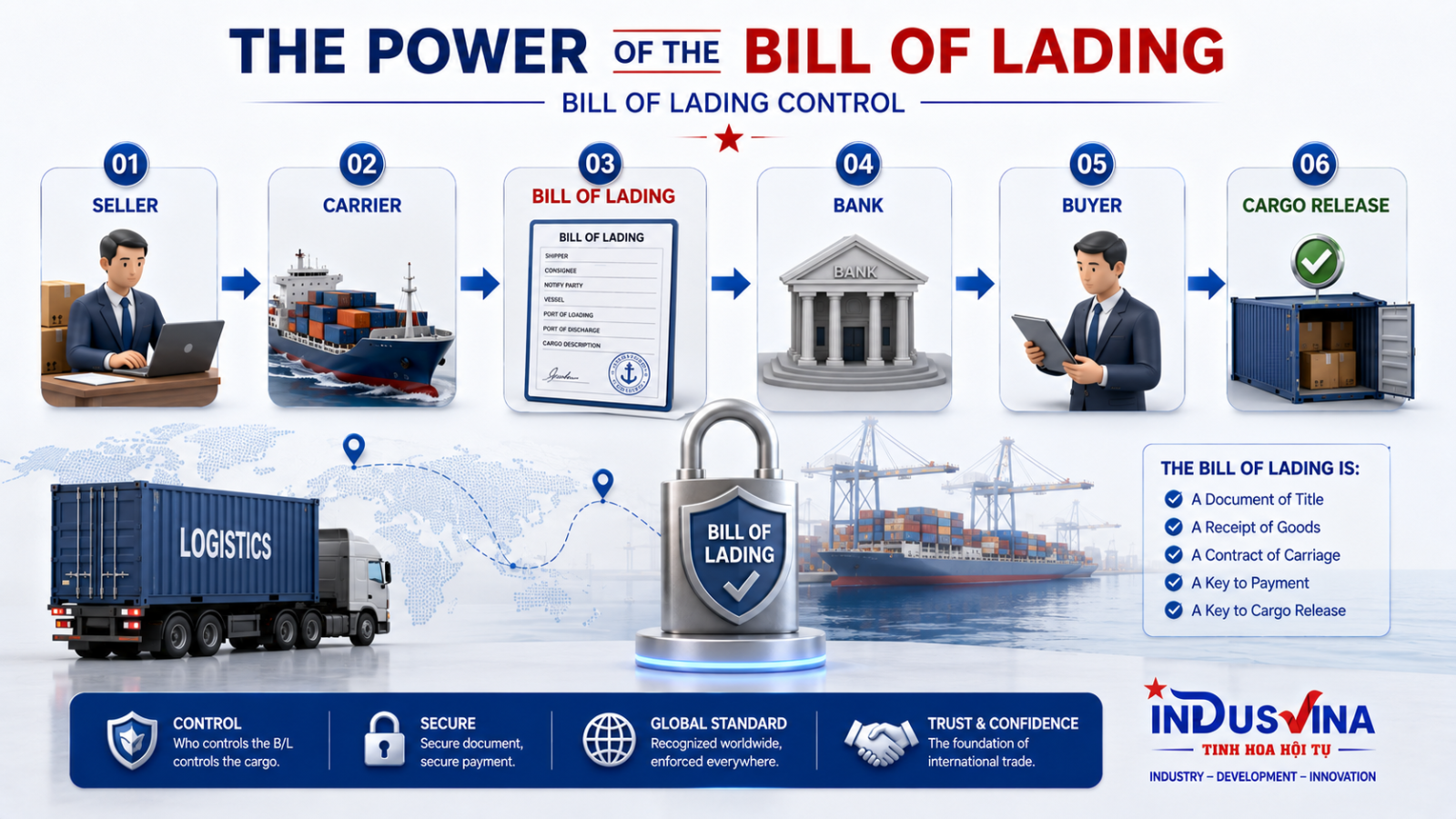
8. The power of the Bill of Lading
An ocean bill of lading should not always be described simply as a “document of title.” Depending on its type and the applicable legal system, a B/L normally performs three core functions: a carrier's receipt for the goods, evidence of the contract of carriage, and—where negotiable—a document capable of transferring control over the goods.
The right to request issuance, review, receive, and endorse the B/L may therefore directly affect:
- The ability to present documents to the bank.
- The ability to control cargo delivery at destination.
- The ability to prove carrier receipt and the on-board date.
- The ability to claim for loss, damage, or misdelivery.
- Negotiating leverage when the buyer has not fulfilled its payment obligation.

9. A cooperation model that benefits both seller and buyer
A sound transaction is not built on one party monopolising all information. The sustainable model is controlled transparency:
Seller commitments
- Deliver the correct quality and quantity by cut-off.
- Provide accurate SI data on time.
- Respond to the draft B/L within the agreed period.
- Give early notice of any production-delay risk.
Buyer commitments
- Nominate a competent carrier/forwarder.
- Share booking and schedule changes.
- Do not request cargo release contrary to payment terms.
- Pay or handle discrepancies within the agreed time.
Forwarder / carrier commitments
- Provide clear information and evidence-based responses.
- Send drafts and confirm amendments on time.
- Disclose charges, surcharges, and applicable conditions.
- Issue official notices for delays or incidents.
Bank and insurer
- Pre-check documentary terms where needed.
- Explain presentation and refusal procedures.
- Clarify the insured party and entitlement to claim.
- Coordinate timely handling of loss documentation.
10. Lessons for Vietnamese enterprises
- Do not sell at one headline price. Export pricing must reflect freight, insurance, surcharges, cost of capital, and collection-delay risk.
- Do not separate logistics from finance. Export, sales, accounting, and banking teams must review the same transaction conditions.
- Do not surrender information together with the right to book. Even when the buyer books, the seller must retain access and approval rights over data affecting it.
- Do not use release mechanisms by habit. Original B/L, Sea Waybill, and telex release provide different levels of control.
- Do not use Incoterms as a substitute for the contract. The contract must address transport, documents, payment, insurance, claims, and additional costs.
- Do not select a carrier on price alone. Schedule reliability, documentary quality, responsiveness, and incident-handling capability have real financial value.
11. Conclusion
Controlling maritime transport does not automatically win every negotiation. However, a company that understands and manages bookings, carriers, bills of lading, insurance, banking, and document deadlines is better able to protect cash flow than one that focuses only on moving the container to port.
The value chain should be understood in this order:
This is not about retaining power to disadvantage the buyer. It is the capability to design a transaction that can be performed, verified, paid, and managed fairly for both parties.
12. Related articles
FAQ – Frequently Asked Questions
Does controlling maritime transport mean owning a vessel?
Is UCP 600 mandatory in every country and every transaction?
Why does the bank not focus on the physical goods?
What should the seller do if the buyer books the vessel?
Is an Original B/L always required?
Can buyer-controlled booking create benefits?
Connect with INDUSVINA
INDUSVINA supports enterprises in connecting with Vietnamese supply sources, developing export solutions, controlling commercial documentation, and coordinating logistics with transparency, accountability, and long-term value.


