


Predictive Maintenance – Data-Driven Maintenance to Reduce Failures and Optimize Costs
Predictive Maintenance – When maintenance is no longer guesswork
Predictive Maintenance is a maintenance method based on data, equipment condition signals and degradation trends to intervene at the right time: not too early to create waste, and not too late to cause failures.

1. What is Predictive Maintenance?
Predictive Maintenance, or PdM, is a method of monitoring equipment condition through real operating data such as vibration, temperature, sound, lubricant oil, electric current, pressure and maintenance history.
The goal is not to repair only after failure, nor simply to maintain according to a fixed schedule, but to predict degradation risks and plan maintenance before failures occur.
2. From Reactive to World Class Maintenance
Maintenance maturity chain
- Reactive: repair after failure.
- Inspection: inspect to detect abnormalities.
- Preventive: planned preventive maintenance.
- Predictive: maintenance based on data and trends.
- Reliability: equipment reliability management.
Core message
A plant cannot move directly to Predictive Maintenance if its Inspection and Preventive foundations are not solid. Data is only valuable when it is collected consistently, interpreted correctly and linked to the actual operating context.

3. Common technologies used in Predictive Maintenance
Measurement devices & methods
- Vibration Analysis: vibration, misalignment, imbalance and bearing condition analysis.
- Thermography: thermal cameras to detect hot spots, overloads and abnormal friction.
- Ultrasonic: detection of compressed air leakage, electrical discharge and abnormal friction.
- Oil Analysis: oil analysis to evaluate wear, contamination and lubricant degradation.
Analysis & forecasting
- Monitor data trends over time.
- Set suitable alarm thresholds for each equipment type.
- Analyze root causes when abnormalities appear.
- Apply AI Analytics when the data is clean, consistent and sufficient.
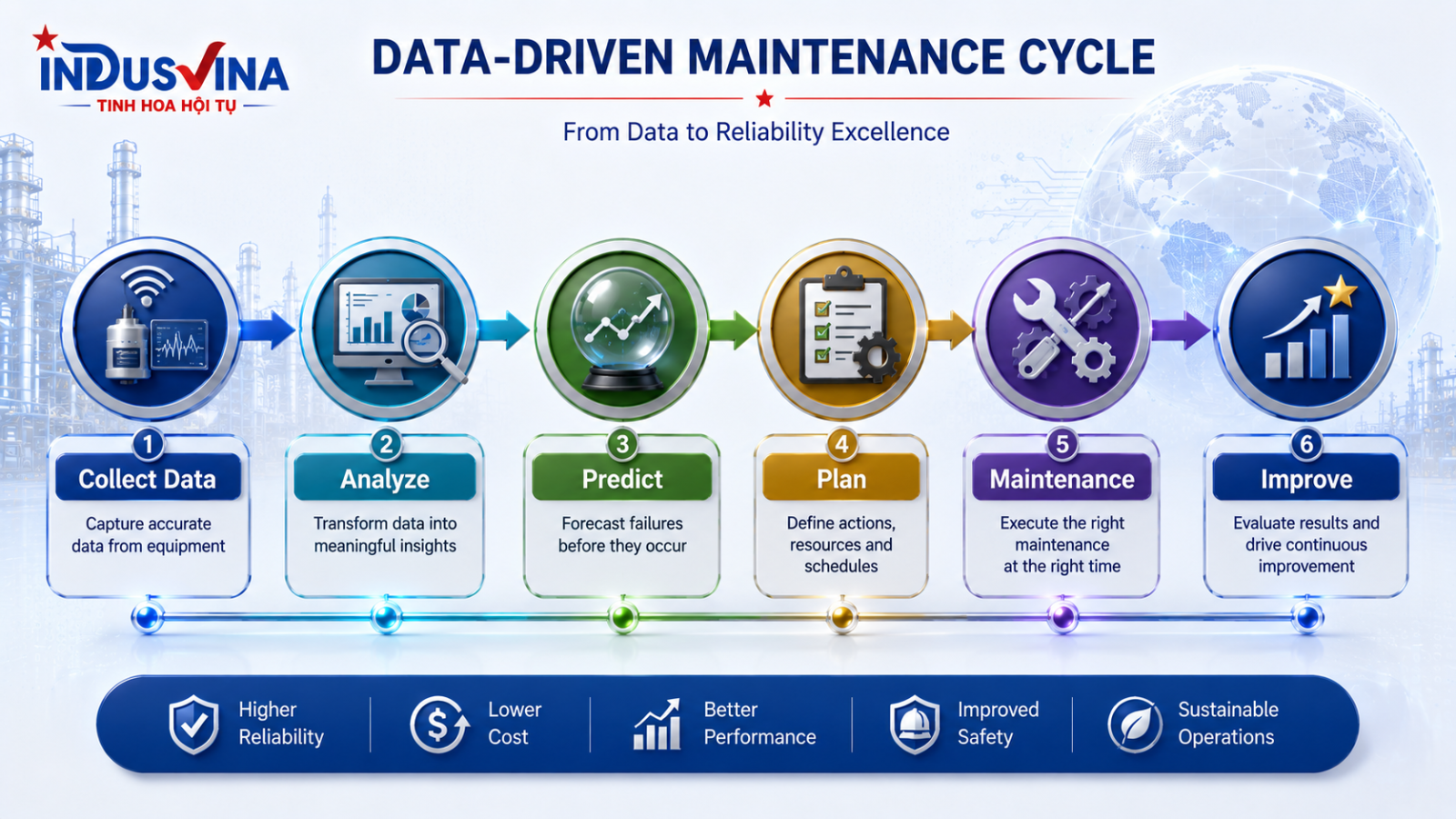
4. Predictive Maintenance implementation process
Step 1: Collect Data
Collect equipment data, failure history, downtime records, operating parameters and periodic inspection results.
Step 2: Analyze
Analyze trends and compare data with standard thresholds and actual operating conditions.
Step 3: Predict
Predict degradation possibility, failure risks and the right time for intervention.
Step 4: Plan
Prepare maintenance plans, spare parts, manpower and suitable shutdown windows.
Step 5: Maintenance
Perform controlled maintenance at the right time, for the right task and to the right standard.
Step 6: Improve
Update post-maintenance data to improve alarm thresholds and analysis methods.

5. Comparison between Reactive, Preventive and Predictive Maintenance
| Criteria | Reactive | Preventive | Predictive |
|---|---|---|---|
| Method | Repair after failure | Maintain by schedule | Maintain by data |
| Emergency cost | High | Medium | Lower if properly implemented |
| Downtime | Difficult to control | Partially reduced | Can be forecast and planned |
| Data requirement | Low | Medium | High |
| Suitable for | Less critical equipment | Equipment with clear cycles | Critical equipment with high production impact |
6. Practical benefits of Predictive Maintenance
- Reduce unplanned downtime: detect risks before equipment fails seriously.
- Optimize maintenance costs: avoid replacing too early or repairing too late.
- Extend equipment lifetime: control degradation based on real data.
- Improve operational reliability: help production become more stable.
- Standardize maintenance knowledge: reduce dependence on individual experience.
7. Illustrative case study
A critical motor in a production line showed a slight increase in vibration over several weeks. Visually, the equipment still appeared to operate normally. However, by tracking vibration trends, the technical team detected a steady increase in amplitude and a frequency spectrum indicating bearing degradation.
Thanks to Predictive Maintenance, the plant proactively planned a short shutdown, prepared bearings, tools and manpower in advance. As a result, it avoided sudden bearing failure, reduced unplanned downtime and prevented secondary damage to the shaft, coupling or motor.
8. Common mistakes when implementing PdM
- Buying measuring devices without a data interpretation process.
- Collecting data without storing history by equipment.
- Looking only at instant values instead of trends.
- Relying entirely on AI while ignoring technical experience.
- Trying to jump directly to Predictive without solid Inspection and Preventive foundations.
9. When should a business apply Predictive Maintenance?
- When equipment has major impact on output, safety or quality.
- When downtime creates high costs or delays customer orders.
- When the plant already has maintenance data, downtime history and inspection checklists.
- When the technical team can read trends or has professional support from partners.
- When the business wants to move from “firefighting” to reliability management.
10. Predictive Maintenance in INDUSVINA’s engineering philosophy
INDUSVINA views maintenance not merely as equipment repair, but as an operating management system. In that system, Inspection is the foundation, Preventive Maintenance is the discipline, Predictive Maintenance is the intelligence, and Reliability is the final goal.
With experience in factory maintenance and repair services, MRO, MEP, construction and technical supply, INDUSVINA pursues a responsible approach: proper survey, proper analysis, proper proposal and long-term partnership with customers.
Related articles
FAQ – Frequently Asked Questions about Predictive Maintenance
How is Predictive Maintenance different from Preventive Maintenance?
Preventive Maintenance is performed according to a fixed schedule or cycle. Predictive Maintenance is based on real equipment condition data and degradation trends.
Is Predictive Maintenance the same as AI?
Not entirely. AI can be part of PdM, but the foundation remains clean data, disciplined inspection, equipment understanding and proper analysis of the operating context.
Do small businesses need Predictive Maintenance?
They may need it, but should begin with the most critical equipment. It is not always necessary to invest heavily at the beginning; implementation can be phased according to risk level.
Which equipment should apply PdM first?
Priority should be given to large motors, pumps, fans, air compressors, gearboxes, electrical systems, rotating equipment and items that significantly affect production if they stop unexpectedly.
Are expensive sensors required for Predictive Maintenance?
Not always. Many businesses can start with periodic inspection, vibration measurement, thermal measurement, oil analysis and historical data storage before investing in online sensor systems.
When should a business move from Preventive to Predictive?
When the business already has inspection checklists, historical data, clearly classified critical equipment and a technical team capable of reading trends or supported by professional partners.
Connect with INDUSVINA
INDUSVINA is ready to accompany customers and partners in MRO maintenance, Predictive Maintenance, MEP construction, technical supply and equipment reliability optimization.
0979 823 639
info@indusvina.com
www.indusvina.com
Ho Chi Minh City, Vietnam


