


Construction Law 2014 – Amended 2020
Summary of Core Contents
Construction Law is an important legal foundation governing all construction investment activities in Vietnam. Whether you are an investor, contractor, design consultant, supervision engineer, site manager, or an individual preparing to build a house, understanding the Construction Law correctly helps reduce legal risks, save time, control costs, and improve construction quality.
This article is systematized by INDUSVINA in a concise, easy-to-understand, and easy-to-reference manner, focusing on the core contents of the Construction Law 2014 and the Law amending and supplementing several articles in 2020.
- Investors and project management boards.
- Construction contractors, M&E contractors, and infrastructure contractors.
- Site managers, site engineers, and supervision consultants.
- Enterprises preparing to build factories, offices, and warehouses.
- Students of construction, architecture, and project management.
- Individuals preparing to build, repair, or renovate houses.
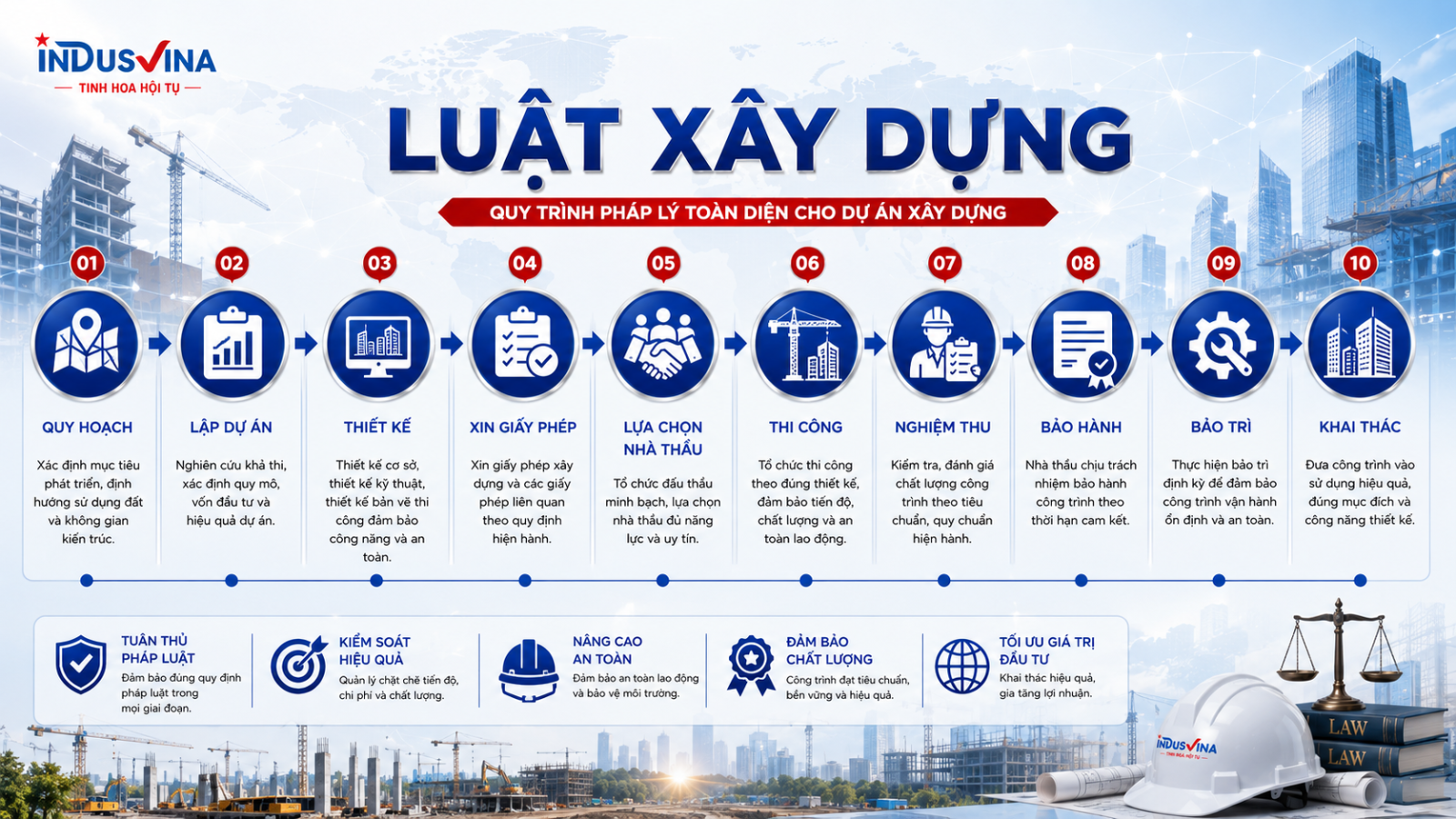
I. Overview of the construction investment process
A typical construction project does not begin only with construction work. It must go through many legal, technical, and management steps. Understanding the correct sequence helps investors and contractors avoid mistakes, missing documents, delayed acceptance, or disputes.

II. Scope of regulation & applicable entities
The Construction Law 2014, amended in 2020, regulates all construction investment activities, including:
- Preparation, appraisal, and approval of construction investment projects.
- Survey, design, construction, supervision, acceptance, and handover of works.
- Management of quality, costs, construction contracts, and maintenance of works.
- Issuance of construction permits and management of construction order.
- Rights, obligations, and responsibilities of investors, contractors, consultants, state management agencies, and organizations or individuals participating in construction activities.
III. Some fundamental concepts
- Construction investment project: A set of proposals for the use of capital to build new works, repair, or renovate construction works.
- Construction work: Houses, civil works, industrial works, transport works, irrigation works, technical infrastructure works, and other types of works.
- Construction design: Includes basic design, technical design, and construction drawing design.
- Construction permit: A legal document allowing the investor to commence, build, repair, renovate, or relocate a work, except for cases exempted from permits.
IV. Construction planning
Every construction project and work must comply with:
- Regional construction planning, urban planning, and rural planning.
- Planning indicators: building height, construction density, setback, land-use function, and work function.
- Requirements for technical infrastructure, traffic, environment, fire prevention and fighting, and architectural landscape.
Planning is prepared, appraised, and approved according to decentralization. It is an important basis for approving investment policy, issuing construction permits, and managing urban and rural development.
V. Management of construction investment projects
1. Basic steps of a project
- Investment policy, if the project is subject to investment policy approval.
- Preparation of pre-feasibility study report and feasibility study report if required.
- Appraisal and approval of the construction investment project.
- Design and construction cost estimate.
- Contractor selection and contract signing.
- Organization of construction, supervision, phased acceptance, and completion acceptance.
- Handover, commissioning, warranty, and maintenance of the work.
2. Project classification
Projects are classified into national important projects, Group A, Group B, and Group C projects based on:
- Scale, nature, and level of impact.
- Total investment amount.
- Funding source: state budget capital, non-budget state capital, private capital, ODA capital, or other lawful capital sources.
VI. Construction design
Construction design must comply with:
- Construction planning, architecture, and surrounding landscape.
- Technical standards and regulations such as QCVN, TCVN, and applicable standards.
- Requirements for safety, functionality, aesthetics, and economic efficiency.
Depending on the type and scale of the work, design may be carried out in one step, two steps, or three steps. Design documents must be verified, appraised, and approved in accordance with regulations before construction is implemented.
The 2020 amendment encourages the application of new technologies such as BIM, modern materials, energy-saving solutions, green buildings, and lifecycle-based construction management.
VII. Construction permits
Construction permits are among the matters most concerned by investors, enterprises, and individuals. Lack of permit, deviation from permit, or construction not in accordance with the permitted contents may lead to suspension of construction, penalties, or compulsory demolition of violating parts.
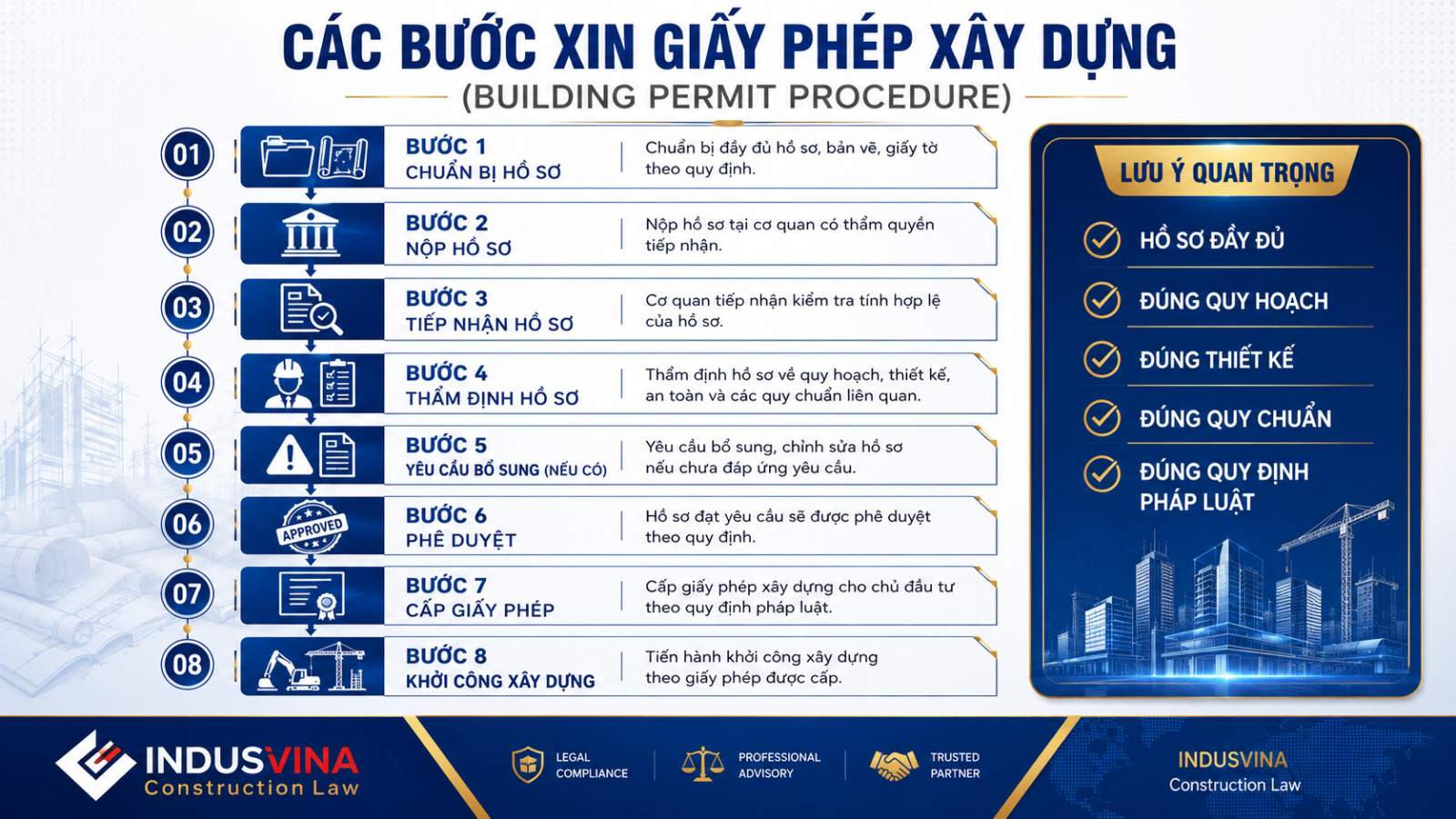
1. Types of construction permits
- New construction permit.
- Repair and renovation permit.
- Work relocation permit.
- Time-limited construction permit.
2. Some cases exempted from construction permits
- State-secret works and emergency works.
- Certain works under construction investment projects already decided by competent authorities and whose designs have been appraised.
- Detached houses in rural areas outside conservation zones and outside urban planning areas subject to permit requirements.
- Certain works in industrial parks, export processing zones, and high-tech zones with approved and managed detailed 1/500 planning.
VIII. Contractor selection & construction contracts
Contractor selection in construction activities must comply with the Construction Law, Bidding Law, and related regulations.
- The contractor must have capacity and experience suitable for the scale and nature of the package.
- The organization must have an appropriate construction activity capacity certificate.
- Key individuals must have appropriate practice certificates for their professional fields.
- The construction contract should clearly define the scope of work, quality, schedule, contract price, advance payment, payment, price adjustment, warranty, and dispute resolution.
IX. Construction management & quality management of works
Quality management of works is a continuous process from survey, design, material selection, construction, supervision, acceptance to handover and maintenance. This directly affects safety, service life, operating costs, and the reputation of investors and contractors.
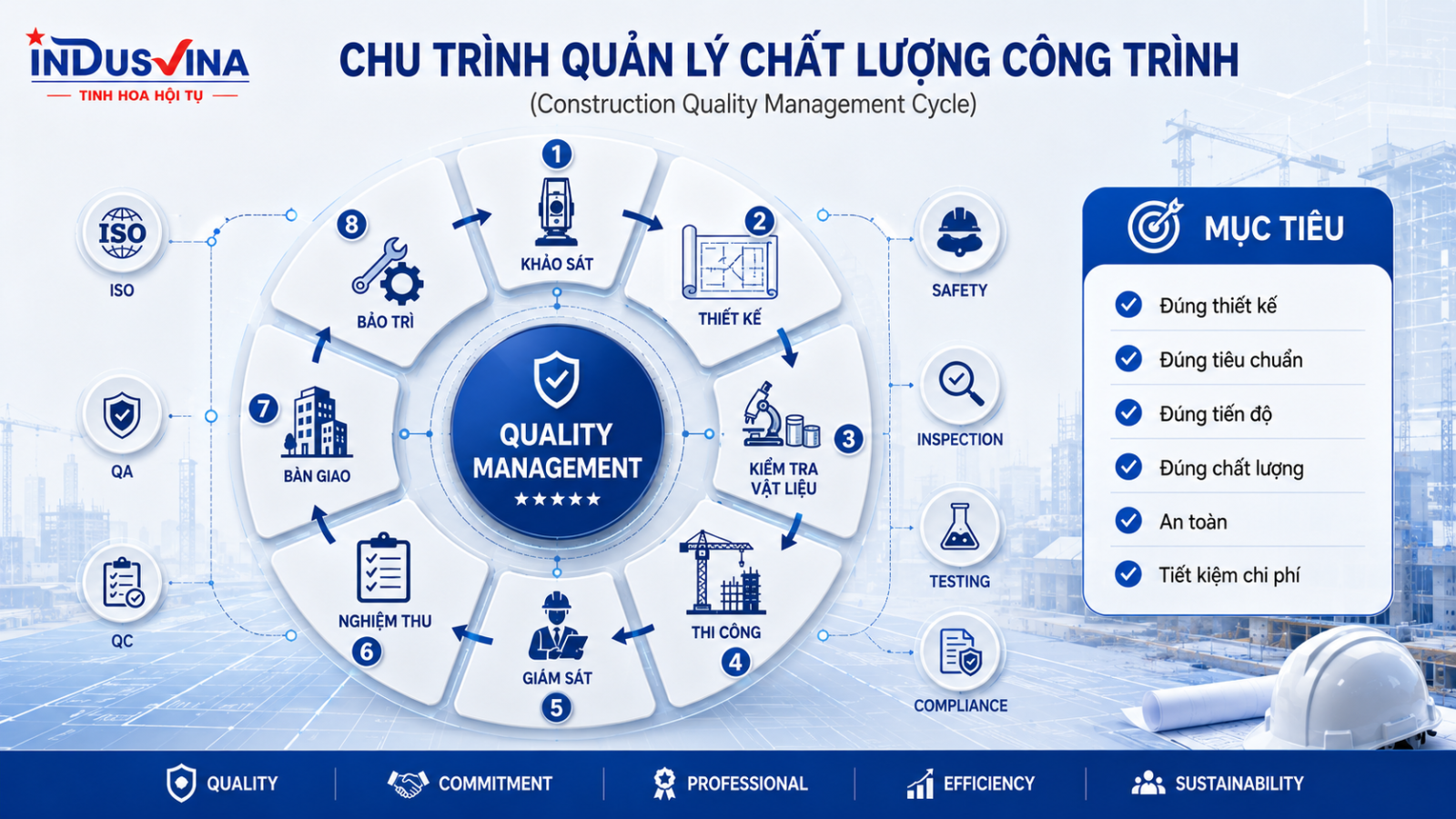
During construction, the contractor must:
- Prepare construction methods and occupational safety measures.
- Manage input materials, components, and equipment in accordance with standards, origin, and quality records.
- Prepare site diaries and acceptance records for each work item and stage.
- Comply with design documents, technical specifications, regulations, standards, and investor requirements.
The investor directly supervises or hires a supervision consultant to control quality, quantity, schedule, safety, and acceptance documents on site.
X. Occupational safety in construction
Construction works must comply with the Law on Occupational Safety and Health and relevant guiding decrees.
- Provide adequate personal protective equipment: helmets, safety shoes, safety harnesses, goggles, and gloves.
- Arrange warning signs, barriers, guardrails, safety nets, anti-collapse, and fall-prevention measures.
- Conduct safety training and assign personnel responsible for occupational safety on site.
- Assess risks and prepare emergency response plans when incidents occur.
XI. Construction investment costs & construction contracts
Construction investment costs include:
- Construction costs.
- Equipment costs.
- Project management costs.
- Construction investment consulting costs.
- Other costs and contingency costs.
Cost estimates are prepared based on norms, unit prices, market price levels, and specific project conditions.
The 2020 amendment emphasizes lifecycle-based cost management, meaning not only the initial investment cost, but also operation, maintenance, repair, and demolition costs.
Common types of construction contracts
- Lump-sum contract.
- Fixed unit price contract.
- Adjustable unit price contract.
- Time-based contract.
- Percentage-based contract.
XII. Acceptance – handover – warranty – maintenance
Acceptance is carried out at several levels:
- Acceptance of construction works.
- Acceptance of construction stages.
- Acceptance of completed work items.
- Completion acceptance of the entire work for commissioning.
After acceptance, the work is handed over to the investor or operating management unit, together with as-built documents, technical documents, operation procedures, and maintenance procedures.
The investor or the work management and operation unit is responsible for preparing and implementing the maintenance procedure throughout the lifecycle of the work.
XIII. Inspection, examination & handling of violations
The law provides for specialized construction inspectorates with authority to:
- Inspect compliance with laws in construction activities.
- Impose administrative penalties for violations.
- Suspend construction when necessary.
- Force remedial measures, demolition of works or parts of works built without permits, contrary to permits, not in accordance with planning, or failing to ensure safety.
XIV. Comparison table of notable points between the 2014 Law and the 2020 amendment
| Content | Construction Law 2014 | 2020 Amendment |
|---|---|---|
| Construction investment procedures | The process is relatively complete but includes many sequential steps. | Oriented toward simplification, shorter procedures, and greater interconnection. |
| Construction permits | Regulates cases requiring permits and cases exempted from permits. | Expands and clarifies several cases exempted from construction permits. |
| Project management | Classifies projects and regulates responsibilities of parties. | Further clarifies responsibilities of investment decision makers, investors, project management boards, and consultants. |
| Construction costs | Focuses on management of total investment, cost estimates, norms, and unit prices. | Emphasizes lifecycle-based cost management of works. |
| Technology & green buildings | Provides general regulations on standards, regulations, and quality. | Encourages application of new technologies, BIM, energy saving, and sustainable development. |
XV. Easy-to-understand practical example
The enterprise needs to check:
- Detailed planning of the land plot and land-use function.
- Basic design, technical design, and construction drawing design documents.
- Requirements for design appraisal, fire prevention and fighting, and environment if applicable.
- Conditions for exemption from or requirement for construction permits.
- Capacity of construction contractors, supervision consultants, acceptance records, and as-built documents.
XVI. Outstanding new points of the 2020 amendment
- Reduction of administrative procedures: Simplifies appraisal and project approval procedures.
- Expansion of construction permit exemptions: Reduces procedural burdens for certain types of works that meet required conditions.
- Lifecycle-based cost management: Orients the selection of optimal solutions for operation and maintenance phases.
- Encouragement of green buildings and smart cities: Prioritizes energy saving, environmental friendliness, and digital technology application.
- Clearer responsibilities: Increases responsibilities of individuals and organizations in each stage to reduce loss, waste, and poor quality.
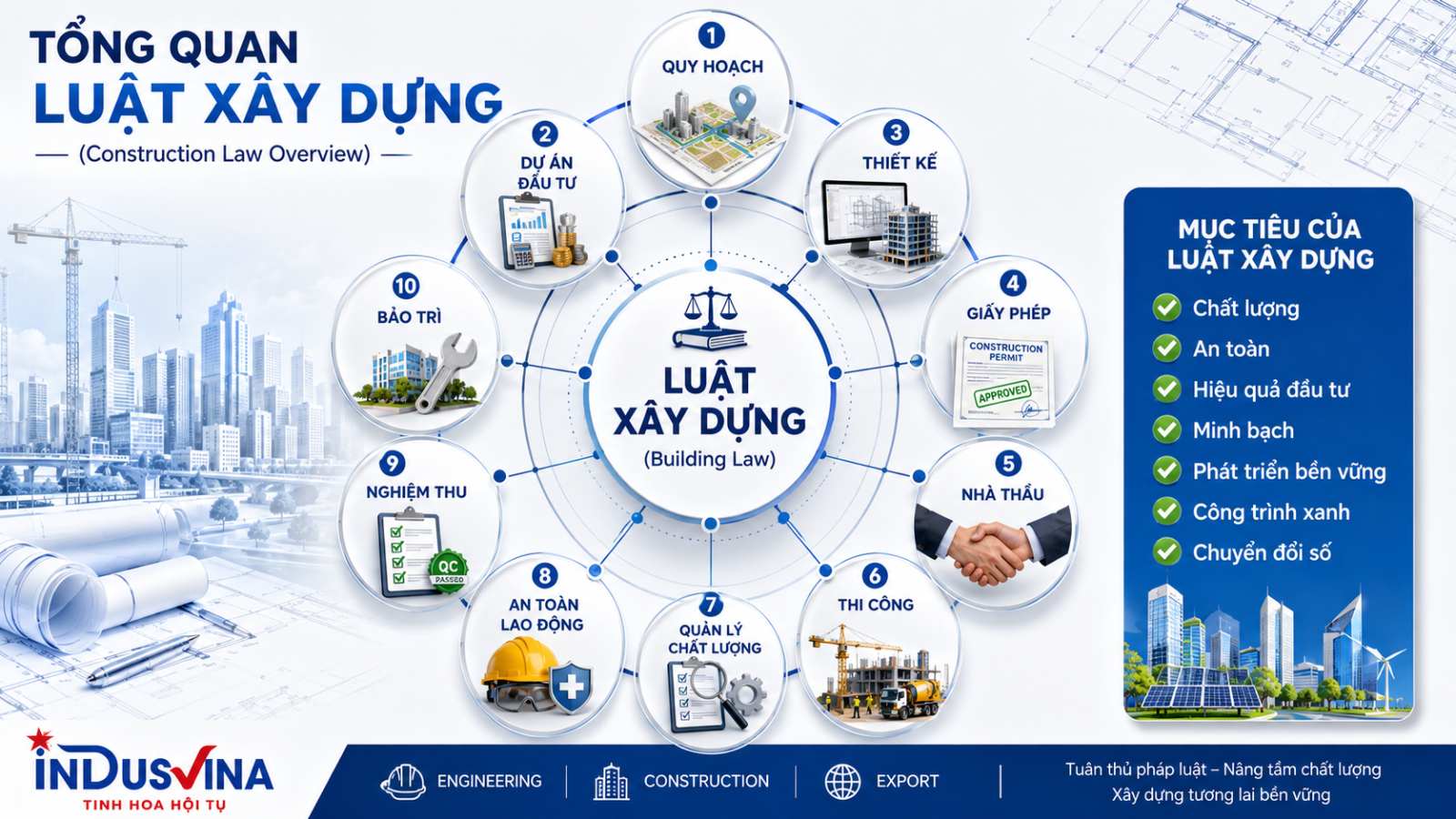
XVII. System overview of Construction Law
XVIII. Frequently asked questions about Construction Law
1. Is the Construction Law 2014 still effective?
Yes. The Construction Law 2014 remains the main legal foundation and has been amended and supplemented by the 2020 amendment and related guiding documents.
2. Which part changed the most under the 2020 amendment?
Notable points include procedural reform, expansion of some construction permit exemptions, clearer responsibilities of parties, and emphasis on lifecycle-based cost management.
3. Which works require construction permits?
Most new construction, repair, renovation, and relocation works require permits, except for cases legally exempted from permits.
4. Do detached houses need construction permits?
It depends on the construction location, planning, urban or rural area, and local management regulations. Detached houses should not automatically be assumed to be exempt from permits.
5. What conditions must construction contractors meet?
Contractors need capacity, experience, construction activity capacity certificates, and personnel with practice certificates suitable for the work they undertake.
6. What does a construction acceptance dossier include?
It usually includes site diaries, acceptance records, material documents, as-built drawings, technical documents, quality records, and other related documents.
7. How is construction contrary to permit handled?
It may be subject to administrative penalties, suspension of construction, required adjustment of documents, or demolition of violating parts depending on the level of violation.
8. Why is construction maintenance necessary?
Maintenance helps maintain safety, functionality, service life, use value, and reduces incident risks throughout the lifecycle of the work.
XIX. Recommended internal links
XX. Legal references
- Construction Law No. 50/2014/QH13.
- Law No. 62/2020/QH14 amending and supplementing several articles of the Construction Law.
- Decrees and circulars related to project management, construction permits, construction quality, construction costs, construction contracts, and occupational safety.
Conclusion
The Construction Law 2014, amended in 2020, creates a legal framework that is:
- Stricter in quality, safety, and environmental management.
- More streamlined in permit procedures and project appraisal.
- More transparent in contractor selection, cost management, and contracts.
- More modern by encouraging technology, new materials, BIM, green buildings, and lifecycle-based management.
This is a fundamental law that every investor, contractor, consultant, site manager, supervisor, and construction project manager should understand to implement projects legally, technically, and effectively.
INDUSVINA accompanies enterprises in construction & engineering activities
INDUSVINA supports the connection of construction, maintenance, M&E, industrial construction, factory, construction material, and technical solution capabilities for domestic and international enterprises.
Website: https://indusvina.com/
Send a request for quotation: View the guide here


