


Overview
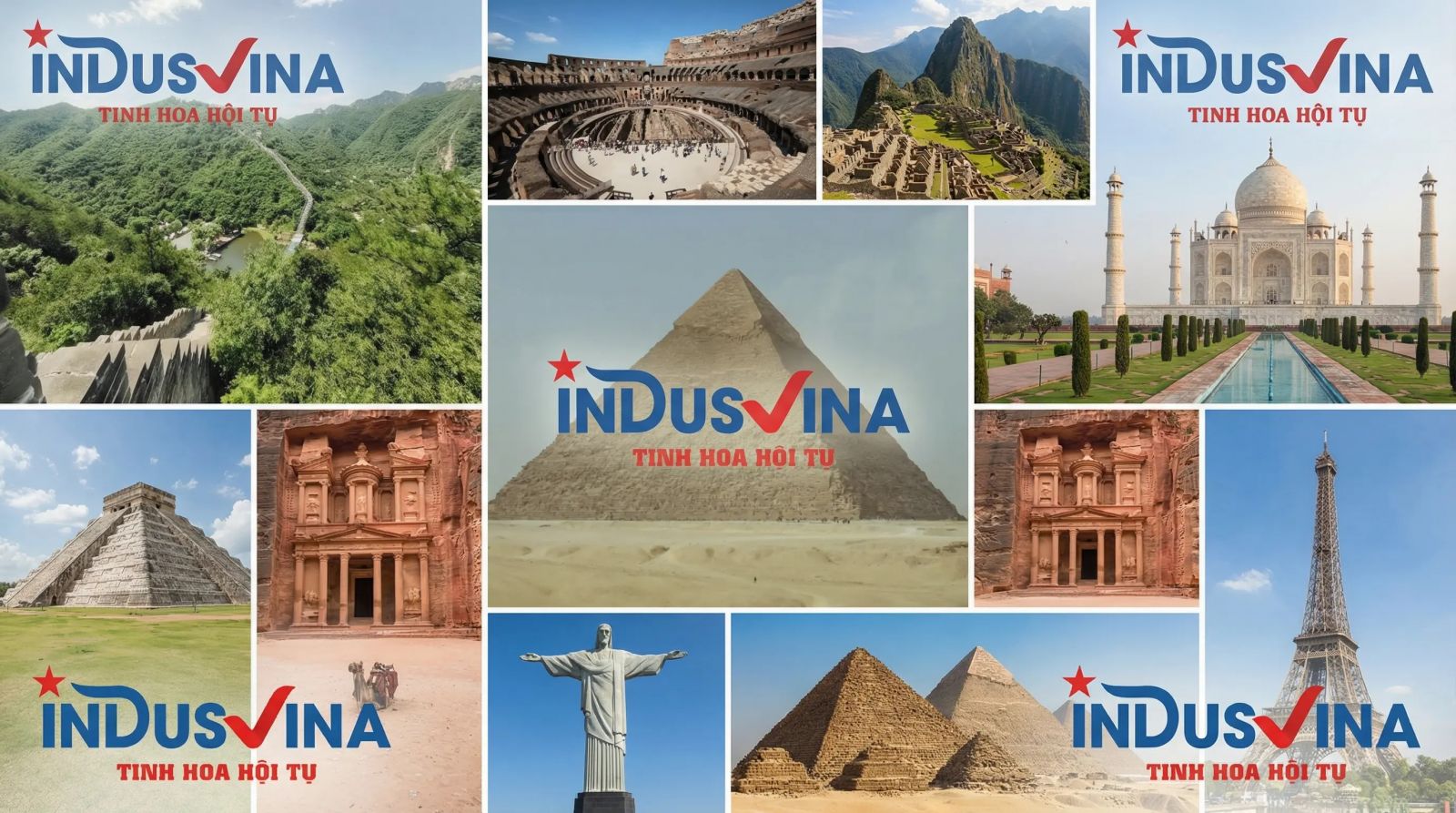
Ten monuments. Ten civilizations. Ten ways humans face the universe. From the Great Pyramid of Giza to the Eiffel Tower, from monolithic stone to industrial steel, humanity has not only built architecture—we have built life philosophies in material form.
All power is temporary. All status moves in cycles. Only the laws of nature—of the universe—are eternal.
I. 10 monuments – 10 stages in the evolution of power
- The Great Pyramid of Giza – Humans fear death and seek immortality.
- The Great Wall – A nation fears enemies and seeks defense.
- The Colosseum – Power fears the masses and seeks manipulation.
- Taj Mahal – Humans fear loss and seek to preserve emotion.
- Machu Picchu – A civilization understands it must live with nature.
- Petra – The will to carve oneself into stone.
- Angkor Wat – Faith becomes a system.
- Notre-Dame – Faith becomes light.
- Versailles – The ego of power reaches its peak.
- The Eiffel Tower – Engineering intelligence replaces every form of “divine right.”
Seen along the axis of time, one law becomes clear: power evolves—and then replaces itself. Theocracy is replaced by military rule. Military rule is challenged by civil power. Monarchy is abolished by revolution. Belief is tested by science. No one holds the summit forever.
II. The universal rule: go against natural law—and you will be replaced
Every monument on this list has witnessed the same truth:
- Egyptian dynasties declined.
- China’s empires rose and changed through cycles.
- Rome collapsed.
- The Mughal Empire faded.
- The Khmer Empire dissolved.
- France experienced revolution.
Yet the monuments remain. What does that tell us? Power does not endure. Only natural law endures. When humans become excessive—forcing nature, breaking balance, placing ego above truth— sooner or later the universe restores equilibrium. Not revenge. Not judgment. Just rebalancing.
III. The greatest mistake of the modern era
We think we are advanced. We think we are smarter than our ancestors. But in reality:
- We fight for oil and gas.
- We fight for gold and wealth.
- We fight for resources.
- We fight for power.
- We fight for domination.
And we fall into the illusion: “Only I can do it.” That is the greatest forgetting: humans are only part of the ecosystem; businesses are part of the market; nations are part of the planet; humanity is part of the universe. When we forget that, conflict begins.
IV. 10 wonders – 10 mirrors for today
- The Pyramid reminds us: do not fear death—live meaningfully.
- The Great Wall reminds us: defense matters, but do not build walls inside your mind.
- The Colosseum reminds us: do not let entertainment replace thinking.
- Taj Mahal reminds us: emotion can create beauty—if ambition does not distort it.
- Machu Picchu reminds us: growth that destroys nature is self-destruction.
- Petra reminds us: to endure, take responsibility for every “chisel strike.”
- Angkor reminds us: systems are stronger than individuals.
- Notre-Dame reminds us: spiritual light matters more than material wealth.
- Versailles reminds us: an inflated ego leads to collapse.
- The Eiffel Tower reminds us: only real capability stands firm.
V. Everything follows the natural science of the universe
The universe is not biased. There is no permanent privilege. Every system follows: Birth – Growth – Peak – Decline – End, and Increase – Overload – Imbalance – Correction. When a person, business, or nation accumulates too much, dominates too much, consumes beyond regeneration— the rule activates automatically. Not because of someone, but because of natural law.
VI. A message for future generations
These wonders are not only for tourism. They are messages carved in stone, steel, and light: Do not imagine you are the center of the universe. Do not think power is eternal. Do not assume resources are unlimited. Do not forget: humans are part of creation.
If we reflect honestly, we can see ourselves in the Pyramid, our ambition in Versailles, our aspiration in the Eiffel Tower, and our humility in Machu Picchu.
VII. Conclusion – what remains after everything
After thousands of years, empires disappear. Kings disappear. Wealth disappears. What remains is: the monument and the lesson.
Perhaps the deepest message of the 10 wonders is this: Live and build in alignment with natural law. Because anything that goes against nature—sooner or later—will be replaced.
When we understand that, we fight less, we hallucinate less, we crave less, we seek domination less. Instead: build without destroying; grow without forcing; succeed without losing yourself. That is the greatest philosophy these monuments leave behind: awakening.
CTA – A sincere thank you from the INDUSVINA team
The INDUSVINA team sincerely thanks you for reading this article. To make the next articles better, we truly need your feedback and sharing.
This is an open knowledge-sharing series. We hope it can contribute—even in a small way—to the stronger development of society. If you find it helpful, please share it to spread the value, and kindly cite the source from indusvina.com as encouragement for the effort we put into collecting and writing this piece.
Once again, we sincerely thank you—with gratitude and respect.
Through these lessons, you may understand more deeply the endurance and evolution of humanity across eras, so we can live more beautifully, meaningfully, and gratefully. Please follow and visit Indusvina.com regularly.
Related articles: 10 masterpieces of human civilization Click to expand
- 1) Great Pyramid of Giza: The greatest wonder of ancient humanity
- 2) Great Wall: The most powerful monument in human history
- 3) Colosseum: Power manipulating mass emotions
- 4) Taj Mahal: The power of love and an immortal ego
- 5) Machu Picchu: When humans become one with nature
- 6) Petra: When humans carve themselves into eternity
- 7) Angkor Wat: When a civilization turns faith into architecture
- 8) Notre-Dame Paris: When humans turn faith into light
- 9) Palace of Versailles: When power turns architecture into an absolute declaration of ego
- 10) Eiffel Tower: When engineering becomes a symbol of civilization
EXPORT – Related series Click to expand
- Article 0: Do you want to know why import/export matters?
- Article 1: Vietnam rising
- Article 2: Vietnam—one of the world’s most FTA-connected countries
- Article 3: Vietnam and comprehensive strategic partnerships
- Article 4: Maritime advantage
- Article 5: Product diversity & tropical climate advantage
- Article 6: The global movement cycle
- Article 7: WHY IS THE WORLD LOOKING AT VIETNAM?
- Article 8: What Vietnam sells that the world needs
- Article 9: As an importer, why do you need to come to Vietnam?
- Article 10: Coming to Vietnam without knowing INDUSVINA—what are you missing?
- Article 11: Strategic triangle: Long Thanh Airport – Cai Mep Port – Can Gio Port
- Article 12: Global logistics must be restructured
MAINTENANCE & M&E – Related series Click to expand
- 1) Origin of INDUSVINA engineering philosophy (MRO is the soul)
- 2) Inspection – the foundation of effective maintenance
- 3) Preventive Maintenance – stopping failures before they happen
- 4) Predictive Maintenance
- 5) Managing maintenance people (not just machines)
- 6) Completing the electrical system – a special journey
CONSTRUCTION MANAGEMENT – Related series Click to expand
- 1) Summary of Vietnam Construction Law 2014 (amended 2020)
- 2) Expert perspective for project owners on project management
- 3) 5 project management process groups (PMBOK)
- 4) Learning project management from zero
- 5) The 4 core tasks of a project manager
- 6) Classifying construction works by grade
- 7) From site supervisor to project manager
- 8) Classification under Decree 06/2021
CIVIL • INFRASTRUCTURE • STEEL BUILDINGS – Related series Click to expand
- 1) Pile foundation method & QC checklist
- 2) Soft ground treatment & settlement monitoring
- 3) Prestressed concrete technology
- 4) Standard procedure for erecting pre-engineered steel buildings
- 5) Pre-engineered steel buildings – cost comparison
- 6) Green buildings – criteria & KPI measurement
- 7) Heat reduction solutions for factories
- 8) Metal deck slabs in steel buildings
- 9) Strip footing method – comparing 4 foundation types
CONSTRUCTION MATERIALS – Related series Click to expand
OCCUPATIONAL SAFETY – Related series Click to expand
13-ARTICLE SERIES ON CONSTRUCTION LAW Click to expand
- Article 1: Scope of regulation & subjects
- Article 2: Definitions & legal basis
- Article 3: Construction planning
- Article 4: Managing construction investment projects
- Article 5: Construction design
- Article 6: Construction permits
- Article 7: Contractor selection
- Article 8: Construction contracts—structure & common pitfalls
- Article 9: Execution management & quality management
- Article 10: Occupational safety in construction
- Article 11: Acceptance – handover – warranty – maintenance
- Article 12: Inspection – audit – violation handling
- Article 13: Key highlights of the 2020 amendments (current article)


